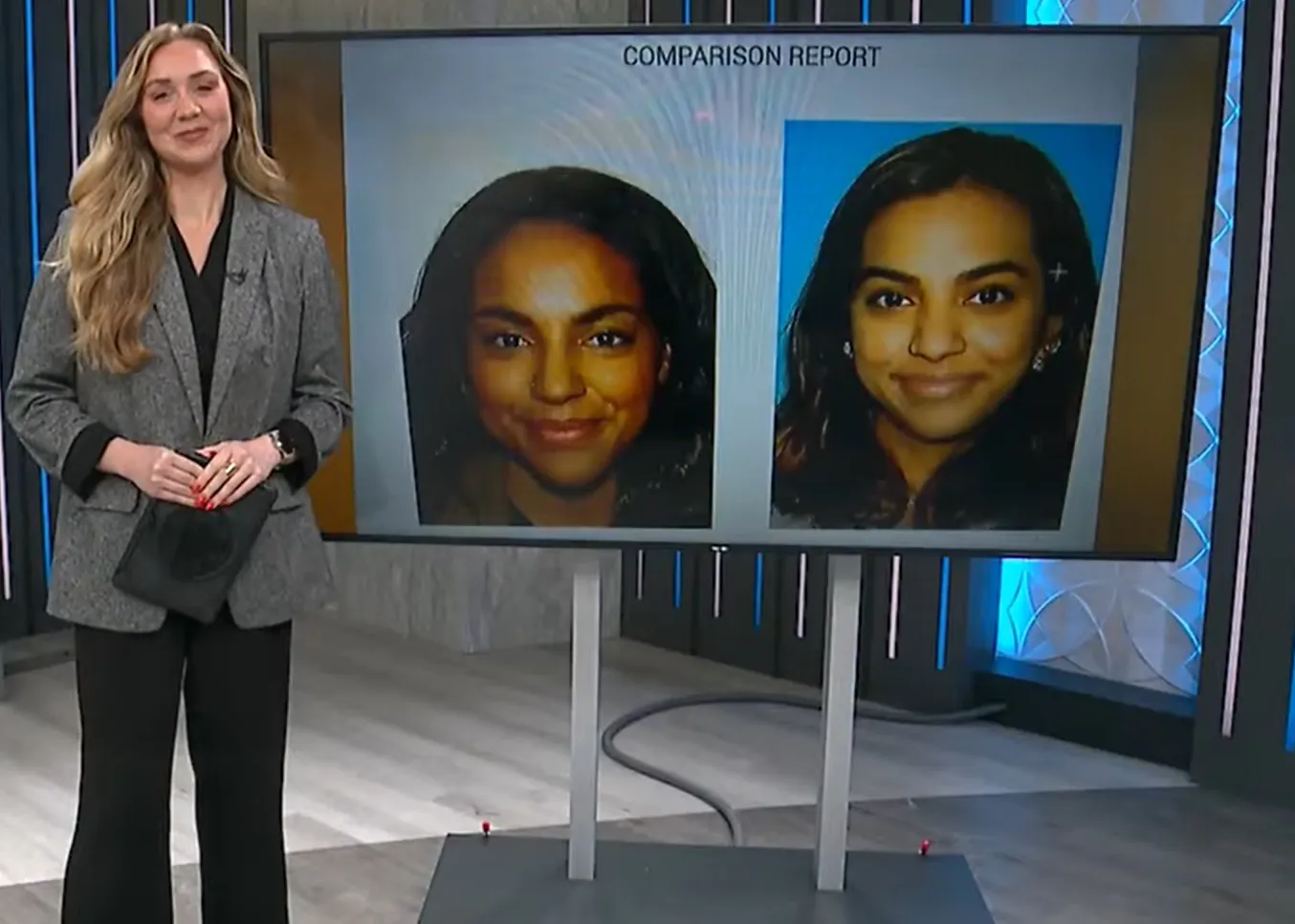
Most trips to the Indiana Bureau of Motor Vehicles (BMV), what most people would simply call the DMV, are about as exciting as watching paint dry. You wait in line, hand over your paperwork, smile for a photo you will immediately regret, and go home. For Erika Brown of Anderson, Indiana, however, what should have been a completely forgettable errand turned into something straight out of a science fiction movie, minus the flying cars.
Brown went in to renew her ID and walked out with more questions than answers, because Indiana’s facial recognition software decided she looked suspiciously like someone else entirely. Not a criminal. Not a fugitive. Just another woman, same age, different name, who happened to share Brown’s remarkably familiar face. The system flagged it as a potential fraud case, and suddenly Brown found herself fielding calls from fraud investigators instead of just picking up her new license.
An investigator from Fraud and Security Enforcement reached out, asking her to verify who she actually was before anything could move forward. During that process, the officer showed Brown a side-by-side comparison of two driver’s license photos. One was hers. The other belonged to a woman she had never met, who happened to live nearby and looked like she could have been her twin. Same age. Same general area. Completely different life.
It took three months of back-and-forth before Brown was finally cleared and issued her new license. But by that point, the question of who this mystery doppelganger was had taken over her brain entirely, and honestly, who could blame her?
She Took the Search to TikTok, Because of Course She Did

Brown did what any curious person with an unresolved mystery and a smartphone would do: she turned to social media. She posted about her experience on TikTok, hoping that the internet’s uncanny ability to connect strangers might help her track down this near-twin she had never known existed.
“What are the odds that we look so similar, live in the same place, and have never crossed paths?” she told local news station WXIN. The answer, apparently, is higher than you might think.
Her TikTok paid off almost immediately. Shortly after her interview aired, Brown revealed in a follow-up video that she had located her lookalike. She was understandably cautious about sharing details, noting that the woman had since moved out of Indiana and that she wanted to respect her privacy. “Just know that I found her and I reached out,” Brown said.
As for the big existential questions Brown was left sitting with, including what the woman’s family looks like, how genetics could produce two such similar strangers, and whether they share some distant ancestor no one has bothered to trace, those remain delightfully unanswered.
Being an Only Child Makes This Even Stranger
Brown noted that growing up as an only child made the whole experience feel particularly surreal. She had never had a sibling to compare herself to, never been told she looked like a cousin or a family friend. So seeing a stranger in a government photo who could have passed for her sister was, in her own words, “really strange and bizarre.”
There is actually a scientific basis for why unrelated people can look remarkably similar. Researchers have studied doppelgangers and found that a limited number of genetic variants control facial features. With billions of people on the planet, the combinations inevitably repeat. A 2022 study published in the journal Cell Reports found that unrelated look-alikes often share significant genetic similarities beyond just their appearance. So Brown and her BMV twin are not just a glitch in the matrix; they are a real, documented phenomenon.
That does not make it any less weird to see your own face staring back at you from a stranger’s driver’s license, but at least there is a reasonable explanation.
What This Story Says About Facial Recognition Technology
Here is where things get genuinely interesting, and a little bit worth paying attention to. Indiana’s BMV processes more than 500 cases like Brown’s every single year. That means hundreds of people annually are being flagged, investigated, and delayed because two unrelated individuals happen to share similar features.
Facial recognition technology has made enormous strides in accuracy, but it is not infallible. The very thing that makes it useful, spotting matches between photos, is also what creates situations like Brown’s. The system is designed to catch fraud, and it does catch fraud. But it also occasionally catches two women who just happen to have the same bone structure and had the poor luck to apply for IDs in the same state.
For most people caught up in the process, the delay is a frustrating inconvenience. For others, particularly those who rely on their ID for work, housing applications, or travel, a three-month resolution timeline can create real problems. Brown’s case ended well, but it raises fair questions about how these systems handle false positives and how quickly agencies can move when an innocent person gets caught in the net.
What We Can Learn From Erika Brown’s Accidental Adventure

First, do not wait until the last minute to renew your license. If you get flagged, three months goes by fast, and DMVs are rarely sympathetic to deadlines you created for yourself.
Second, facial recognition at government agencies is more widespread and more actively used than most people realize. If you have ever wondered whether those ID photos are just sitting in a database somewhere, the answer is yes, and they are being cross-referenced regularly.
Third, doppelgangers are real, they live near you, and they are apparently getting driver’s licenses. The odds of sharing a state, an age, and a face with a complete stranger are low, but they are not zero. Indiana’s 500-plus annual cases prove that.
And finally, if you ever find yourself in a situation this bizarre, TikTok is apparently a surprisingly efficient investigative tool. Brown found her answer faster online than she did through any official channel, which says something about either the internet or government bureaucracy, and possibly both.