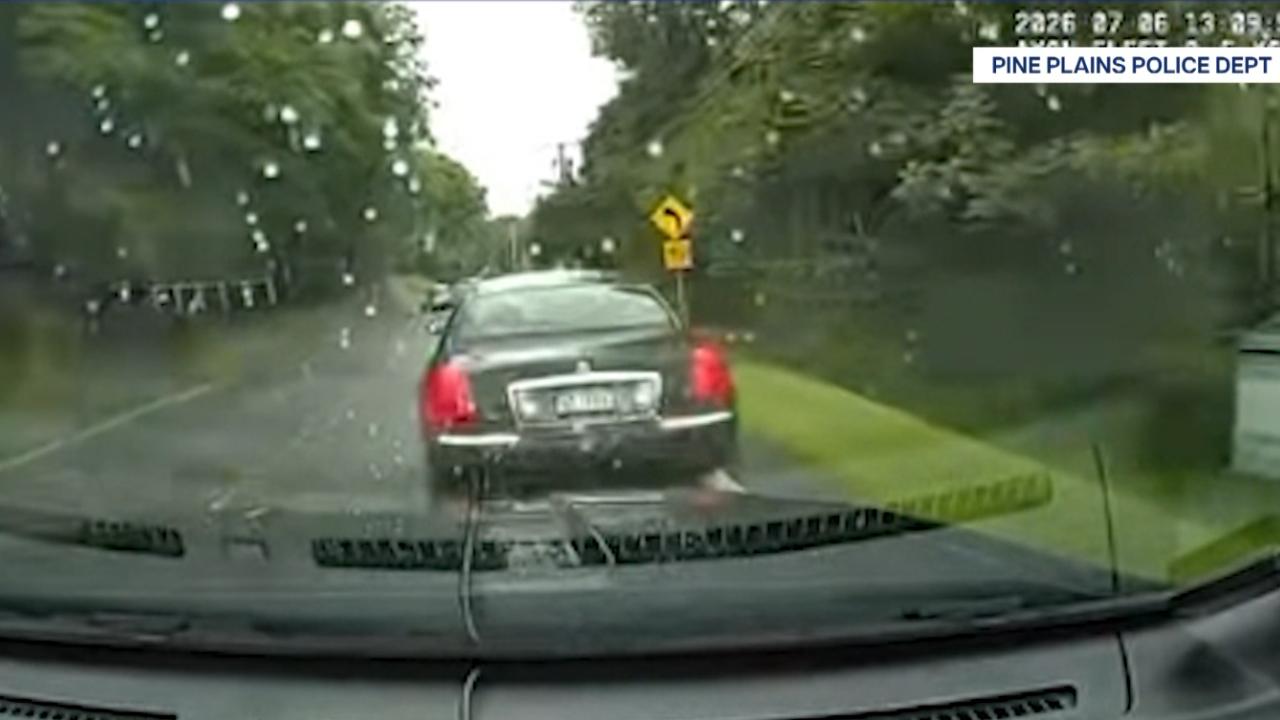
A Pine Plains, New York, police officer has resigned after newly released dashcam footage showed his cruiser rear-ending a stopped car on Route 199, a crash that injured two officers. The collision happened on July 6 at about 1:14 p.m. near the intersection of Lake Road and Stissing Mountain Road in Dutchess County, according to the Hudson Valley Post. New York State Police took over the investigation at the Pine Plains department’s request.
Officer Brian Johnson, a relatively new officer who graduated from the police academy recently and is currently in his field training phase, was driving patrol unit 7K165 westbound on Route 199 as Officer Aaron Fantroy sat in the front passenger seat. Ahead of Johnson and Fantroy, a 2003 Lincoln driven by George H. Hill, 66, of Pine Plains, had come to a complete stop in the westbound lane. Hill was stopping to let oncoming traffic pass before turning left.
The cruiser struck the rear of Hill’s Lincoln, causing damage to both cars. Johnson stated that when he looked over to check if there was traffic in the right lane, he could not see that Hill’s car had come to a stop prior to impact. State Police reviewed dashboard camera footage from Johnson’s cruiser and confirmed his version of events by what they observed. State Police said the video shows Hill had activated his brake lights and turn signals prior to the rear-end impact.
Both Johnson and Fantroy suffered injuries, but neither injury was serious enough to be life-threatening. One officer with the Pine Plains Police Department was taken to Albany Medical Center, while the second officer was treated for minor injuries and then released. Hill was uninjured and declined medical treatment at the scene.
What the Investigation Found
Pine Plains Police leadership asked the New York State Police to take over the crash investigation, and the department also opened its own internal administrative review. Investigators determined Johnson was not under the influence of alcohol or drugs at the time of the crash. A review of body-worn camera footage found no evidence that he had been distracted by a cell phone or the in-car laptop right before the collision.
The dashcam footage reviewed by both agencies matched what Johnson told investigators. Hill had done nothing wrong: his brake lights and turn signal were on, and he was lawfully stopped to make a left turn when the cruiser hit him from behind. Johnson resigned from the department following the crash. He had still been in his department-mandated field training at the time.
Why Rear-End Crashes Fall on the Trailing Driver
In almost every rear-end collision, the driver who hits the vehicle in front is presumed at fault, because drivers are required to keep enough following distance and enough attention to stop safely for whatever is ahead. A stopped car waiting to turn is a normal, foreseeable road condition, so failing to notice it in time generally leaves the trailing driver responsible, regardless of occupation. A police cruiser gets no special exemption when it is not running lights and sirens for an emergency.
The detail that Johnson said he was scanning the shoulder points to a common cause of these crashes: attention being drawn away from the road ahead. Patrol work can pull an officer’s eyes toward the roadside, but the vehicle directly in front remains the immediate hazard. Departments train officers to manage that split of attention, which is one reason the crash prompted both an internal review and an outside investigation rather than being treated as a routine fender-bender.