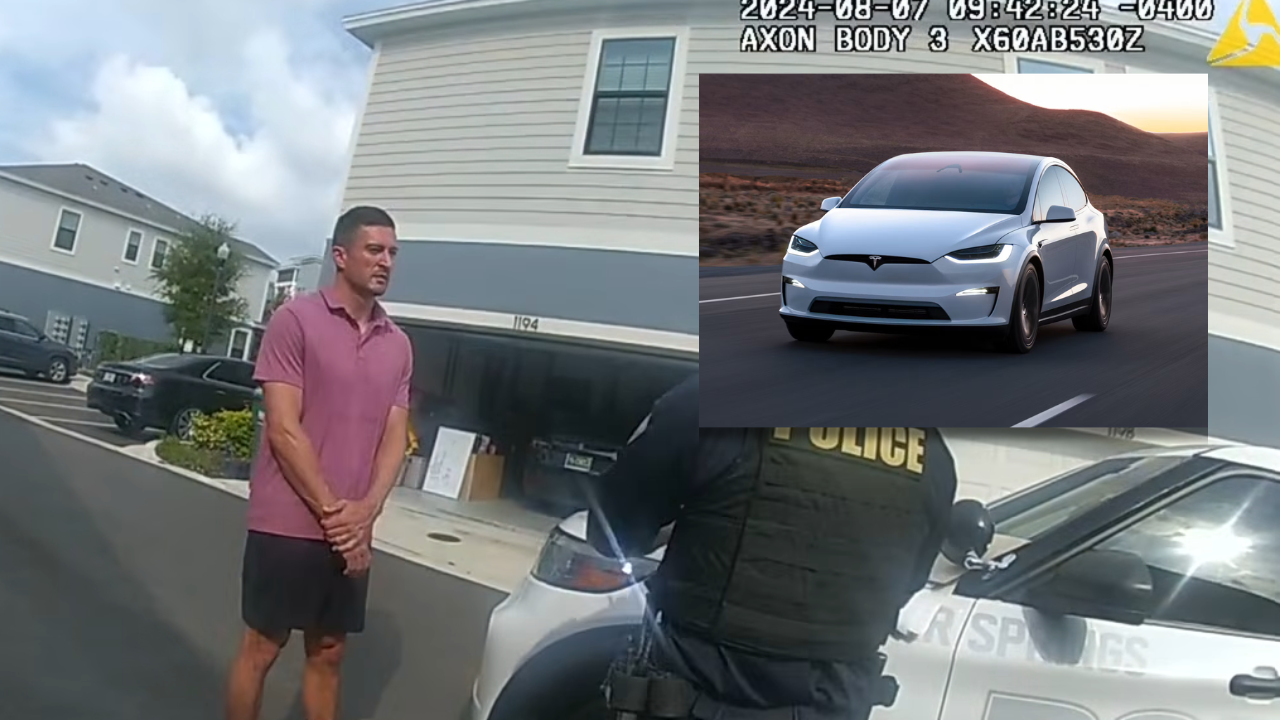
A Florida Tesla owner confronted at gunpoint outside his own garage spent nearly two years fighting a criminal reckless driving charge. In July 2026, a Seminole County judge acquitted him after his defense presented footage recorded by the car.
Kevin Finley was returning home in Winter Springs when a police officer accused him of fleeing an attempted traffic stop. Finley maintained that he had never seen the patrol vehicle following him, and the encounter ended with four citations, including a criminal misdemeanor carrying potential jail time.
The officer’s description of Finley’s driving would eventually face scrutiny in court, where prosecutors argued that his maneuver endangered other motorists. The judge initially allowed the criminal case to proceed, then reconsidered after watching the Tesla footage and hearing Finley’s testimony.
The August 2024 confrontation has attracted renewed attention following an October 16 video from The Civil Rights Lawyer, featuring police body-camera recordings, an extended interview with Finley, and details from the recently concluded trial.
A Turn That Escalated
Embedded media follows; please allow a moment for it to load.
The encounter began near State Road 434 and Michael Blake Boulevard, where newly installed traffic signals had not yet been activated. With the lights covered and traffic moving continuously through the intersection, drivers waiting to turn left had to find openings in oncoming traffic.
Finley testified that a vehicle ahead of him had moved toward the median and appeared to be preparing for a U-turn. After watching several opportunities to turn pass without the other driver moving, he proceeded around the vehicle and turned left onto Michael Blake Boulevard.
Winter Springs Police Officer Erik Schwartz, waiting on the opposite side of the intersection, described a more dangerous maneuver. He testified that Finley passed multiple vehicles from a through lane, forced oncoming motorists to brake, and accelerated rapidly enough for his Tesla to begin fishtailing.
Schwartz estimated that the car subsequently reached at least 40 mph on Michael Blake Boulevard, where the posted limit was 25 mph. He activated his emergency lights and siren, turned around, and attempted to catch up.
By the time the officer reached Finley’s neighborhood, the Tesla was entering a garage. Finley testified that he had not seen the patrol vehicle or realized anyone was attempting to stop him. Hearing sirens outside after closing the garage door, he reopened it to investigate.
Body-camera footage shows Schwartz drawing his firearm, ordering Finley outside, directing him to his knees, and placing him in handcuffs. The driver complied while repeatedly insisting that he had never seen the officer following him.
Four Citations and a Camera
As additional officers arrived, the recordings captured discussions about whether Finley’s driving constituted felony fleeing or warranted traffic citations. Schwartz maintained that the driver must have seen his emergency lights, while Finley continued explaining that he had simply returned home.
The officer ultimately issued four citations. According to Seminole County court records, they involved criminal reckless driving, improper passing, failure to yield to an emergency vehicle, and operating a vehicle with an expired registration.
Despite the accusations made during the confrontation, Finley was never charged with felony fleeing and eluding. Florida law requires a driver to knowingly and willfully disregard an officer’s order to stop for the basic fleeing offense. Finley maintained that he could not have deliberately ignored a patrol car he never realized was pursuing him.
He also told officers that his Tesla recorded its surroundings. Once released, he immediately retrieved the storage device, concerned that continued recording could overwrite the footage, and transferred its contents to his computer.
The patrol vehicle, meanwhile, lacked a dashboard camera. Although Schwartz’s body camera recorded the pursuit and confrontation, it did not provide the same view of the original turn, leaving the officer’s observations and Finley’s account to be examined against the Tesla recording.
Two Accounts Under Oath
The competing descriptions remained central when the case reached trial on July 16, 2026, before Seminole County Judge Debra Krause.
Schwartz testified that Finley had bypassed multiple vehicles, entered the intersection from a through lane, and caused oncoming drivers to brake to avoid a collision. He also stood by his earlier sworn description of the Tesla losing traction during the turn.
Finley disputed the number of vehicles involved and insisted that he remained within the turning lane and median. He said no other motorists had to brake or swerve, denied that the car fishtailed, and maintained that he had enough room to complete the maneuver safely.
Prosecutor Chaerim Lee questioned Finley about the acceleration capabilities of his dual-motor Tesla Model 3 Long Range, although the testimony established no measured acceleration rate during the encounter. Officer Vincent Maine, who had responded as backup, acknowledged that he had neither witnessed the driving nor reviewed footage of the original maneuver.
After prosecutors rested their case, defense attorney Ethan Carlos moved for a judgment of acquittal, citing Florida appellate decisions distinguishing improper traffic maneuvers from criminal recklessness. Among them was Berube v. State, a 2008 decision involving an improper left turn across oncoming traffic.
Krause initially denied the motion, finding enough evidence at that stage for jurors to consider the charge. The defense then called Finley to testify and introduced the Tesla recording, which prosecutors did not object to admitting.
Carlos renewed the motion after the defense rested, arguing that the video undermined Schwartz’s account and that the prosecution had failed to establish the willful or wanton disregard for safety required for criminal reckless driving.
The Judge Reconsiders
Krause granted the renewed motion, concluding that the evidence supported careless driving and possibly speeding, but fell short of the criminal standard under Florida’s reckless driving statute. A first conviction under that law can carry up to 90 days in jail.
“The officer’s testimony alone, I mean, would suffice to do a careless driving, but reckless, that is a much more elevated charge than that,” Krause explained.
Lee argued that the conflicting testimony and recordings presented factual questions for the jury. The judge nevertheless found insufficient evidence that Finley had intentionally, knowingly, or purposefully driven with disregard for the safety of people or property.
Jurors were released without returning a verdict.
An exchange after the ruling exposed a disagreement about the officer’s testimony. Krause recalled that Schwartz had described no braking, honking, swerving, or other evasive action by nearby motorists. Lee pointed out that he had testified that oncoming drivers applied their brakes to prevent a collision.
The prosecutor was correct about that portion of his testimony. Krause acknowledged that she had missed it, but the judgment of acquittal stood.
The Seminole County docket confirms that the reckless driving charge ended in acquittal on July 16, 2026. The judge also dismissed the expired-registration and failure-to-yield citations.
Finley entered a no-contest plea to improper passing, with adjudication withheld and a $300 fine. Court records show that he paid the amount in full that same day.
After the Criminal Case
In September 17 reporting, FOX 35 Orlando cited a statement from Winter Springs Police Chief Matt Tracht, who declined to address the specific case because of what he described as pending litigation.
Tracht explained that officers frequently have limited information about drivers’ intentions or potential weapons during traffic stops, with erratic or reckless driving increasing their concerns.
Finley has questioned the justification for the gunpoint confrontation. In his October interview with attorney John Bryan, he described the experience as frightening and said he became uncomfortable driving around police afterward.
He also reported submitting a seven-page complaint to the Winter Springs Police Department after his criminal case concluded. According to Finley, a lieutenant accepted the document but gave no definite answer about whether the department would respond.
By the time of the interview, he said he had heard nothing further. He was consulting attorneys about potential civil action but confirmed that no lawsuit had been filed.
Whether the department has investigated his complaint or reviewed Schwartz’s conduct remains unconfirmed.