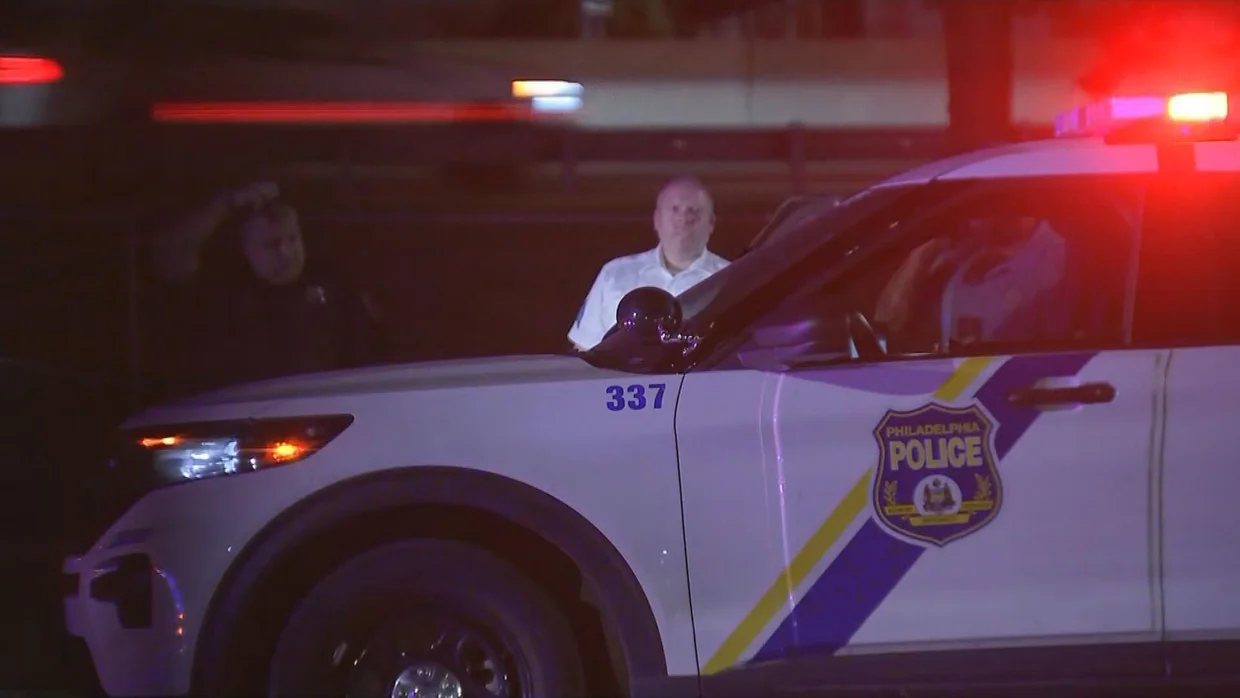
A Philadelphia police officer doing one of the more thankless jobs in law enforcement, standing in the middle of a chaotic post-game traffic surge so that tens of thousands of fans can get home safely, was struck by a vehicle Wednesday night near Citizens Bank Park. The officer was hurt, the driver stayed put, and the investigation is ongoing. It is the kind of incident that tends to get a brief mention in the news cycle before everyone moves on, but the circumstances deserve a closer look.
According to Philadelphia police, the collision occurred at approximately 9:20 p.m. at the intersection of Broad Street and Packer Avenue. That corner sits at the heart of South Philadelphia’s sports complex, a stretch of road that transforms into one of the busiest and most unpredictable traffic corridors in the region the moment a game lets out. On a Wednesday night with the Phillies playing at home, officers are routinely stationed there to manage the surge of vehicles, pedestrians, and general post-game disorder that descends on the area.
The officer was transported to a local hospital with a leg injury. Police confirmed the driver of the vehicle that struck the officer remained at the scene, which is at least one piece of reasonable news in an otherwise grim situation. What caused the driver to hit the officer remains unclear at this time, and no charges had been announced as of initial reports.
Directing traffic at a packed sports venue is a genuinely hazardous assignment that does not get enough attention. Officers stand exposed in active traffic lanes, relying almost entirely on other drivers to pay attention and respond appropriately. After a night game with a large crowd filtering out through a compressed street grid, the conditions are rarely ideal, and the margin for error is narrow.
Broad and Packer: One of Philadelphia’s Most Chaotic Post-Game Intersections
The intersection of Broad Street and Packer Avenue is essentially ground zero for post-event traffic in South Philadelphia. Citizens Bank Park, Lincoln Financial Field, and the Wells Fargo Center all sit within a few blocks of each other, which means that on busy sports nights the surrounding streets absorb an enormous volume of foot and vehicle traffic in a very short window of time.
Broad Street functions as a major north-south arterial through the city, and when thousands of cars are simultaneously trying to access it after a game, the intersection can become difficult to navigate even under ideal conditions.
Officers stationed at busy intersections like this one are not there for appearances. Their presence is intended to impose order on a situation that can deteriorate quickly when drivers get impatient, distracted, or simply fail to notice someone standing in the roadway. That last scenario is more common than most people realize.
The Risks Officers Face Directing Traffic Are Well-Documented
Traffic direction may not carry the same perception of danger as other police duties, but the statistics tell a different story. According to the National Law Enforcement Officers Memorial Fund, vehicle-related incidents consistently rank among the leading causes of officer fatalities in the United States. That category includes not just pursuit crashes and patrol vehicle accidents, but also officers struck while on foot in traffic control situations.
Busy post-event environments are particularly dangerous. Drivers exiting large venues are often navigating unfamiliar routes, watching for pedestrians in every direction, and sometimes dealing with reduced visibility in crowded urban settings.
Add in the distraction of mobile devices, the occasional driver who is impaired, and the general impatience that tends to build in standstill traffic, and you have a situation where a moment of inattention can have serious consequences for someone standing in the roadway.
Driver Remained on Scene, Investigation Underway
One notable detail from this incident is that the driver did not flee. In an era when hit-and-run incidents have become distressingly common, a driver who stays at the scene at least allows investigators to work with a full picture of what happened. Whether or not charges follow will depend on the findings of that investigation.
Philadelphia police have not released the identity of the driver or any details about the vehicle involved. The circumstances leading up to the collision, whether the driver failed to see the officer, misjudged the officer’s position, or experienced some mechanical or medical issue, have not been confirmed publicly. Those details will matter considerably when it comes to determining what, if any, legal consequences follow.
What This Incident Reflects About Post-Event Traffic Safety
This is not the first time an officer has been struck while managing traffic outside a Philadelphia sports venue, and it will not be the last unless the approach to post-event traffic management evolves in meaningful ways. Some cities have experimented with more aggressive pedestrian and vehicle separation, extended road closures around stadiums, or additional physical barriers to protect officers in traffic control positions. Whether Philadelphia’s approach to the sports complex corridor is due for a review is a question worth asking.
For now, the officer is receiving medical care, the driver is cooperating with investigators, and the intersection at Broad and Packer has gone quiet for the night. The Phillies continue their home schedule, and officers will be back at that same corner the next time the gates open.