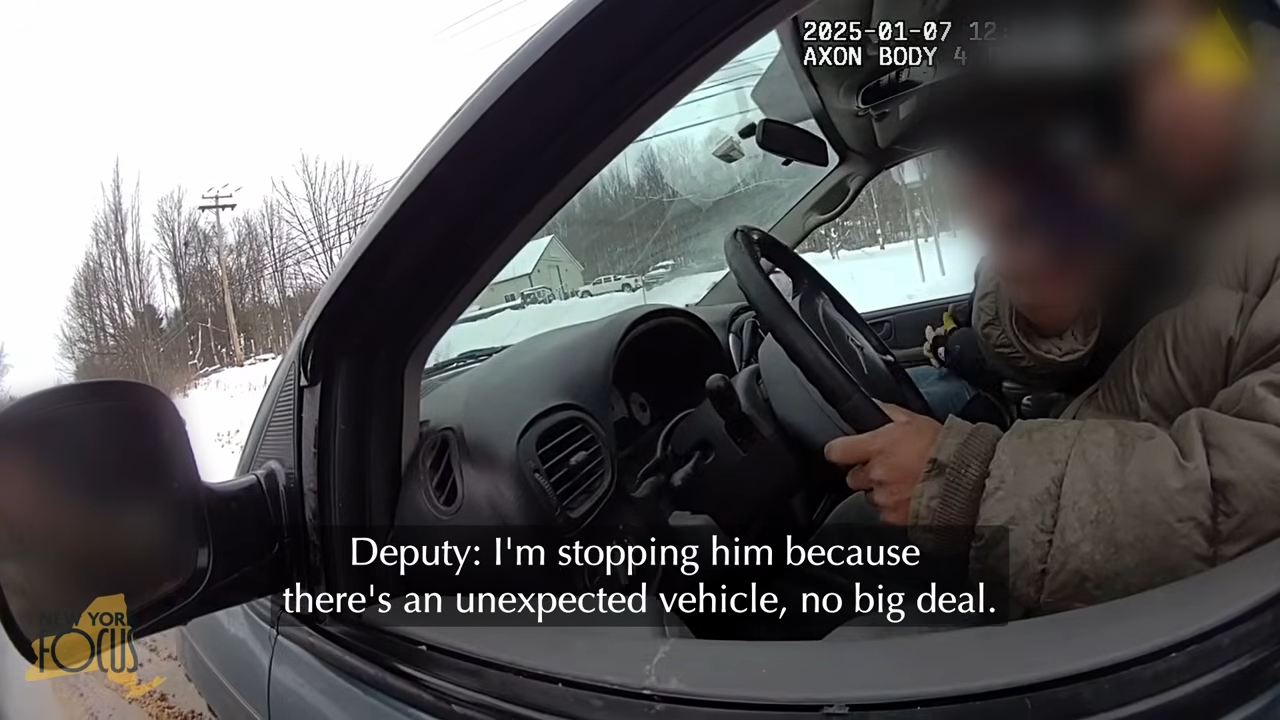
Body camera footage obtained through a public records request reveals a troubling pattern inside the Oswego County Sheriff’s Office, where deputies reportedly extended traffic stops far beyond what was legally necessary, sometimes waiting nearly an hour for federal immigration agents to show up. The footage, reviewed by New York Focus, captures one deputy identified as Officer Taylor pulling over a driver who only spoke Spanish, then calling a Border Patrol contact to run the man’s passport information over the phone. When agents could not immediately identify the driver in their system, Taylor did not let the car leave.
He waited.
The incident in Oswego County, located in north-central New York, is far from isolated. Between January and September of last year, deputies from the sheriff’s office made similar calls to Border Patrol at least a dozen times during traffic stops, according to the footage. At least eight people were arrested by immigration agents as a direct result of those calls. In some cases, agents were too far away to respond, meaning the outcome depended largely on geography rather than any legal standard.
What makes the footage particularly striking is how openly the deputy discussed his reasoning. When a fellow officer suggested calling ICE for translation help instead of waiting for Border Patrol to drive out, Taylor was clear: translation had nothing to do with it. “I am waiting because I don’t think they’re supposed to be here,” he said on camera. That candid admission is now at the center of an ongoing investigation by New York Attorney General Letitia James’s office, which requested records from the sheriff’s office last June.
The Oswego County Sheriff’s Office has not responded to requests for comment, and the attorney general’s office confirmed the investigation remains open. But the footage has reignited a debate that Albany has been struggling to resolve for years: exactly how much local law enforcement can cooperate with federal immigration authorities, and where the legal and ethical line falls.
What the Law Actually Says
New York does not have a comprehensive statewide ban on local police collaborating with federal immigration enforcement. However, a 2018 state appellate court ruling established that local officers cannot detain people for civil immigration violations without a judicial warrant. That ruling applies directly to traffic stop scenarios where police hold someone longer than necessary in order to let immigration agents arrive.
Attorney General James clarified this standard in a 2020 policy guidance, making plain that extending a traffic stop for immigration purposes, without a warrant, crosses a legal line. The body camera footage from Oswego County suggests that deputies either were unaware of that guidance or chose to disregard it. Taylor, in one instance, held the stopped vehicle for 45 minutes while waiting for Border Patrol agents to travel to the scene.
Ify Chikezie, a staff attorney at the New York Civil Liberties Union, put the legal standard simply: if someone should be free to go after a traffic stop is concluded, they must be allowed to leave. Speaking Spanish, appearing to be a person of color, or working as a day laborer does not provide legal grounds for extended detention.
“Translation” as a Pretext
One of the more telling aspects of the footage is how immigration involvement was sometimes framed. There are instances where the question of language barriers was raised, with officers suggesting that Border Patrol could help translate. Jennifer Connor, executive director of Justice for Migrant Families in Buffalo, said she has heard this framing used repeatedly in communities near the Canadian border over the past year and a half.
“Translation has always been a thinly veiled pretense to call immigration in a situation that does not warrant it,” Connor said. The Oswego footage seems to confirm that concern. Taylor himself waved off the translation framing entirely when speaking to a fellow deputy, making clear that his intent was immigration enforcement, not communication assistance.
The Border Patrol agent involved in the call also offered a window into how federal agents view these interactions. After arresting the two men, the agent told Taylor that having a traffic ticket on record was useful because it showed “there was a legitimate reason for running into them.” That kind of coordination, critics argue, amounts to an informal pipeline that funnels immigrants into deportation proceedings through routine traffic enforcement.
What We Can Learn From This Incident
The Oswego County situation illustrates something that immigrant rights advocates have argued for years: formal agreements between local police and immigration enforcement are not required for significant collaboration to happen. Oswego County does not have an official agreement with ICE. No memorandum of understanding was signed. Yet Border Patrol agents responded to deputy calls, arrested individuals, and coordinated with local officers in real time.
Governor Kathy Hochul has proposed limiting only formal agreements between local police and ICE, a position that advocates say misses the point entirely. “Local police departments maintain incredibly close working relationships with ICE and CBP officers and will go out of their way to funnel immigrant New Yorkers into the deportation pipeline,” said Zach Ahmad, senior policy counsel at the NYCLU.
The incident is also a reminder that body cameras, intended primarily as an accountability tool for use-of-force situations, can capture a much wider range of officer behavior. The footage from Oswego was obtained through a public records request, and it proved far more revealing than anyone in the sheriff’s office may have anticipated when the cameras were rolling.
The Bigger Albany Battle
Lawmakers in New York have been wrestling with how to address local and federal immigration cooperation for months. Progressive legislators have pushed for the New York for All Act, a sanctuary bill that would prohibit even informal cooperation between local law enforcement and federal immigration authorities unless agents present judicial warrants. The bill’s supporters say it is the only approach that would close the loophole that situations like Oswego County exploit.
Negotiations over a broader immigration compromise in Albany recently broke down, leaving the legal landscape largely unchanged for now. Until something changes at the state level, departments like the Oswego County Sheriff’s Office may continue operating in the gray area between state civil rights protections and federal immigration enforcement priorities.
The footage does not suggest a department operating in ignorance of those tensions. It suggests one operating with confidence that nobody would stop them.