The scariest thing at Dover Motor Speedway last week had nothing to do with cars going 150 miles per hour. It happened before a single engine was fired up.
During Friday setup ahead of the NASCAR Craftsman Truck Series race at Dover International Speedway in Delaware, a Spire Motorsports pit box broke free and began rolling downhill toward pit road, straight into a crowd of people. Among them: Fox Sports NASCAR reporter Amanda Busick. What followed next took less than a second, but it is already being called one of the most remarkable acts of selflessness the sport has ever seen on pit road.
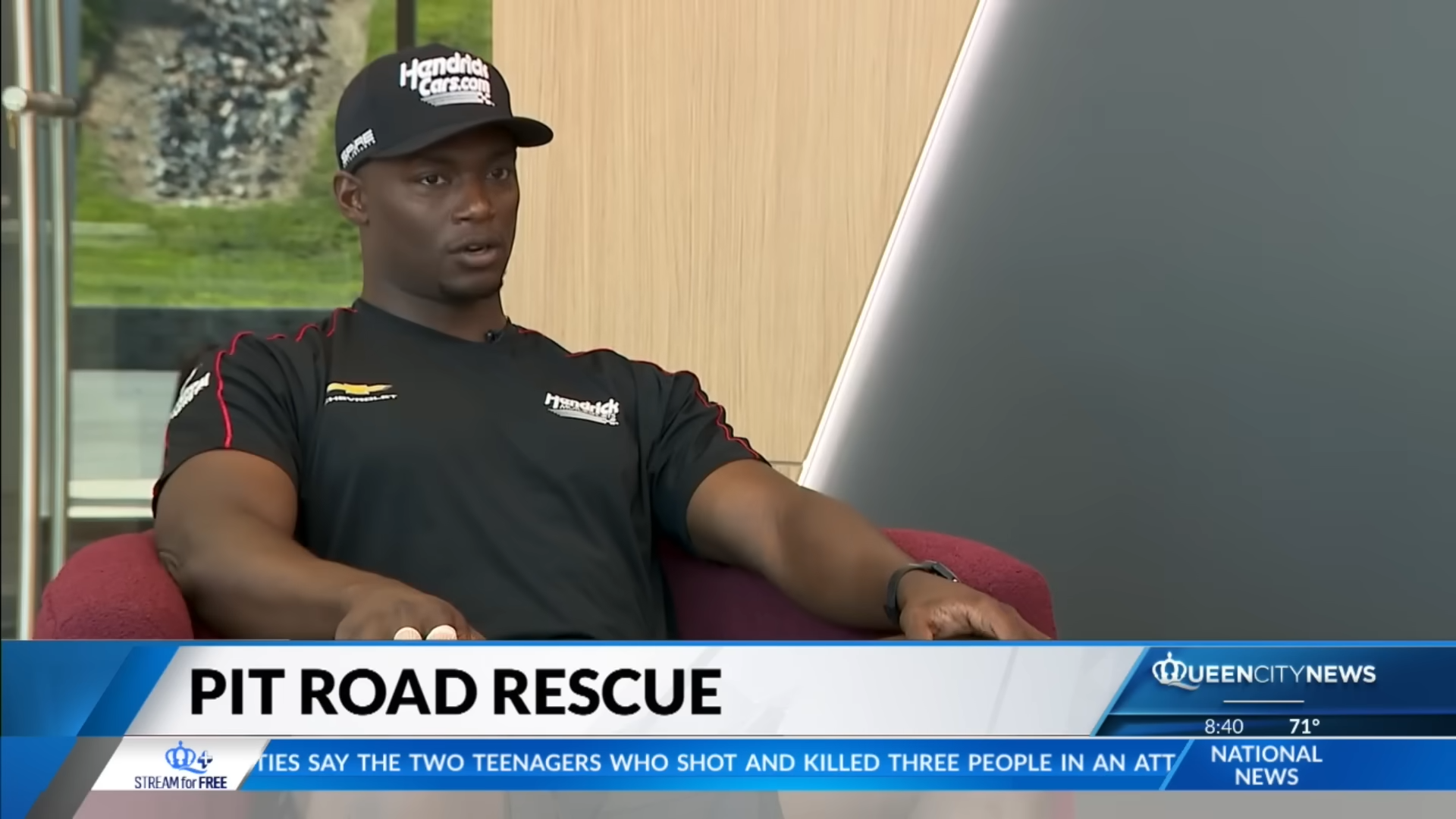
Donovan Williams, a tire carrier in his fourth season working NASCAR pit road who was affiliated with Hendrick Motorsports and carrying duties for Daniel Suarez’s No. 7 Spire Motorsports team, did not hesitate. He threw his body directly in front of the rolling cart, absorbing the impact himself and shielding Busick from what could have been a catastrophic collision. “It was definitely one of the scariest moments of my life,” Williams said after the incident.
The moment quickly went viral after FOX NASCAR posted the video to social media, and national attention followed fast. Now, more than a week later, Williams is recovering at home, Busick is back on the broadcast, and the two have formed an unexpected friendship born out of one terrifying afternoon on pit road. NASCAR officials, meanwhile, are reviewing pit road equipment protocols and safety procedures in the wake of the incident.
What Actually Happened When the Pit Box Went Rogue at Dover
Pit boxes are the massive, rolling equipment stations teams use to store tools, tires, and technology during a race weekend. They are heavy by design. This one weighed roughly 4,000 pounds. While being moved into position on the downward slope toward pit lane, the Spire Motorsports pit box lost control and began barreling toward the pit wall area, where crew members and media were gathered during setup for Truck Series qualifying.
People scattered. Williams did not.
He planted himself directly in the path of the cart and braced for impact, attempting to slow its momentum before it reached the crowd. The collision knocked both Williams and Busick to the ground, with the two being pushed somewhere between five and ten feet together before the cart ultimately struck some fencing and a stack of tires. Busick later described the moment as moving “in slow motion, but super-fast,” saying she could see Williams trying to brace the cart but that it had too much speed. “This all happened in probably less than half a second, maybe a second,” she said, per The Athletic.
Williams took the worst of it. He suffered a deep laceration to his right side that was severe enough to cause significant blood loss, along with serious road rash to his right hand. He was rushed to a local hospital where he was treated and released that same night. All X-rays came back negative.
The Former D1 Athlete Who Was Built for a Moment Like This
Spire crew member Donovan Williams was treated and released Saturday after suffering minor injuries while saving our own @AmandaBusick from a runaway pit box in Dover. pic.twitter.com/evWuZQMRWI
— FOX: NASCAR (@NASCARONFOX) May 16, 2026
Donovan Williams was not just in the right place at the right time. He was physically equipped to do something most people simply could not have.
Before he ever set foot on pit road, Williams was a Division I football player who competed at the University of Connecticut and later at Elon University. That athletic background matters in a sport where pit crew members are increasingly recruited from college and professional sports rosters. Pit crew roles, especially tire carriers, require explosive strength and the ability to move fast under pressure. It is less of a side job and more of a specialized athletic career.
Busick acknowledged as much when speaking about the incident. “Donovan is a former D1 athlete,” she said. “I wouldn’t have been able to take that cart head-on. It would have been a much different story for me if he had not been there.”
Williams himself reflected on those first few moments of awareness after the impact. “The first thing I am thinking of is my family and my career,” he said, noting that in the chaos he did not yet know the extent of his injuries. “I just remember feeling how much pain I was in, the amount of blood. I think my body went into shock just from all the trauma.”
A Hospital Visit That Turned Into a New Friendship
Perhaps one of the more touching parts of the story is what happened after the adrenaline wore off.
Busick visited Williams at the hospital following the incident, and the two have stayed in contact since. Williams described texting back and forth with Busick the night after, with her checking in on how he was feeling. His response was about as relatable as it gets: he told her he felt like he had just been hit by a football player. Which, in a sense, he had, except the football player was a 4,000-pound steel cart.
“She’s been amazing,” Williams said. “Coming by to see me, checking on me at the hospital, me and my family and some of my teammates were texting. She was asking how I was feeling.”
Busick echoed the sentiment on social media the following day, writing that she told Williams at the hospital she hated they had to meet that way, but that she was so grateful they did. “We both agreed what a reminder this is to never take any of it for granted,” she posted. “Can’t wait to hug you at a track again soon.”
The two have since joked that when they see each other next, it will hopefully be under far more normal circumstances. That is the kind of friendship you do not plan for, and apparently you do not need to.
What NASCAR and the Industry Can Learn From This Incident
The fact that this incident even happened raises questions worth asking out loud.
Pit road is one of the most densely packed, high-activity environments in all of sports. During race weekends, it is filled with crew members, media personnel, officials, and equipment, often moving simultaneously. The setup phase before qualifying or practice, while slower than an active race, still involves moving extremely heavy equipment through confined spaces on surfaces that are not always flat. The Dover incident happened on a downhill slope, which contributed directly to the cart gaining speed.
NASCAR officials have since confirmed they are reviewing pit road equipment protocols, safety procedures, and handling guidelines for large, heavy equipment to determine whether stricter rules are needed. That review is overdue. While NASCAR has made significant strides in pit road safety since introducing pit road speed limits in 1991 following a fatal incident at Atlanta, the focus of those improvements has largely centered on cars in motion, not equipment on the ground.
The broader lesson here is about the gap between structured race moments and the less-regulated setup windows around them. Williams was not mid-pit-stop. He was not reacting to a car coming in hot. He was standing near equipment being walked into position, and yet the danger was just as real. NASCAR’s safety culture is strong, but this incident is a reminder that the margins for error exist everywhere, not just when the green flag drops.
Support for Williams poured in from across the NASCAR garage following the incident, including from Hendrick Motorsports leadership. As for Williams himself, he says he is taking the recovery one day at a time, working with medical and training staff to heal and regain his mobility. He does not yet know when he will be back on pit road. His replacement, Andrew Egnarski, stepped in for Suarez’s team in the interim.
Whatever the timeline looks like, Williams is going back to a sport that now knows his name, and for all the right reasons.