Motorcyclists know the feeling all too well. You are riding along, minding your business, reading the road ahead the way experienced riders do, and in an instant something goes wrong that was never your fault to begin with. That split-second awareness that every rider develops over years of seat time is both a gift and a curse, because sometimes you see it coming and there is simply nothing you can do about it.
That is more or less what happened to Emile Modesitt, a 32-year-old co-founder of the rock climbing YouTube channel “Hoopers Beta,” on a Sunday evening in mid-May 2026. He was on his motorcycle, heading home to Encinitas along Old Highway 395 in Bonsall, California, after a day of riding. A vehicle driven by 48-year-old Patricia Cannon turned off Lilac Road and pulled out directly in front of him. Modesitt, by his own account, recognized the danger immediately and tried to react. Then everything went dark.
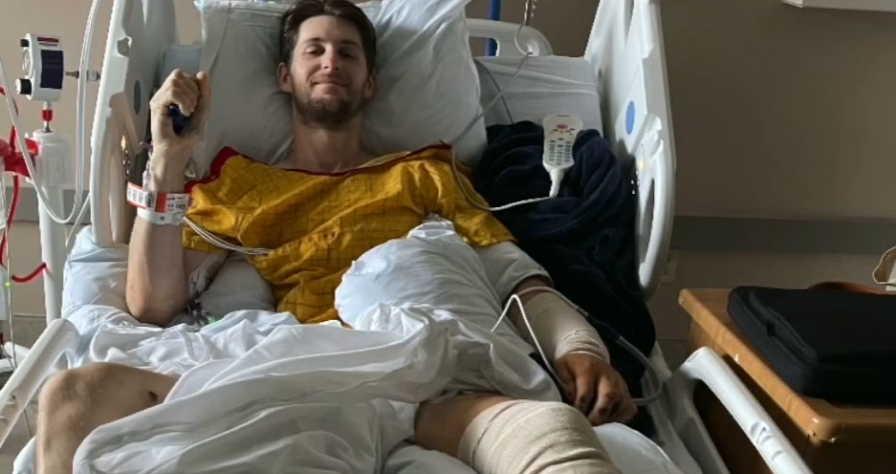
The crash threw him from his bike and deposited him under a guardrail. The injuries he sustained were serious by any measure: a fractured arm, a crushed pelvis, and leg trauma so severe that his left leg required amputation below the knee. He was transported to the hospital in critical condition. Cannon was subsequently arrested and charged with felony DUI.
What makes this story more than just a grim traffic report is what came after. Speaking from his hospital bed nearly two weeks later, Modesitt is not drowning in bitterness. He is already thinking about prosthetic designs, already leaning on the same mental discipline he built over 15 years of rock climbing, and already expressing gratitude that he still has, as he put it, his mind and most of his body. That is not the reaction most people would expect. It is, however, the reaction of someone who has spent a decade and a half learning how to fall and get back up.
What Happened on Old Highway 395
The sequence of events is unfortunately familiar to anyone who rides. Modesitt was traveling along Old Highway 395 when Cannon’s vehicle came out of Lilac Road fast enough that he immediately flagged it as a threat. His description of the moment, that his “rider brain” clocked the danger and he attempted to evade, is a textbook account of the kind of split-second risk assessment motorcyclists are trained to perform constantly.
The problem is that physics does not always cooperate, even when your instincts are sharp. At road speeds, there is only so much a rider can do when a car materializes in the path of travel with little to no warning. The crash was severe. Modesitt ended up pinned under a guardrail, and emergency responders transported him to the hospital with multiple traumatic injuries.
Cannon, the driver, faces felony DUI charges. The investigation is ongoing, but those charges indicate authorities believe she was impaired at the time of the collision.
A Motorcyclist’s Reality on California Roads
This crash is not an isolated incident, and experienced riders will not be surprised to hear it. California roads, particularly in rural North County San Diego, often mix high-speed arterial routes with intersecting side streets that create exactly the kind of T-intersection scenario that claimed Modesitt’s leg. The combination of impaired drivers, poor visibility at certain rural intersections, and the inherent vulnerability of motorcyclists makes these collisions a persistent and documented problem.
The National Highway Traffic Safety Administration has long noted that intersection-related crashes are among the leading causes of motorcycle fatalities and serious injuries in the United States. Drivers failing to yield the right of way to motorcycles, often because they do not see them or misjudge their speed, accounts for a significant portion of those incidents. Alcohol and other impairment only compound the problem dramatically.
For riders, the calculus is harsh. You can wear full gear, ride conservatively, maintain proper following distance, and do everything right, and still find yourself under a guardrail because someone else made a catastrophic decision before getting behind the wheel.
The Mental Side of Recovery
Modesitt’s attitude toward his situation is worth examining on its own terms. He acknowledged anger at the circumstances, and that is entirely reasonable. Losing a limb because someone else chose to drive impaired is not a minor inconvenience to process with a shrug. But he also spoke about not wanting to let that anger become the center of his recovery.
He credits rock climbing, specifically the long-term commitment and psychological resilience required to improve at a difficult sport over many years, with giving him a framework for facing what lies ahead. The sport demands patience, incremental progress, and the ability to fail repeatedly without abandoning the goal. Apparently, that translates. He is already thinking about the design of his prosthetic, approaching it like a problem to engineer rather than a tragedy to mourn.
His YouTube community responded with an outpouring of support that visibly moved him during his interview. The “Hoopers Beta” channel, which covers rock climbing training and injury recovery among other topics, has built an audience that apparently considers him more than a content creator. That kind of response does not happen for everyone, and he seemed genuinely caught off guard by the scale of it.
What This Means for the Driving and Riding Communities
For drivers, this is a straightforward reminder that the consequences of impaired driving do not stay contained to the impaired driver. Modesitt will spend the rest of his life adapting to the loss of his leg, undergoing further surgeries, and navigating the physical and logistical challenges that come with amputation, all because of a decision that Cannon allegedly made before she got into her vehicle.
For motorcyclists, there is not much comfort here beyond the solidarity of knowing that others understand the risk. Gear helps, training helps, awareness helps. None of it is a guarantee. What Modesitt’s response does offer, perhaps, is a model for how to keep going when the road deals you something you never could have anticipated. He is still here, still thinking, still planning the next climb.
A GoFundMe campaign has been established to assist Modesitt with medical expenses and related costs as he begins what will be a lengthy rehabilitation process.