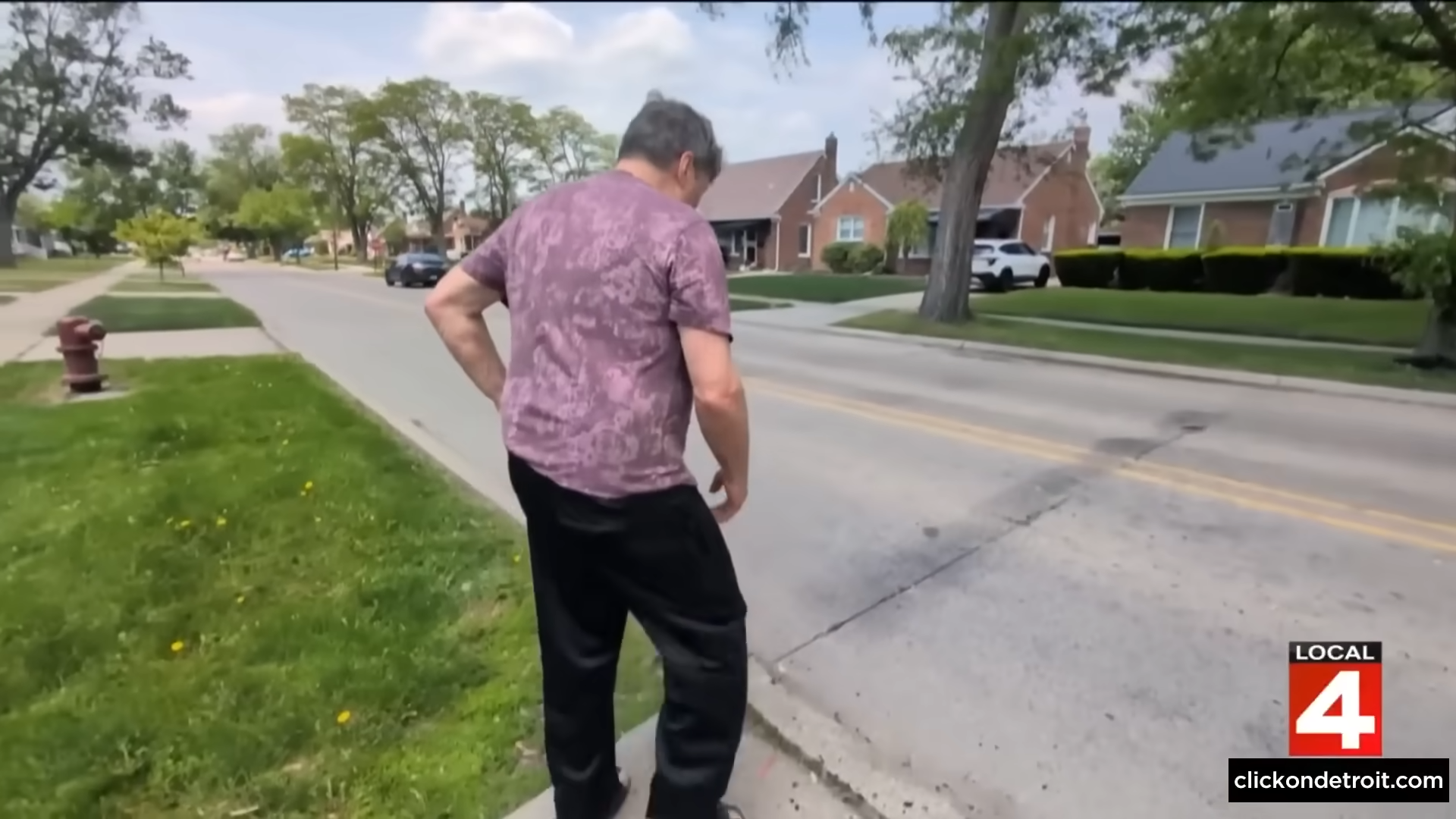
Most people who are fed up with speeders in their neighborhood complain to the city, maybe post in a Facebook group, or just shake their fist every time a car blows through the stop sign at 11 p.m. Dale Wells is not most people. The Lincoln Park, Michigan, resident grabbed a bag of asphalt, walked to the end of his street, and built his own speed bump right there on Moran Avenue. It lasted about as long as a gas station sushi roll.
Within minutes of Wells laying down the material on the evening of May 17, Lincoln Park police arrived and told him it had to come out. The officers cited safety concerns and made clear that residents do not get to unilaterally redesign public roads, even with good intentions. Wells complied but was clearly frustrated, telling reporters he had tried going through official channels before and felt like nothing was happening while drivers continued to race through the neighborhood without consequence.
What he left behind was a thin black stripe of asphalt across the road and a story that resonated with people far beyond suburban Detroit. Residential speeding is one of the most universal grievances in American neighborhoods, and Wells essentially did what thousands of people have wanted to do but never followed through on. That combination of relatability and pure “I cannot believe he actually did that” energy is exactly why the story spread the way it did.
The incident has sparked a broader conversation about who is responsible for keeping residential streets safe, how long residents should reasonably be expected to wait for the city to act, and whether the systems cities have in place to address speeding concerns are actually built to move at a speed that matches the urgency people feel when they watch cars fly past their kids playing outside.
What Dale Wells Was Up Against
Wells says he routinely watched drivers race down Moran Avenue and blow right through a nearby stop sign. “They run through that stop sign like crazy, especially at 10 o’clock at night,” he told reporters. “They see no lights and just keep going.” A reporter who covered the story used a radar gun on the road and clocked drivers exceeding the posted 25 mph speed limit.
Wells said he resorted to the DIY fix after feeling that previous calls to the city and police were going nowhere. His neighbor Raquel Diaz, a mother of two young children, told reporters her kids do not play out front precisely because of how people drive on the street. She summed up the whole situation with the kind of blunt clarity that only a tired parent can deliver: “Obviously a little crazy, but he’s not wrong.”
Why the City Told Him to Tear It Down
It would be easy to frame the police response as bureaucratic overreach, but there are real engineering reasons why random citizens are not allowed to install traffic control features on public roads whenever they feel like it.
A badly placed speed bump could damage cars, damage tires, create hazards for cyclists, block ambulances, or injure pedestrians. Traffic engineers do not guess where to put speed bumps. They evaluate factors like actual vehicle speeds, road width, proximity to intersections, and more before making changes.
There is also a technical distinction that matters here. According to the Federal Highway Administration, a speed bump is typically between one and two feet in length and up to six inches in height, which is why they are usually found in parking lots or commercial driveways, not on public roadways. A speed hump, the type designed for residential streets, is around 12 feet long and three to four inches tall. What Wells built, using a bag of store-bought asphalt, was likely closer to a bump than a hump and would have applied a significant jolt to vehicles at even low speeds.
What the City’s Process Actually Looks Like
According to Lincoln Park’s police chief, the city currently has no official speed bumps anywhere. Residents who want them installed need to file formal complaints with the police department. From there, officers can conduct a traffic study, determine whether speeding is a documented problem, and present their findings to the City Council for consideration. Residents can contact the police directly or by email.
That process is not unreasonable on paper. Traffic studies exist for good reason, and city councils are meant to allocate resources across many competing needs. But for a resident who has already been raising the alarm for an extended period, being told to submit a complaint and wait for a study understandably feels like being handed a pamphlet while the building is on fire.
Ironically, Wells may have accomplished something through the incident anyway. After the asphalt episode, police were seen monitoring traffic on Moran Avenue, which is exactly the kind of enforcement presence he had been asking for all along.
What This Incident Can Teach Us About Traffic Safety
Wells’ story is not just entertaining. It is a useful lens for understanding a problem that affects nearly every residential neighborhood in the country.
Transportation research has consistently found that road design plays a major role in driver behavior. Wide, straight roads with long sightlines naturally encourage higher speeds, often regardless of what the posted speed limit signs say. In other words, if a road feels like a highway, many drivers will unconsciously treat it like one.
When properly engineered speed humps are used in residential settings, research shows they can reduce average speeds by 20 to 25 percent between humps, with an average crash rate reduction of about 13 percent. That is a meaningful safety outcome, but it requires proper design and placement, not a bag of cold-patch asphalt applied to the road at 6 p.m. on a Sunday.
There are also tradeoffs worth knowing. Studies suggest that physical barriers like speed bumps can delay emergency response times for ambulances and fire trucks, and drivers will sometimes take alternate routes through other residential streets to avoid them, which can simply shift the problem rather than solve it.
The broader takeaway from the Wells situation is that individual frustration and systemic infrastructure planning are often working on completely different timelines, and that gap tends to produce exactly the kind of improvised, well-intentioned chaos that ends up on the local news. His heart was in the right place. His asphalt was not, at least not according to city code.
Whether Lincoln Park ultimately installs a proper speed hump on Moran Avenue remains to be seen. But it is a fair bet that local officials are paying closer attention to that street now than they were before Dale Wells and his bag of patch mix made headlines.