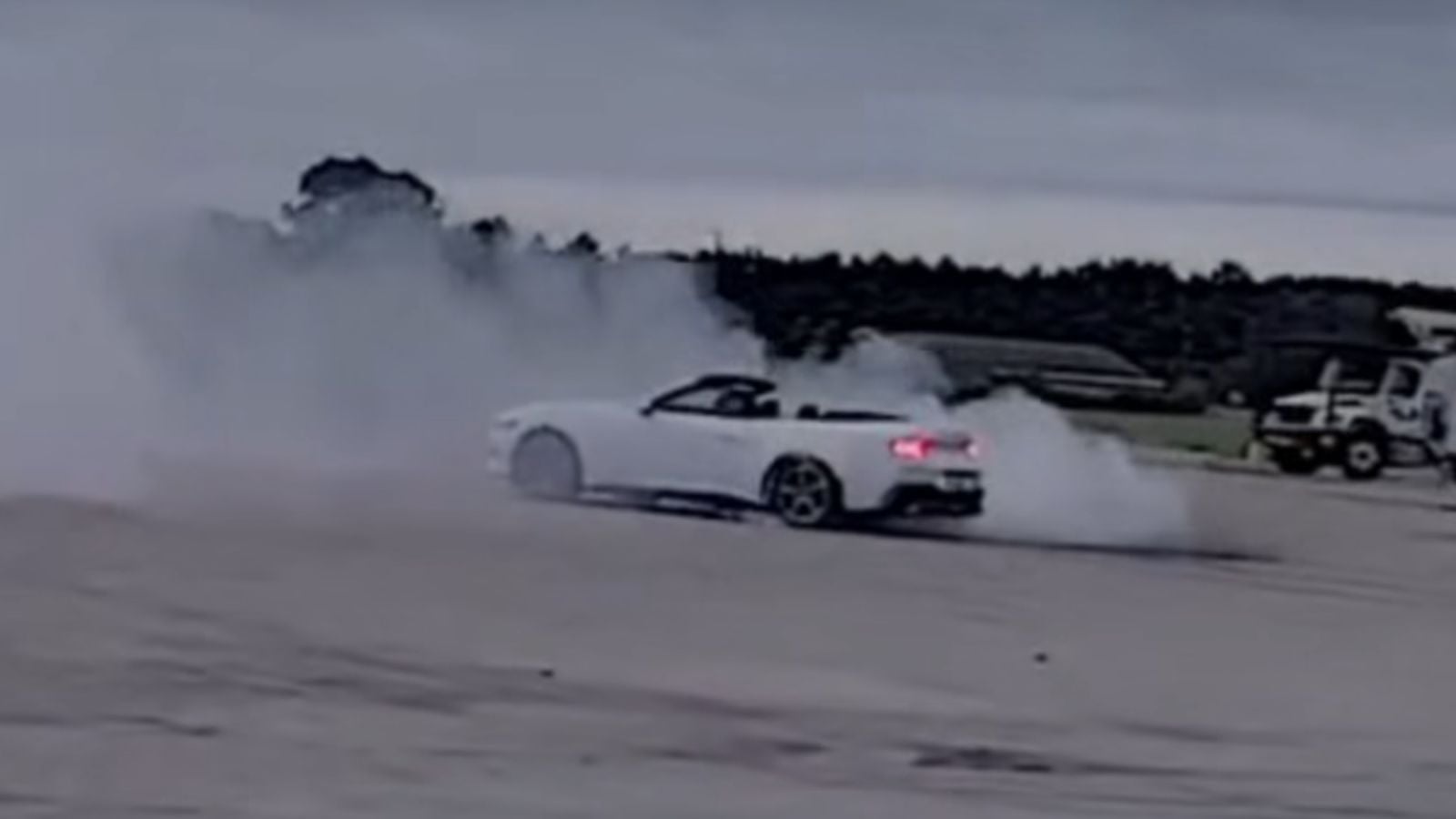
An overly excited man in Battle Creek, Michigan, appeared thrilled while being arrested after allegedly performing donuts in a newly purchased Ford Mustang. While he could end up losing the car and missing a planned first date, he also seemed convinced the arrest might help boost his social media following.
In a statement issued by the City of Battle Creek, authorities said the incident occurred on Sunday, June 14. At around 7:30 a.m., Jaylone Porter allegedly arrived at the West Columbia Avenue Meijer parking lot in a recently purchased 2024 Ford Mustang.
According to city officials, Porter began performing donuts in the parking lot just feet away from active fuel pumps. Authorities said the stunt was done in an attempt to generate social media attention.
Unfortunately for Porter, a Battle Creek police officer witnessed the activity firsthand and quickly intervened.
“This Is So Cool!”
Embedded video follows; please allow a moment for it to load.
As shown in the video above, Porter was unusually candid during the encounter. He immediately acknowledged what had happened and told officers he would take responsibility for his actions.
“I just woke up and felt like spinning ’em,” Porter said, according to the City of Battle Creek. Officials also said he explained that he “need[ed] a flick for [his] gram” in hopes of boosting his livestream audience.
Porter then appeared to embrace the situation, exclaiming, “This is so cool! I’m locked up!” According to the city, he even estimated that an arrest photo would bring him “at least 100 viewers.”
Date Night Takes a Hit
The conversation became even more memorable when Porter discussed his plans for later that day. According to the city, he had a first date scheduled in Ohio and quickly realized the arrest could complicate those plans.
Officials said Porter discussed alternative transportation options, including renting a vehicle or borrowing his father’s car. While the arrest may have provided content for social media, it also threatened to derail his evening plans.
Authorities also said Porter remarked that he was “not getting caught again” and discussed finding another location where he could continue performing similar stunts.
City Wants the Mustang
The incident has taken on added significance because Battle Creek has now filed what officials describe as the city’s first vehicle forfeiture lawsuit under its updated public nuisance ordinance.
Battle Creek Police Chief Shannon Bagley said he appreciated Porter’s “candor and cooperation” throughout the investigation. However, Bagley also noted that Porter’s own statements suggested he understood why officers intervened.
“When someone talks about not getting caught again and immediately begins looking for another place to do the same thing, it underscores why accountability matters,” Bagley said.
The City of Battle Creek is now asking a court to forfeit the Mustang under its reckless-driving provisions. If the request is granted, Porter could permanently lose a vehicle he had reportedly purchased only days before the incident.
Why Vehicle Forfeiture Cases Often Spark Debate
Vehicle forfeiture laws have long been controversial. Supporters argue they give authorities a powerful tool to remove dangerous drivers, disrupt criminal activity, and hold offenders accountable. Critics counter that, in some situations, the punishment can feel disproportionate to the underlying offense, particularly when a valuable asset is permanently taken over conduct that did not directly involve violence.
Over the years, several forfeiture cases have drawn national attention and fueled debate over where that line should be drawn. One example involved an Alaska pilot who is fighting to keep his aircraft after being accused of transporting beer into a dry village. Among car enthusiasts, forfeiture cases often generate attention when law enforcement agencies take possession of high-value performance vehicles. Many readers have likely seen photos of officers using forfeited cars for public outreach or enforcement efforts, including the widely discussed case involving a seized C8 Corvette in Suffolk County, New York.
A common misconception is that if law enforcement seizes a financed vehicle, the government agency, and ultimately taxpayers, becomes responsible for making the loan payments or paying off the remaining balance. Generally speaking, that is not how forfeiture works. A lender’s lien does not automatically prevent a forfeiture action, and the borrower’s loan obligation does not simply disappear because the vehicle was seized.
In most cases, lenders have a protected interest in the vehicle and can file claims to recover it or receive compensation from the proceeds if it is ultimately sold. The government does not typically assume the loan, and taxpayers do not end up making the monthly payments. If the vehicle is auctioned and the sale does not generate enough money to satisfy the outstanding balance, the borrower may still be responsible for the remaining debt.
As a result, vehicle forfeiture cases often generate discussion that extends far beyond the original incident. While some people view forfeiture as a necessary public safety tool, others see it as a punishment that can create consequences far greater than the offense that led to the seizure in the first place. In Porter’s case, the court will ultimately decide whether losing a nearly new Mustang is an appropriate consequence for the alleged stunt-driving incident.