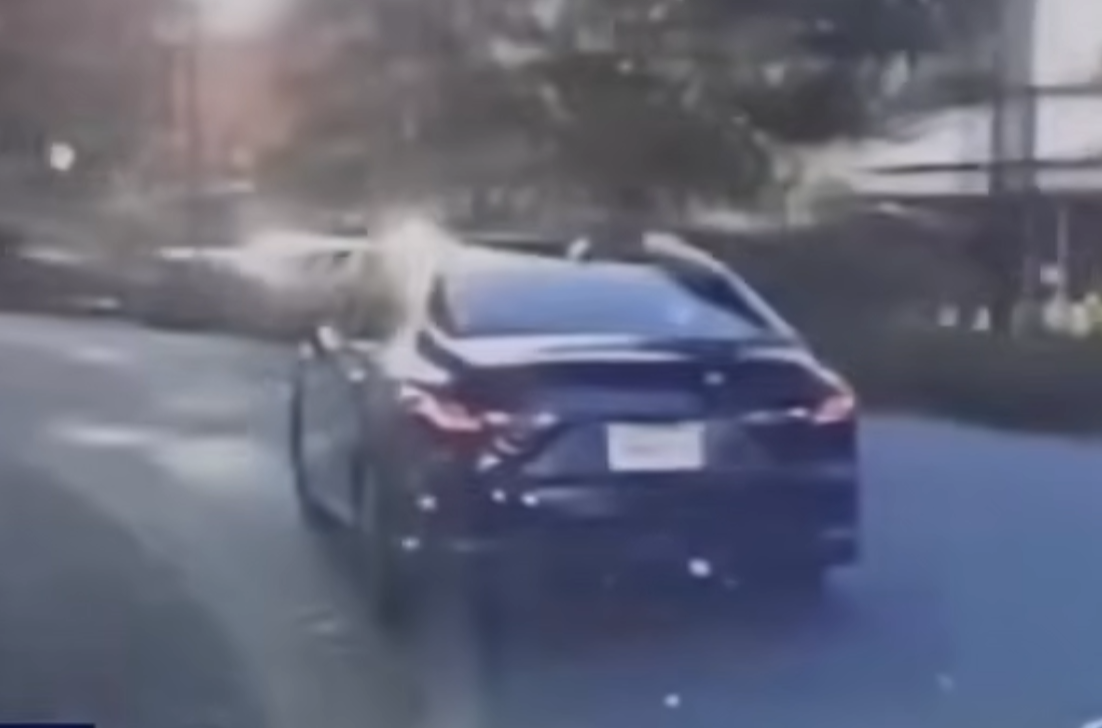
When a stolen car went flying through a Menlo Park neighborhood last Saturday, the driver probably thought he was in the clear. He was wrong. Not because officers outran him. Not because a helicopter was circling overhead. But because while he was busy flooring it, a GPS dart was already stuck to his car, quietly reporting his every move back to dispatch. Welcome to the era of the StarChase, the police pursuit gadget that basically says: go ahead, run — we’ll catch up.
Menlo Park police have been quietly using this technology since 2022, and last weekend’s car theft case gave the department one of its cleaner illustrations of how the system pays off. Officers spotted the stolen vehicle, deployed the tracker, and then — in a move that sounds almost counterintuitive for a police chase — backed off. No high-speed pursuit through residential streets. No screeching tires through school zones. Just calm, real-time GPS tracking until the car came to a stop in Berkeley, where officers from multiple agencies were waiting to make the arrest.
Inside the vehicle were three juveniles: two 15-year-olds and a 13-year-old. Also inside? A replica Glock 19. It is a sobering reminder that car theft is rarely just car theft, particularly when minors are involved and replica weapons are along for the ride. The case quickly became about more than a missing vehicle.
As police departments across California and the country wrestle with the dangers of high-speed pursuits, the Menlo Park case is drawing attention to a broader conversation about smarter, safer policing technology. StarChase is not new, but its growing adoption — and the very visible success stories that come with it — is prompting departments to take a harder look at what modern pursuit management can actually look like.
What Is StarChase and How Does It Work?
StarChase is a pursuit management system built around a deceptively simple concept: if you can tag a fleeing vehicle with a GPS tracker, you no longer need to chase it. The system uses a compressed-air launcher mounted behind the grille of a police cruiser. The launcher uses a laser to target the fleeing vehicle and fires a projectile containing a miniature GPS module, which adheres to the suspect’s car and transmits coordinates back to dispatch.
In real-time, on a secure web-based mapping portal, the tagged vehicle’s location and movements can be tracked. Officers can pull back from the unfolding situation and choose to monitor from a safe distance. An offender who thinks they are no longer being pursued can then be safely apprehended.
The tracker relays real-time data including speed, distance, and direction, making the overall operation more efficient and far less dangerous than a traditional pursuit. Officers can fire the tag remotely with the touch of a button from inside the patrol vehicle, or using a supplied key fob. There are two tags per launcher, so officers get more than one shot — literally — at making it stick.
According to StarChase, the technology has been in use for over a decade and has a record of zero injuries or fatalities associated with its deployments. That is not a statistic most policing tools can boast.
The Menlo Park Case: How It Unfolded
Officers spotted the stolen vehicle on Saturday and moved quickly. Video released by the Menlo Park Police Department shows officers pursuing the vehicle before deploying the StarChase system, which attaches to a suspect’s car and allows officers to monitor its location.
Once the tracker stuck, officers did something that goes against every instinct a pursuit-trained cop probably has: they eased off. The stolen car made its way to Berkeley — perhaps the driver feeling increasingly confident he had shaken his tail — and that is where the arrest went down. Multiple agencies, including Menlo Park, were involved in taking the occupants into custody.
The driver now faces charges of felony reckless evading and possession of a stolen vehicle. The two 15-year-olds and 13-year-old were also arrested. The presence of a replica firearm, while not a real weapon, adds a layer of seriousness to a case that might otherwise be categorized as a juvenile prank gone too far.
Menlo Park Sgt. Allen Swanson has spoken about the department’s approach to the technology, noting its value is not just tactical but ethical. StarChase president Trevor Fischbach, based in Virginia Beach, has said the technology was designed to allow law enforcement to de-escalate potentially risky events for themselves, for the public, and for the suspects themselves. In a case involving three teenagers, that framing feels particularly relevant.
Not Every Department Is Sold — And That Is Worth Talking About
For all its appeal, StarChase is not a perfect tool, and not every agency that has tried it has stuck with it. Oakland police dropped the technology entirely, citing a lack of consistent use and limited success in actual deployments. Privacy advocates have also flagged concerns. In one example noted by privacy advocate Brian Hoer, suspects or passengers physically detected the tracker after deployment and simply removed it from the vehicle before driving away — effectively defeating the system on the spot.
Menlo Park officers acknowledge the challenges freely. The department reports a 60% success rate when it comes to getting the trackers to stick to a fleeing vehicle. That means four out of ten deployments may not work as intended — a meaningful failure rate for a device that costs money per tag and is supposed to be a viable alternative to a dangerous pursuit.
In Moraine, Ohio, police who adopted StarChase reported that the technology significantly reduced their pursuit miles and time in the field in a short period of use, suggesting that when the conditions are right, the results can be substantial. The key phrase is “when the conditions are right.” Surface type, vehicle speed, and deployment angle can all affect whether the adhesive and magnetic tag connects cleanly.
What This Case Teaches Us About the Future of Police Pursuits
High-speed police chases are one of the most reliably dangerous activities in law enforcement. Bystanders, officers, and suspects alike face serious risks every time a pursuit spills onto public roads. Technology like StarChase does not eliminate that risk, but it changes the equation in meaningful ways.
As one Washington state police sergeant put it, the technology is safer for everyone — the officer does not have to engage in a full pursuit, there is less concern about erratic driving from the fleeing suspect, and the situation can resolve more quietly and more safely from a distance.
The Menlo Park case is a useful study in that principle playing out in practice. Three young people are in custody. A stolen car is recovered. Nobody was hurt. Whether the charges stick, whether the juveniles receive appropriate intervention, whether StarChase’s 60% adhesion rate improves — all of those are open questions. But the fact that the arrest happened at all, and happened without a dangerous chase through populated neighborhoods, is the point.
Other Bay Area departments appear to be watching closely. Fremont and Hayward are also using StarChase. San Francisco adopted the technology as recently as this past spring. As cities continue to debate pursuit policies and search for tools that balance accountability with public safety, the GPS dart may end up being a bigger part of the conversation than anyone expected — especially when the alternative is letting someone drive off entirely or chasing them until, as one Menlo Park officer put it, the wheels fall off.