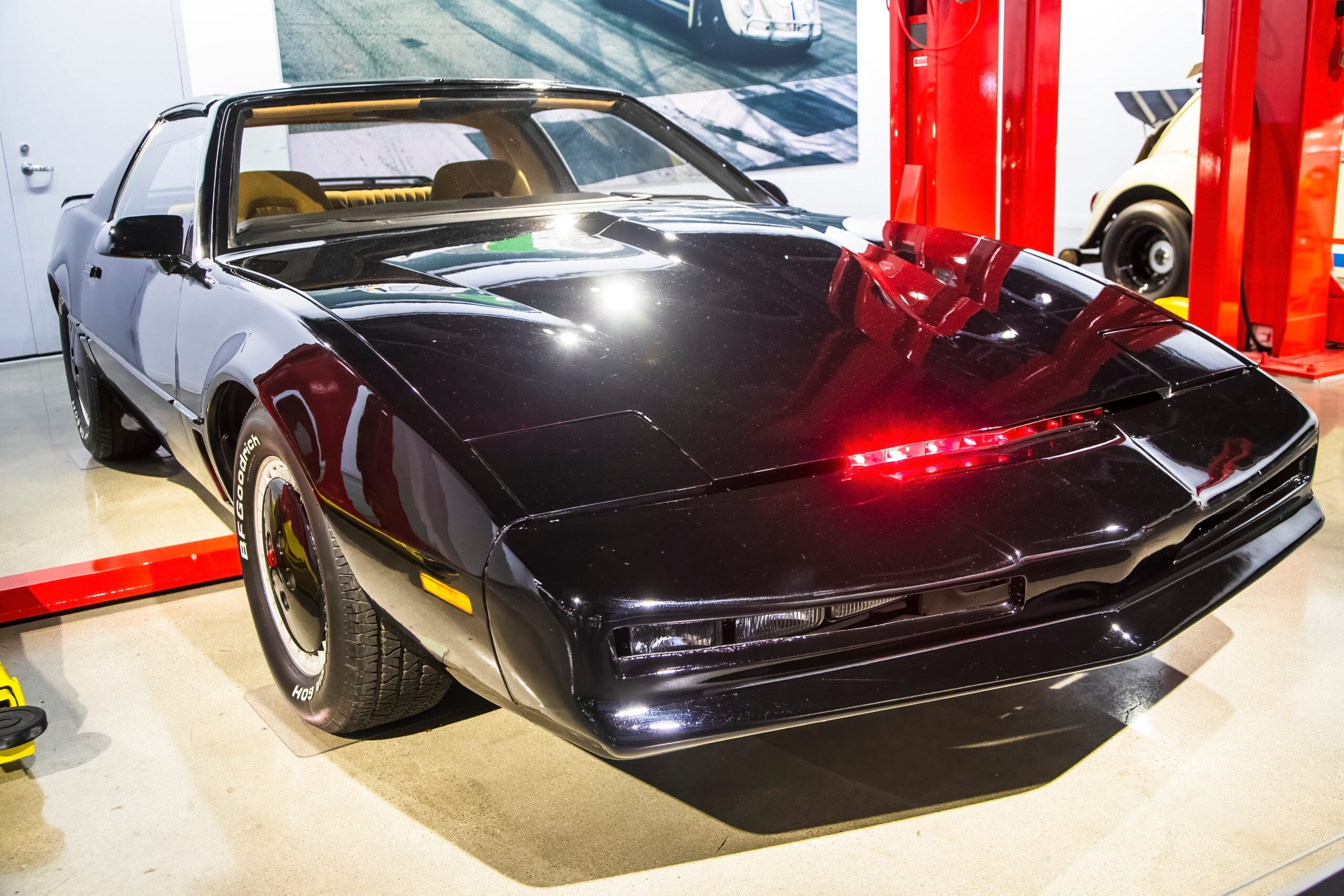
The legendary 1982 Pontiac Firebird Trans Am that played the role of the world’s smartest vehicle is apparently also one of its most reckless drivers, at least according to New York City.
The Volo Auto Museum in Illinois recently received a $50 traffic citation in the mail, and the name on the ticket was not a person. It was KITT, the artificially intelligent, turbo-boosting, Michael Knight-rescuing supercar from the beloved 1980s television series “Knight Rider.” According to the citation, the car was caught speeding through a school zone in New York City on April 22. Apparently even a sentient vehicle with a built-in AI defense system cannot resist blowing past a crossing guard.
There is just one fairly significant problem with all of this: KITT has not gone anywhere. The authentic replica has been sitting inside the museum as a stationary display piece for years, not cruising the streets of Manhattan. The only turbos firing in that building are the imaginations of nostalgic visitors who grew up watching David Hasselhoff talk to his dashboard.
Museum staff believe the confusion stems from the car’s novelty license plate, which reads “Knight,” a playful nod to the show. New York City’s automated ticketing system apparently scanned that plate somewhere in the city on a speeding vehicle and cross-referenced it against registered vehicles, eventually landing on the museum’s replica. The museum has since requested a formal hearing to fight the ticket, which, when you think about it, is exactly the kind of bureaucratic mess KITT would have been able to solve in about 45 seconds.
How Automated License Plate Readers Can Get It Very Wrong
This situation is a pretty entertaining example of what can happen when automated systems make assumptions without enough context. License plate reader technology has become widespread across the country, used by cities and law enforcement agencies to track vehicles, catch stolen cars, and issue violations. The cameras capture plate images and cross-reference them against databases.
The problem is that these systems are not foolproof. If a novelty or custom plate shares a sequence with a registered plate somewhere in a database, the system can make a match that is wrong in every practical sense but technically passes its own logic check. In KITT’s case, a plate reading “Knight” on a speeding car in New York somehow became a citation mailed to a museum in Illinois. That is not a small error. That is the kind of error that requires a time machine to explain.
The Volo Auto Museum and Its Very Famous Car
The Volo Auto Museum, located in Volo, Illinois, is no stranger to iconic vehicles. It houses an extensive collection of famous cars from film and television history, and the KITT replica is one of its most recognizable attractions. The museum has maintained the car as an authentic tribute to the show, making it a destination for fans who want to see the Trans Am up close.
For the record, the car on display is a replica, not the original screen-used prop. But it is detailed and faithful enough to capture what made the vehicle so iconic in the first place: the sleek black exterior, the red scanner light on the front, and the general feeling that this machine is judging you a little bit.
What This Whole Situation Says About Us
It would be easy to write this off as a funny glitch and move on, but there is something worth sitting with here. Automated systems are increasingly making consequential decisions, and when they get it wrong, real people (and, apparently, fictional cars) have to deal with the fallout. Fighting an erroneous ticket takes time, documentation, and a hearing request. Most people hit with a bad automated citation do not have the platform or the resources to push back effectively.
The KITT story is funny because it involves a TV car and a $50 fine. But the underlying mechanics of how the error happened are the same mechanics that can flag real drivers, real people, and real license plates incorrectly. Novelty plates, vanity plates, and even standard plates can create false matches in systems that are moving fast and checking boxes. The story is a reminder that automation without meaningful human review can produce outcomes that are embarrassing at best and genuinely harmful at worst.
What Happens Next for the World’s Most Famous Parked Car
The museum has formally requested a hearing to contest the ticket, which is the appropriate and entirely reasonable response to receiving a speeding citation for a car that has not left the building. Whether New York City’s system will review the case, acknowledge the error, and dismiss the fine remains to be seen.
In the meantime, KITT continues to hold its position on the museum floor, scanner light presumably at rest, waiting patiently for justice to be served. If the city rules against the museum, perhaps they can argue diminished capacity. After all, it is very hard to speed when you do not have a driver.