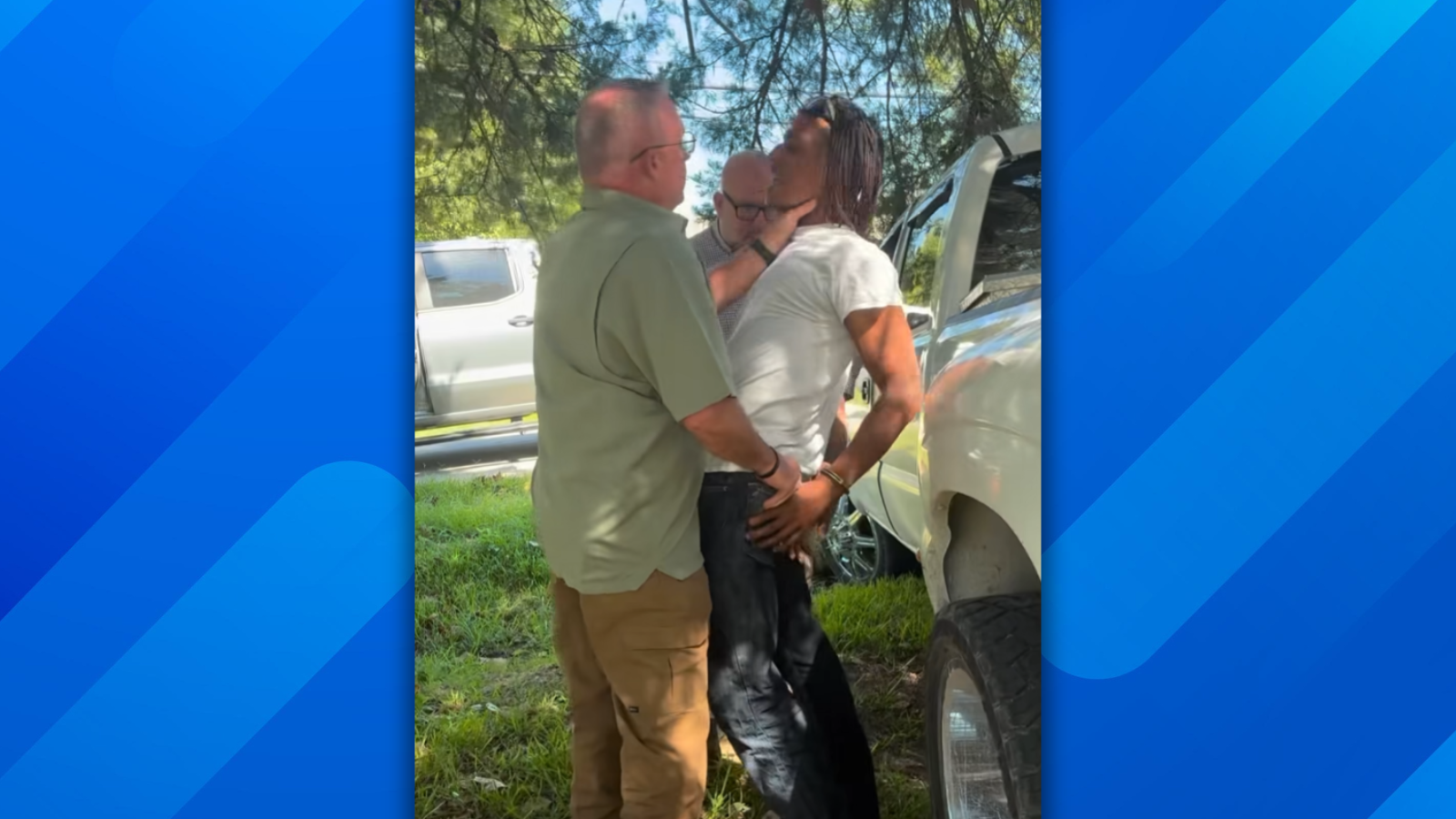
A video showing a Texas police chief confronting a driver in his own yard has attracted considerable attention online, drawing thousands of likes and comments as questions mount over how officers handled an apparent traffic stop.
The encounter took place in Sour Lake, a small city in Hardin County, where Police Chief Aaron Burleson and another officer approached Kendrick Bates outside his home. Both wore civilian clothing, and the recording captures an increasingly contentious exchange as Bates and witnesses challenge their actions.
At one point, Burleson responds to a challenge to his authority with a remark that has become a focal point of the reaction: “I’m the police chief, so deal with me.”
Bates shared the video on Facebook, where viewers have debated the encounter and demanded answers. The city has since acknowledged the incident and announced an investigation.
The Chief Has Something to Say
Embedded media follows; please allow a moment for it to load.
Bates says the encounter began after officers claimed he had run two stop signs. His wife, Hailey Shelburne, who recorded the confrontation and spoke with us, says he had already pulled into their yard, parked his pickup truck, and been welcomed home before the officers arrived. Both men wore civilian clothing and approached in an unmarked vehicle without activating emergency lights. “They were not directly behind him attempting to pull a traffic stop in any sort,” she explained. According to the couple, the officers began restraining Bates without identifying themselves or explaining why they had approached him.
The video begins with Chief Aaron Burleson and another officer holding Bates against his truck, his arms behind his back. “He was in the driveway when y’all got here,” Shelburne protests, repeatedly insisting her husband isn’t resisting. She says each officer already had control of one of his arms even as they continued ordering him to stop resisting.
Bates objects when Burleson reaches into his pocket. “You’re going in my pocket, sir. You didn’t ask me for any consent.” An officer responds, “Well, just let me have your driver’s license,” to which Bates answers, “No, sir. I don’t have to.”
Burleson also places his hand against the front of Bates’s neck. “Hey, get your hands off of his neck,” Shelburne demands. “Can you please be gentle with him? Why is your hand on his neck? Why are you throwing him against the truck?” She insists the contact was captured on video, telling the chief, “No, no, I have it on camera. You put your hand on his neck.” Shelburne and others at the scene repeatedly call for additional police: “Call the cops. More cops need to come here.”
Bates also challenges Burleson’s authority and says he intends to contact a judge. In his Facebook post, he identifies that judge as Mark Ames, the Hardin County Precinct 4 justice of the peace. Burleson responds, “I’m the police chief, so deal with me.”
Bates was ultimately cited for two alleged stop-sign violations and was not arrested, Shelburne confirmed. He has since announced plans to sue the Sour Lake Police Department and has set up a GoFundMe fundraiser.
The City Makes Its Move
The City of Sour Lake acknowledged the incident in an October 7 Facebook announcement, confirming that the officers involved had been reassigned to non-patrol duties while the matter was investigated. City officials also reported contacting the Texas Rangers and another law enforcement agency concerning an independent review.
The announcement offered no explanation for the officers’ handling of Bates, the decision to handcuff him, or the search of his pockets. It also did not establish whether the outside agencies had formally accepted investigative responsibility.
Plenty of Opinions, Few Answers
The recording has attracted widespread attention on Facebook, where viewers disagree over both the officers’ conduct and Bates’s behavior. Some argue that the physical restraint was excessive for alleged stop-sign violations, particularly after Bates was handcuffed, while others question what happened before filming began and whether he refused lawful commands.
Several commenters also dispute the number of alleged violations. Bates and Shelburne describe two stop signs, but others claim an officer mentions three during the encounter. The citation should clarify the specific offenses for which Bates was ticketed.
Police may detain a driver to investigate a traffic violation, and reaching one’s driveway does not automatically prevent officers from enforcing traffic laws. Handcuffs may also be used during an investigative detention when justified by specific circumstances, although their use can affect whether a detention amounts to an arrest.
Under Texas Transportation Code § 521.025, a driver must display a driver’s license upon a peace officer’s lawful demand. That requirement does not automatically authorize an officer to reach into the driver’s pockets to retrieve it. The legal justification for the search shown in the recording remains unclear, as does the reason officers considered handcuffs and the physical restraint necessary.
All parties are presumed innocent unless and until proven guilty in a court of law.