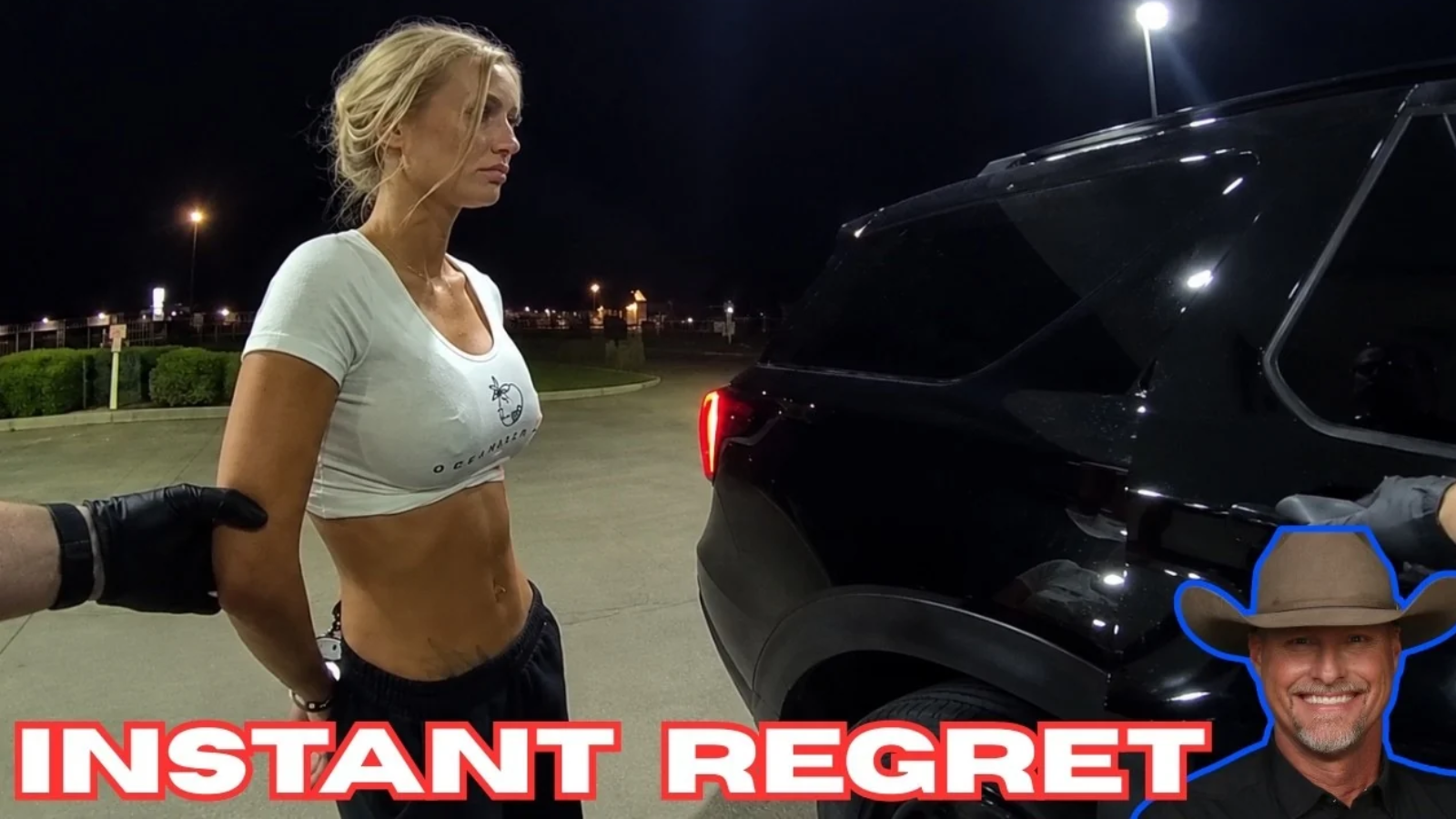
A woman driving a bright green Jeep Wrangler in Illinois turned a traffic stop into a broken-window arrest after repeatedly refusing police orders to get out. Officers tried reasoning with her, threatened to break the glass, and even positioned a tire-deflation device near the Jeep before finally forcing their way inside.
The September 3, 2026, encounter began in Sandwich, about 60 miles west of Chicago, when an officer observed the Wrangler running a stop sign and drifting across lane markings. He followed the four-door Jeep into a Casey’s gas station on East Church Street. During the stop, he told the driver she had also been speeding and that her driving was among the worst he had seen in some time.
The woman, identified in a Sandwich Police Department arrest notice as Jordan R. Weeks, 35, of Yorkville, supplied her identification but declined to answer questions. When the officer ordered her out of the Jeep to investigate suspected impairment, she questioned his legal authority and refused. Even the arrival of another officer and a sergeant failed to persuade her to open the door.
The confrontation has since reached millions of viewers after retired Sheriff Mark Lamb featured the police footage on YouTube in October. His video had attracted approximately 2.6 million views and more than 8,700 comments by October 27. Body-camera recordings sometimes reach the public weeks or months after an incident through records requests and subsequent releases. Illinois law permits public access to certain recordings involving arrests, subject to applicable restrictions, although it is unclear how this particular footage was obtained.
Police Prepare
As Weeks remained inside the Wrangler, another officer placed a tire-deflation device near its front wheel. The precaution appeared intended to hinder a possible attempt to drive away. These devices can compromise steering and control by puncturing tires, regardless of which wheels receive engine power. A vehicle can still move on flat tires, but doing so becomes considerably more difficult and dangerous.
Weeks continued arguing about whether police could legally require her to exit. The officer referenced the U.S. Supreme Court’s decision in Pennsylvania v. Mimms, which permits officers to order drivers out of vehicles during lawful traffic stops. A driver’s right to decline investigative questions does not eliminate that authority.
A sergeant joined the conversation, explaining that officers needed to establish whether Weeks was safe to drive and asking her to cooperate. The original officer repeatedly warned that her window would be broken and that she could face an additional charge if she continued refusing.
Eventually, he told Weeks she was under arrest for obstructing a peace officer. She remained seated, and the officers prepared to remove her.
A Small Tool
The officer used what appears to be a spring-loaded center punch, a compact tool commonly carried by police, firefighters, and other emergency responders. The Jeep’s driver’s window shattered almost instantly, without the repeated baton strikes sometimes seen in police videos. Officers then opened the door, removed Weeks and placed her in handcuffs.
The difference comes down to the tool and the glass. A spring-loaded punch concentrates force at a tiny point, causing tempered safety glass to fracture into small pieces. While tempered glass remains common in vehicle side windows, some newer vehicles use laminated glass, which has a plastic interlayer that holds broken fragments together and generally resists conventional window punches. The way the Wrangler’s window shattered is consistent with tempered glass.
Once Weeks was outside, an officer remarked that she smelled of alcohol. Police arranged to tow the Jeep and discussed conducting an inventory of its contents, a procedure used to document property inside vehicles taken into police custody.
Vehicle Recovery Costs
At the police station, Weeks became considerably more cooperative. She asked to call her husband and later remarked that the officer had been very nice, although he had broken her window.
Police explained the consequences of refusing chemical testing, including a potential suspension of her driver’s license. In Illinois, qualifying refusals can trigger an administrative suspension separate from the DUI criminal case. The officer told Weeks that she could continue driving until the suspension took effect.
Recovering the Wrangler would also carry a substantial expense. An officer explained that Weeks would have to pay the police department a $500 vehicle-release fee and then pay the towing company separately. Those charges would come before any repair bill for the shattered window.
The recording also shows police discussing citations for the driving violations and her failure to produce current proof of insurance. That does not necessarily mean the vehicle was uninsured, and the officer told her she could bring valid documentation to court.
The Sandwich Police Department confirmed that Weeks was cited for driving under the influence of alcohol and charged with resisting or obstructing a peace officer. She was released with a notice to appear at a future LaSalle County court date in Ottawa, Illinois.
The video has generated considerable debate over the officers’ repeated warnings. Some viewers praised their patience, while others questioned why it took so long to break the window. One commenter observed that repeatedly giving a final warning rather defeated the purpose.
All parties are presumed innocent until proven guilty in a court of law.