The use of drones across various industries has grown significantly over the past decade. But regardless of their size, most share one major drawback- they are loud and easy to spot.
That lack of stealth can be a problem in applications such as wildlife conservation, where drones used in forests can disturb animals simply because of their noise and visibility.
Now, however, engineers at Northwestern University have developed a drone that almost disappears, making it remarkably difficult to detect while in flight.
Roughly the size of an adult’s palm, the Phantom Twist drone spins at up to 25 revolutions per second, creating an optical illusion that makes it extremely challenging for the human eye to see.
Motion Blur Does the Trick
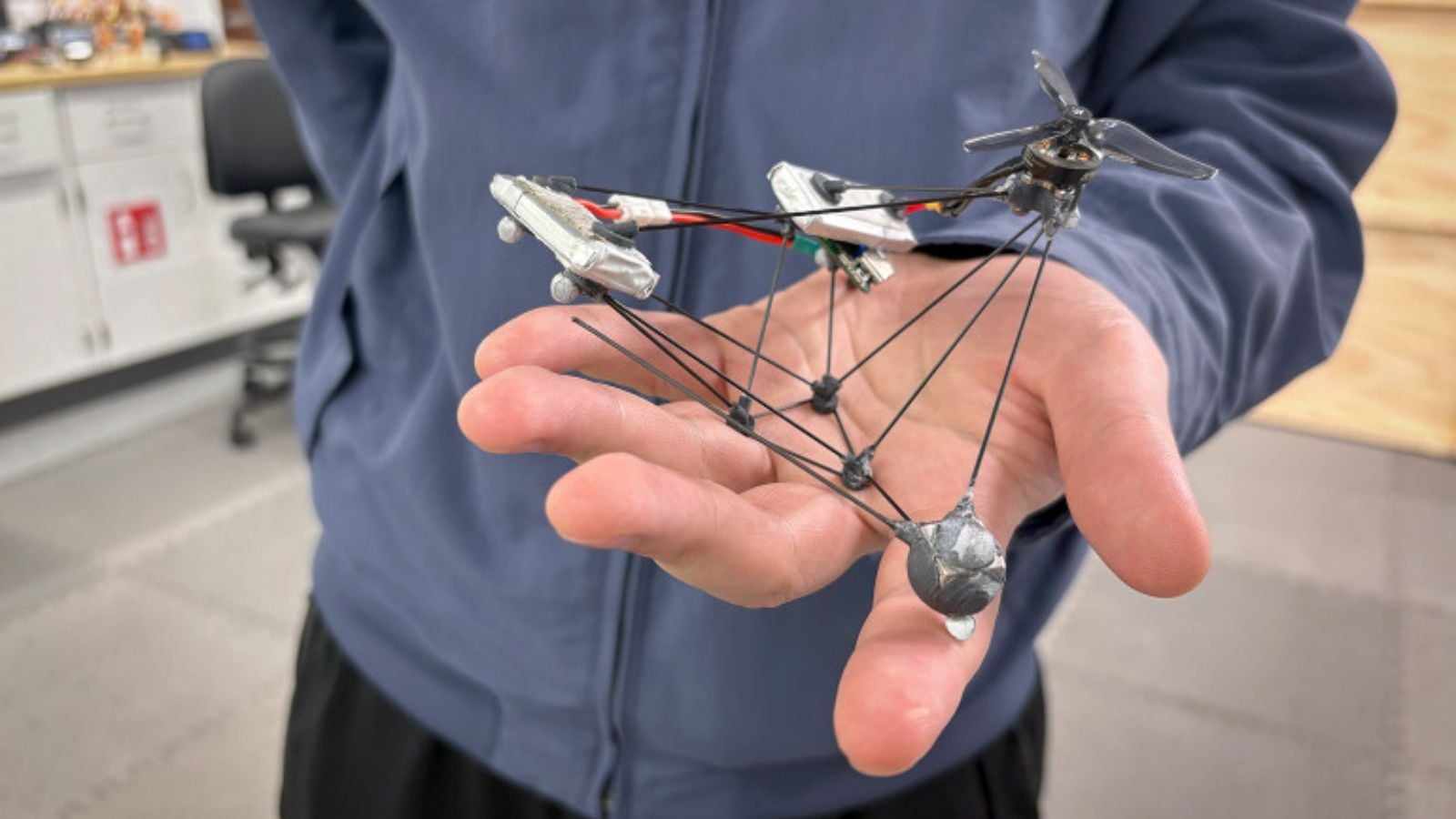
According to a report by Northwestern University, the Phantom Twist spins so quickly that the human eye struggles to see it clearly. The effect is similar to a fan. When it is switched off, the blades are easy to see, but once it is running at high speed, the rapid rotation makes the individual blades almost impossible to distinguish.
The drone could eventually be adapted for a wide range of applications, from wildlife monitoring to environmental surveys. While it does not become truly invisible, its rapid spinning creates a hazy appearance that makes it much more difficult for observers to recognize it as a drone.
Michael Rubenstein, the associate professor who led the project, said:
“Most efforts to hide drones focus on making them look like their surroundings. Instead, we asked whether we could design the drone itself around the way humans perceive motion. This idea of low visibility through persistent motion is something few people have explored.”
Northwestern co-author Emma Alexander said:
“The human eye takes time to accumulate signals, roughly analogous to the exposure time of a camera. When an object spins quickly, we perceive it as blurring out and losing distinct features. Because this new drone is almost entirely transparent, its few opaque components are visually averaged with the background for an overall appearance of a slight haze.”
A Less Noticeable Drone Keeps Everything as Is
According to the report, drones used for tasks such as wildlife monitoring can easily alarm animals and attract attention. The same applies to people.
Someone who notices a drone is more likely to change their behavior, making it harder to observe situations naturally. A drone that is much harder to notice could carry out these jobs without causing as much disturbance.
To achieve this, Northwestern engineers redesigned the drone rather than trying to camouflage it. The Phantom Twist uses a single motor and propeller, with the propeller spinning in one direction while the rest of the drone rotates the other way. Rubenstein added:
“For a typical quadrotor drone, the propellers are spinning, but the robot is stationary. So, you still see its body. For our drone, the whole thing is rotating, so there are no stationary parts.”
The Northwestern team used artificial intelligence to test around 20,000 drone designs, rearranging key components to find a design that was both stable in flight and difficult to see.
They then compared the best designs against real-world backgrounds using a model of human vision before refining them further to create the Phantom Twist.
“The design process was fully automated,” Rubenstein said. “Then, when we were confident that a drone met all our criteria, we built it.”
The final design places the drone’s components at different heights and angles so they don’t overlap as it spins. Instead of forming a clear shape, the drone appears as a faint, blurry cloud that is much harder to notice.
However, there is scope for further improvement because the propeller makes a considerable amount of noise, while the drone’s support rods and wires have been left exposed. The team plans to design future iterations with transparent materials to make the Phantom Twist less noticeable during flight than it already is.
The prototype does not appear to include an onboard camera, with the project focused instead on demonstrating the low-visibility design.
Although the Phantom Twist is not being developed specifically for surveillance, quieter and less visible future versions could have potential law enforcement applications. Whether that becomes a reality remains to be seen.