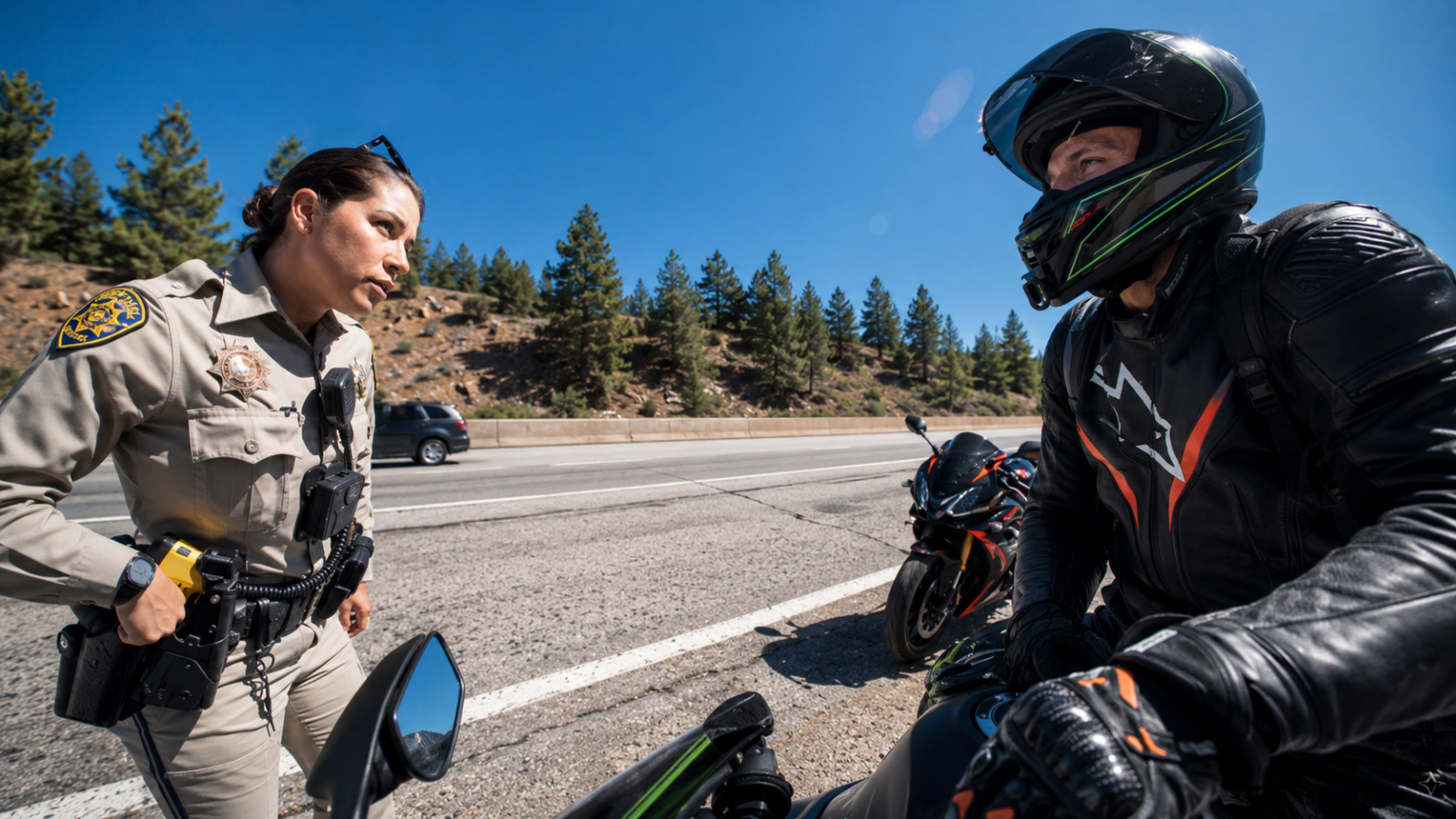
A traffic stop involving a group of motorcyclists has sparked an interesting question: Can police detain riders who apparently did nothing wrong because other members of their group fled? A video circulating online shows exactly that scenario unfolding after three motorcyclists allegedly took off from an officer at extremely high speed.
According to the officer in the footage, the fleeing riders reached approximately 120 mph while passing vehicles on the shoulder. Two other motorcyclists from the group apparently stayed behind and were subsequently stopped, despite the camera-wearing rider repeatedly insisting that he personally had broken no laws.
The officer explained that she wanted his identification to document the encounter and said she wasn’t attempting to issue him a citation. The rider refused, arguing that because he hadn’t committed an offense, he shouldn’t have to provide identification.
That disagreement quickly turned a relatively calm roadside encounter into a legal standoff. The rider asked whether he was free to leave, the officer said he wasn’t, and when he asked whether he was being detained, she confirmed that he was before calling for backup.
Three Riders Allegedly Fled at 120 MPH
she pulled him over because somebody else broke the law? she needs to be fired on the spot. pic.twitter.com/0ba2mzAWvz
— Sarrah Bellus (@sarrah_bellus) July 16, 2026
The confrontation reportedly began after several riders from the larger group encountered the officer on a mountainous stretch of highway. According to her account in the video, three motorcyclists fled after she activated her emergency lights, accelerating away and using the shoulder to pass traffic.
“I lit them up and everything. 120 miles an hour, gone. Passing on the shoulder,” the officer tells the remaining riders. She appears to connect the stopped motorcyclists with those who fled because the group had entered the highway together using the same on-ramp.
That connection became the central issue in the encounter. The remaining riders weren’t accused on camera of participating in the alleged 120-mph escape, yet the officer still wanted to identify them following the actions of their companions.
The Rider Refused to Hand Over His ID
The camera rider maintained that he had done nothing to justify the stop and therefore wouldn’t provide his driver’s license. When the officer explained that she simply wanted to record his information and wasn’t planning to write a ticket, his position remained unchanged.
“I haven’t done anything wrong,” he tells her while declining the request. He then asks the question that often becomes critical during encounters with law enforcement: whether he is free to leave.
The officer says no and confirms that he is being detained. When the rider asks what crime he is suspected of committing, the disagreement continues, and the officer eventually calls for backup while attempting to obtain information from the second motorcyclist.
Was the Stop Actually Legal?

The answer isn’t clear from the video alone. The legality of requiring someone to identify themselves can depend on several factors, including the jurisdiction, whether the officer had reasonable suspicion that the person was involved in criminal activity, and the specific circumstances surrounding the stop.
The U.S. Supreme Court’s decision in Terry v. Ohio established the principle that police may briefly detain someone when they have reasonable suspicion supported by articulable facts that criminal activity is occurring or has occurred. A later Supreme Court case, Hiibel v. Sixth Judicial District Court of Nevada, upheld the application of a state stop-and-identify law during a valid investigative detention.
Those principles don’t automatically establish whether the officer’s actions in this particular video were lawful. Simply riding with people who later flee from police does not necessarily mean every person in the group participated in an offense, while additional facts unavailable in the footage could potentially provide an officer with grounds for an investigative detention.
The location of the encounter is also important because identification requirements differ between states. Without independently confirming where the stop occurred and what happened before the recording began, confidently declaring either the officer or the rider legally correct would go beyond what the available footage establishes.
Being Part of the Group Complicated Everything
From the rider’s perspective, the argument was straightforward: other people allegedly broke the law, while he stayed behind and shouldn’t be treated as though he participated. From the officer’s perspective, she had just watched three members of a motorcycle group allegedly flee at dangerous speeds and wanted information from riders she believed were connected to them.
That doesn’t necessarily make the remaining motorcyclists responsible for what their companions allegedly did. It does, however, explain why an officer investigating the incident might want to determine who was traveling together and potentially identify the riders who escaped.
The situation also highlights the difference between being detained and being charged with a crime. An investigative detention can occur without an arrest, although police generally still need a lawful justification for preventing someone from leaving.
The Video Doesn’t Give Us the Final Answer
Based solely on the footage described, there isn’t enough information to definitively determine whether the officer had sufficient legal grounds to detain the two remaining motorcyclists or require identification. The answer would depend heavily on the state, the applicable laws, and facts that may have occurred before the camera footage began.
What seems considerably clearer is that the three riders who allegedly fled transformed what might otherwise have been an uneventful ride into a complicated roadside confrontation for everyone associated with them. The two riders who stayed behind may not have participated in the alleged high-speed escape, yet they still found themselves dealing with the consequences of being part of the same group.
For anyone riding in a large group, that’s an uncomfortable lesson. You might be following every traffic law yourself, but when someone you’re riding with allegedly blasts past traffic at 120 mph and runs from police, the resulting investigation may not end when their taillights disappear.