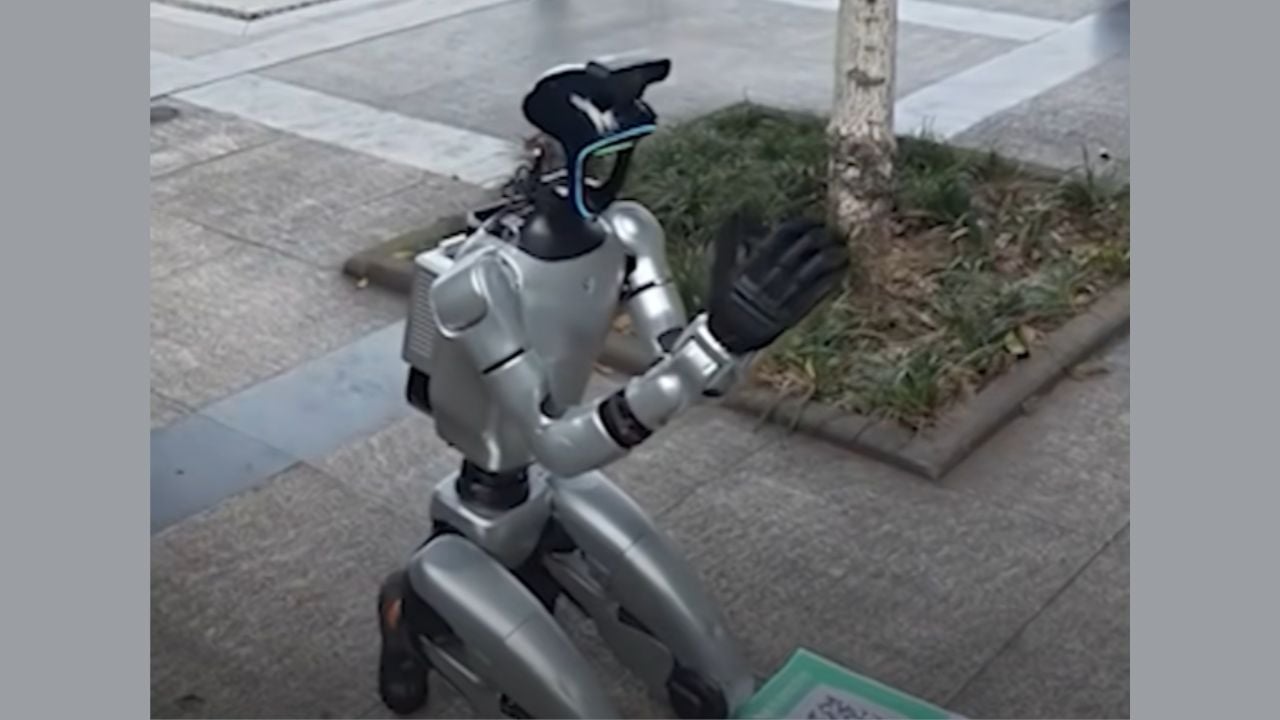

The future arrived in China and apparently forgot to budget for electricity. A humanoid robot worth around $16,000 was filmed kneeling on a street in Sichuan province, asking strangers for help paying its power bill.
According to a report by the Daily Mail, the machine bowed to passersby with its hands pressed together. An LED display and loudspeaker informed onlookers that it had “no money to recharge” and pleaded for assistance with electricity costs.
The scene was a proper satire despite the science fiction it projected. Beside the kneeling robot sat a plate for donations and, in keeping with the times, a QR code for digital payments.
For years, people have debated whether robots would replace workers. Few predicted that one of them might skip the employment line altogether and head straight for public fundraising.
From Job Thief to Coin Collector
The robot has been identified as a Unitree G1 humanoid robot, a machine designed to showcase advances in robotics. Yet in footage that spread across social media, its role shifted from symbol of progress to participant in a form of street theatre.
The people responsible for placing the robot there remain unknown, leaving room for theories to flourish. Was it performance art? Was it a prank? Was it an experiment in public generosity? Or was it a business model that understood one truth about internet culture: people cannot resist opening their wallets when absurdity arrives with a QR code.
Social media users had a field day. “Even beggars are being replaced by robots,” one person joked. Another wrote, “Job market so bad even robots have to beg.” A third lamented, “First they took our jobs, now they’re taking our spare change.”
Behind the punchlines sat a deeper unease. Anxiety over automation has long focused on livelihoods and identity. Seeing a machine mimic one of humanity’s oldest acts of desperation created an image that was difficult to classify. People laughed because it was funny. They paused because it also felt uncomfortably familiar.
Performance, Profit, and Public Conscience
Some viewers questioned the economics of the stunt. After all, if someone can purchase a machine valued at thousands of dollars and send it into the street with a donation plate, perhaps the robot was not the one in need.
One commenter suggested that the owner was probably relaxing at home while the machine earned income. Others saw something more troubling in the willingness of people to donate.
“If we can’t guarantee basic dignity for our own citizens, why would we treat artificial intelligence any better?” one person asked.
Another rejected the idea outright, arguing that money should go to people facing hardship rather than a machine acting out a script. The debate revealed something about human instinct. People respond to stories.
Whether the figure before them is flesh or metal, many still react to gestures of need. Compassion can be guided by reason, but it is often triggered by narrative.
China’s Robot Era Comes With Slip-Ups
The begging robot joins a list of incidents involving humanoid machines in China that have captured public attention. The Daily Mail noted previous episodes involving Unitree robots.
One clip showed a robot during a martial arts display collapsing and directing kicks toward children who stepped onto the field. Another captured a machine striking a boy during a dance sequence before handlers intervened.
There was also footage of a robot dancing to “Billie Jean” before losing balance and ending in a heap on the floor, prompting comparisons to a relative enjoying themselves too much at a wedding.
China sees robotics as part of its economic future, especially as demographic and growth pressures reshape priorities. Yet each stumble, misstep and plea for electricity exposes an irony embedded in the march toward automation.
The machines built to represent efficiency keep revealing traits that look human. They fall over. They attract sympathy. They become subjects of jokes. And now, it seems, they ask for change.
According to the Daily Mail, even the future sometimes needs help covering the electricity bill.