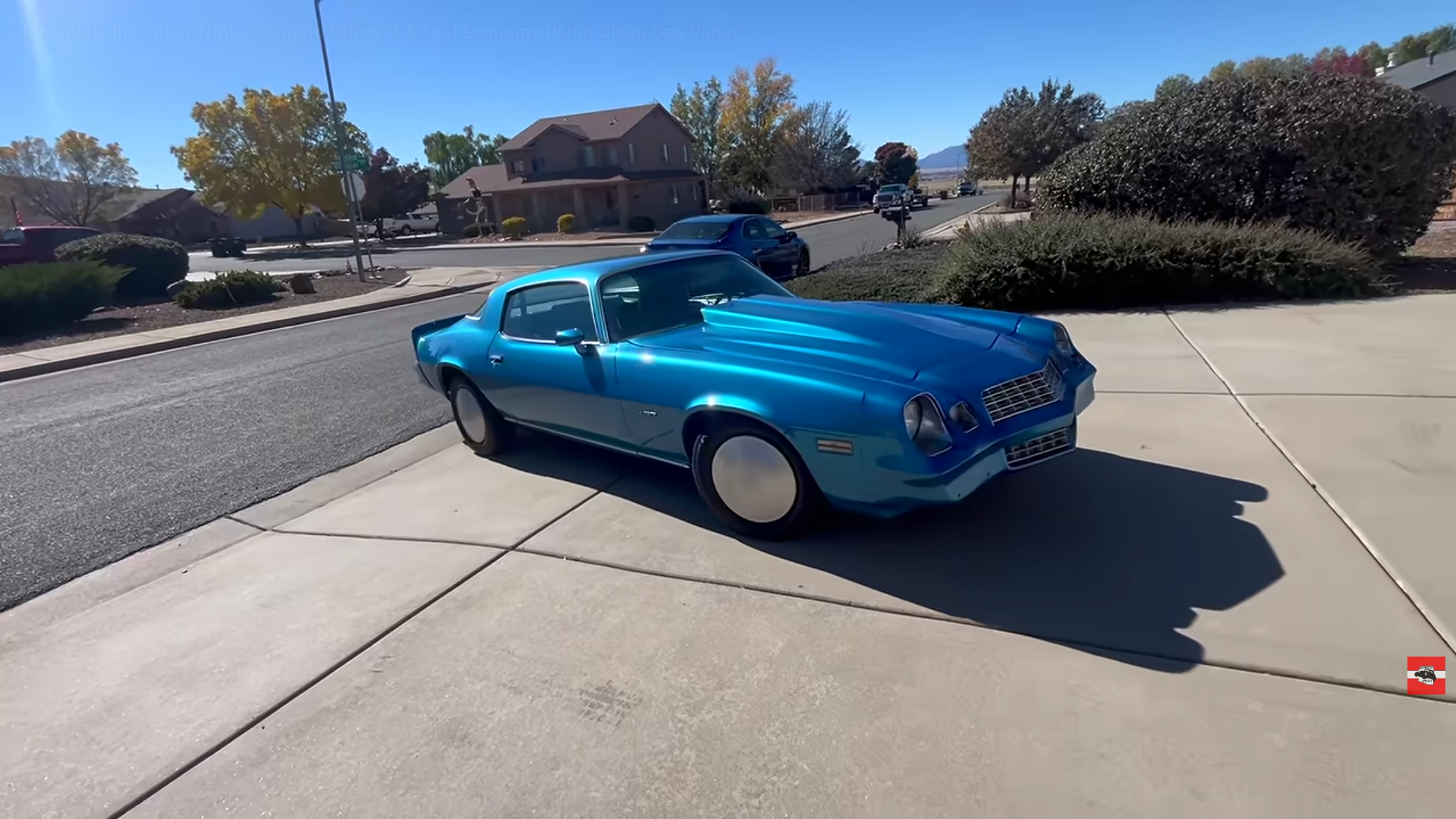
Getting 35 mpg from a classic Chevrolet Camaro with a 350-cubic-inch V8 sounds like wishful thinking. Yet one backyard inventor claims he’s achieved exactly that, using an unlikely combination of motorcycle parts, a turbocharger, and something originally designed for a swimming pool.
His name is Mike, a retired real estate broker who has spent much of his life tinkering with engines. In an interview featured on the Automotive AZ Rancher YouTube channel, his homemade gasoline-vapor system took three years and 17 prototypes to develop.
The inspiration came decades earlier, when a teenage Mike opened the fuel cap on his Dodge Charger during a scorching Las Vegas summer. Hearing the pressure escape from the hot tank sparked an idea: what if an engine could run on gasoline deliberately converted into vapor?
He eventually bought an old Camaro specifically to test that theory, choosing its familiar small-block Chevy because it lacked computerized engine management. Ten years after completing the conversion, he says the car still runs reliably.
A Harley Carburetor Feeding a Chevy V8
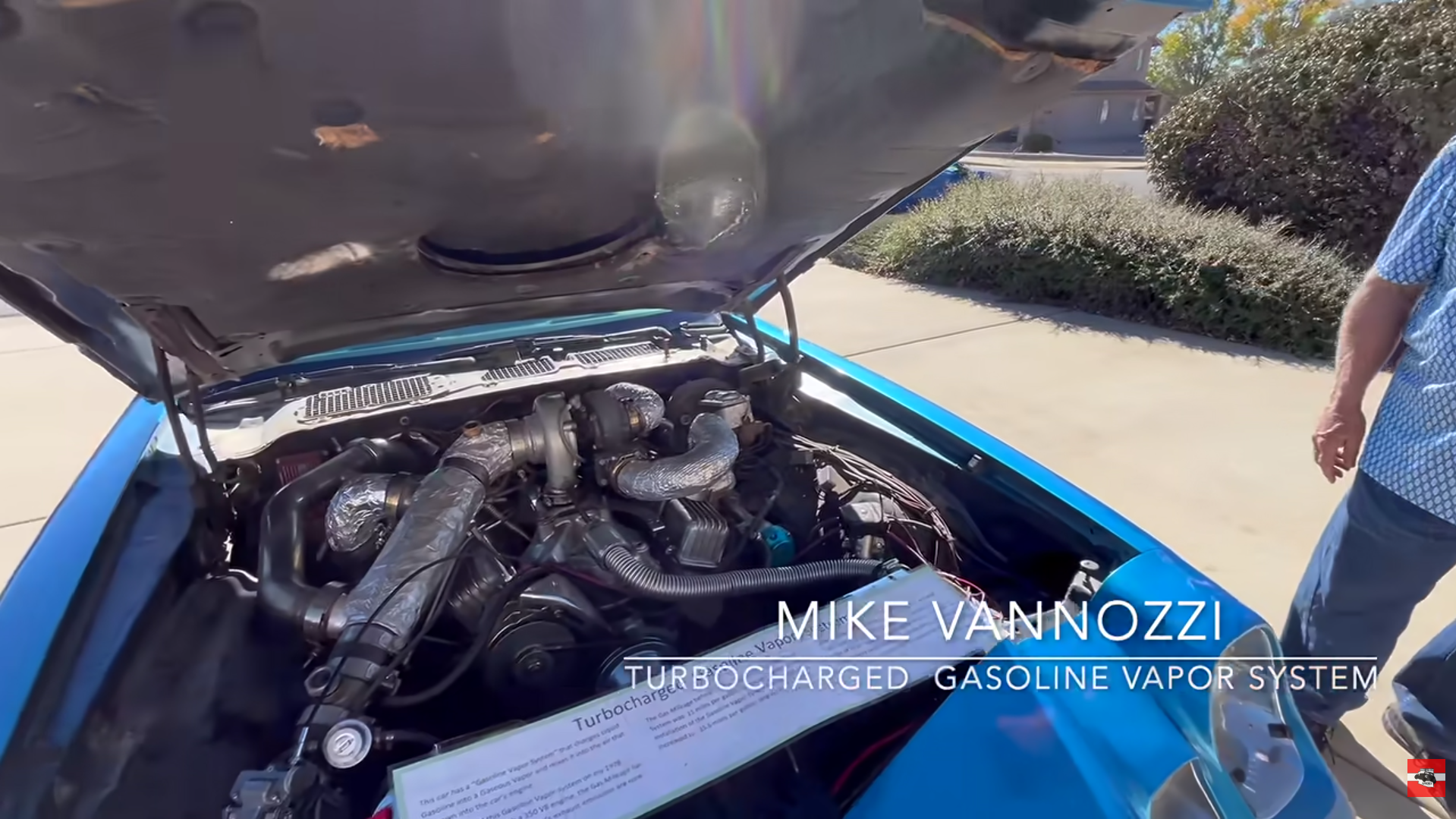
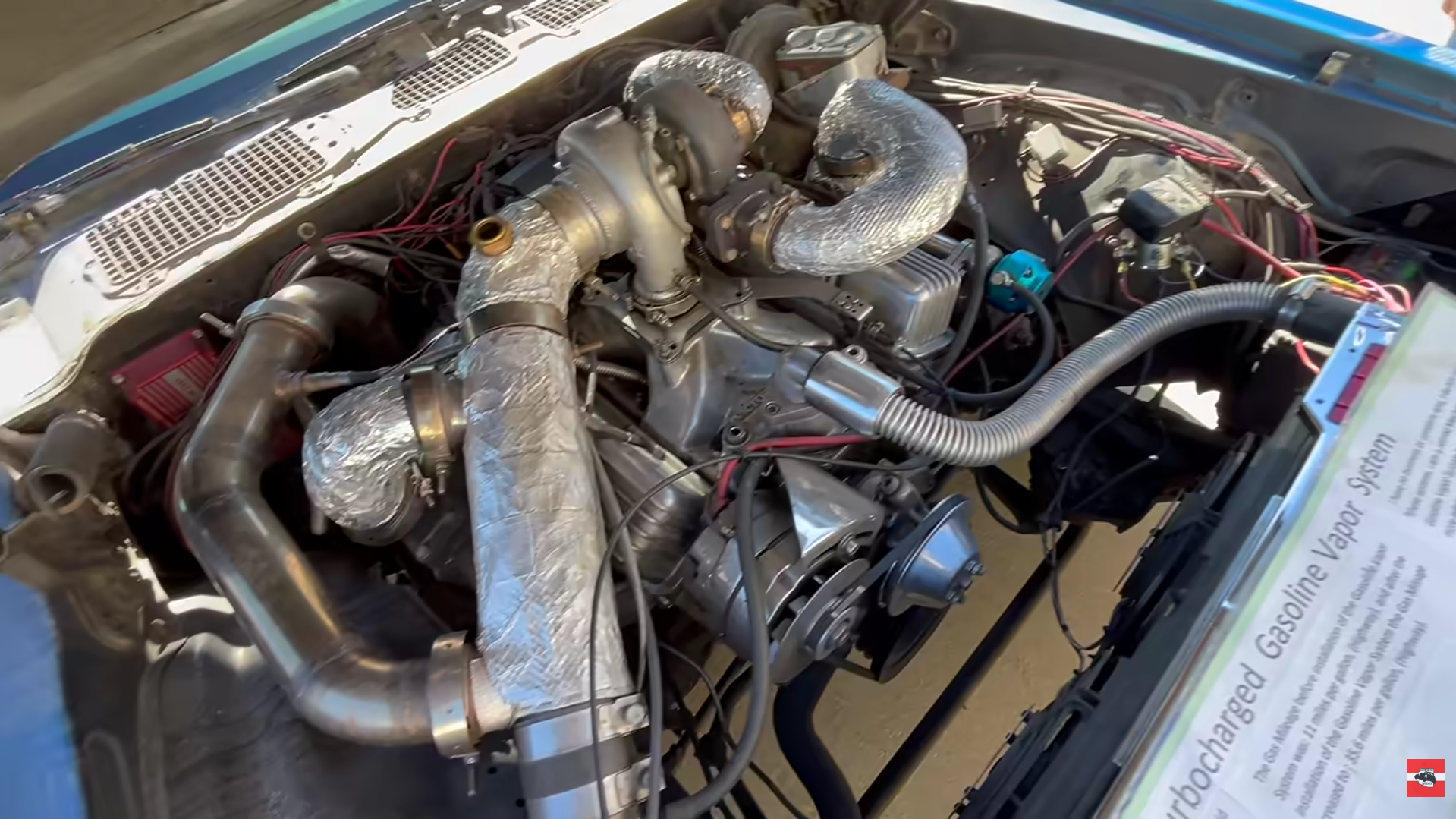
The strangest component is a 48-mm Mikuni carburetor normally associated with Harley-Davidson motorcycles. Instead of the Camaro’s original Rochester Quadrajet, this comparatively tiny unit supplies fuel to the 5.7-liter V8.
The mixture then enters a modified stainless-steel swimming-pool heat exchanger, which uses exhaust gases at temperatures Mike describes as roughly 500 degrees Fahrenheit. Mike says this converts the atomized gasoline into vapor before a turbocharger compresses the mixture and delivers it to the intake manifold.
An Idea With Racing Roots
The principle has an intriguing predecessor: NASCAR legend Smokey Yunick developed a hot-vapor engine for a Pontiac Fiero during the 1980s. His system also recycled engine heat to vaporize fuel, using an exhaust-driven device to condition the intake mixture.
Mike’s arrangement is independently developed and uses different hardware, but the underlying ambition is familiar: extracting better efficiency from gasoline engines through improved fuel preparation.
From 11 MPG to a Claimed 35.6 MPG

Mike says his Camaro previously returned 11 MPG and now achieves 35.6 MPG on the highway. He also installed a five-speed overdrive manual transmission, meaning the vapor system alone cannot be credited with the entire improvement.
He reports clean emissions despite having no catalytic converter, although the video provides no independently verified emissions figures or controlled mileage testing. Claims of complete combustion are also unverified.
Built to Prove a Point

Mike says he has patented his invention but has no company or kits to sell. Developing versions for different engines and vehicles would require resources he doesn’t have. “I built this in my home garage,” he explains. “I wanted to prove to myself it could be done.”
Whether the Camaro can consistently achieve its claimed fuel economy under independent testing is still an open question. What we can say for certain is that something is fascinating about a retired enthusiast spending three years and building 17 prototypes simply to see whether an unconventional idea could work.