
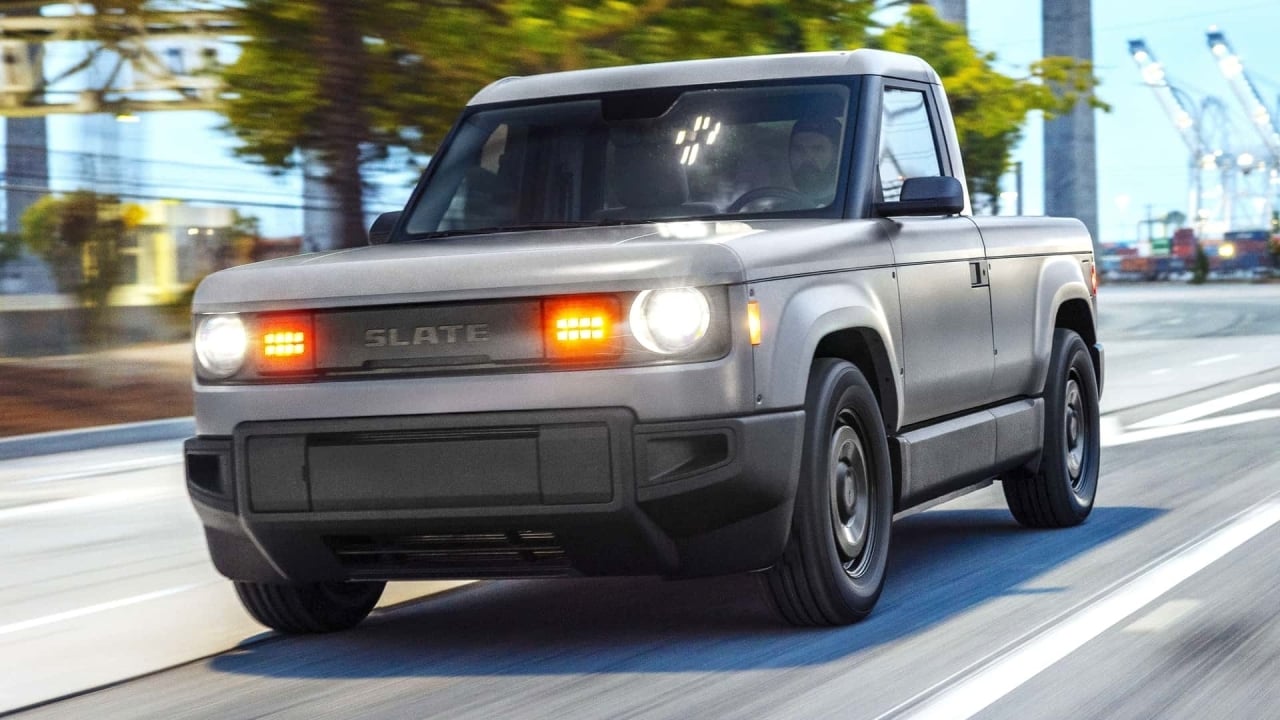
The upcoming Slate electric truck will reach production with a significantly different battery setup than the one originally announced. Early specifications called for two battery sizes and as much as 240 miles of range, but the production model is taking a different approach.
When Slate revealed its prototype in April 2025, the company planned to offer nickel-manganese-cobalt, or NMC, batteries. The entry-level 52.7-kWh pack was expected to provide 150 miles of range, while an optional 84.3-kWh battery would increase that figure to approximately 240 miles.
The production truck will instead use a single 65-kWh lithium iron phosphate, or LFP, battery with an estimated 205 miles of range. That means buyers gain 55 miles over the originally proposed base model but lose the option of upgrading to the longer-range 240-mile configuration.
The change is tied to a combination of cost, battery sourcing, and shifting federal EV policy. With Slate positioning its truck as an affordable electric vehicle starting at $24,950, LFP chemistry ultimately became a better match for the company’s value-focused strategy.
The Original Truck Was Designed Around NMC Batteries

Slate’s initial decision to use NMC batteries was influenced by federal EV tax-credit requirements. At the time the prototype was being developed, sourcing restrictions tied to the incentive made using batteries connected with certain Chinese suppliers potentially problematic for eligibility.
Because China dominates global production of LFP cells, Slate reportedly planned to source NMC batteries from South Korea instead. That approach allowed the company to pursue a battery supply chain better aligned with the tax-credit requirements that existed during the truck’s development.
Once the federal EV tax credit was eliminated, however, Slate no longer had the same incentive-driven sourcing constraints. The company could reconsider which battery chemistry made the most sense based primarily on the vehicle’s price, performance, durability, and production requirements.
The result is a move to LFP batteries supplied by Gotion. Although Gotion is Chinese-owned, the company has established battery production operations in Illinois, placing manufacturing relatively close to Slate’s planned vehicle assembly operation in Indiana.
LFP Batteries Help Keep the Slate Truck Affordable
Cost is one of the biggest advantages of switching to LFP chemistry. NMC batteries depend on materials including nickel and cobalt, which can be expensive and have also faced scrutiny over the environmental and ethical challenges associated with some mining operations.
LFP batteries instead rely primarily on lithium, iron, and phosphate. Their lower material costs have helped make the chemistry increasingly attractive to automakers developing affordable electric vehicles where keeping the purchase price down is a higher priority than maximizing energy density.
That fits neatly with Slate’s broader philosophy. Rather than competing with increasingly expensive electric pickups loaded with luxury equipment and advanced technology, the company is targeting buyers who want a simpler and less expensive EV.
With a starting price of $24,950, battery costs become particularly important. Without a federal tax credit reducing the effective purchase price, lowering manufacturing expenses directly becomes one of the most important tools Slate has for keeping its truck accessible.
There Are Durability and Safety Advantages Too
LFP batteries also bring benefits beyond price. The chemistry is known for strong thermal stability, reducing its susceptibility to the thermal runaway events that can make lithium-ion battery fires particularly difficult to control.
The batteries can also tolerate large numbers of charging cycles with relatively low degradation. That potentially makes LFP well suited to a utility-focused electric truck expected to accumulate significant mileage over years of regular use.
For buyers who intend to keep their vehicles for extended periods, battery longevity could ultimately matter as much as maximum driving range. The trade-off is that LFP chemistry generally offers lower energy density than comparable NMC technology.
The Longer-Range Slate Is No Longer Happening
That lower energy density appears to have had a direct effect on Slate’s product plans. The new 65-kWh LFP battery reportedly occupies all of the space allocated for the pack within the truck’s existing platform.
As a result, there is no room for a larger battery without significant changes to the vehicle. Buyers will therefore receive a single 65-kWh configuration offering approximately 205 miles of range, rather than choosing between the originally proposed 150- and 240-mile versions.
Whether 205 miles is enough will depend heavily on how customers intend to use the truck. Drivers regularly covering long distances may find the lack of an extended-range option limiting, while buyers using it primarily for commuting, local work, or shorter trips could find the compromise perfectly reasonable.
The battery switch ultimately reflects what Slate appears to value most: affordability, durability, and simplicity rather than chasing the longest possible range. The production truck may not match the specifications originally advertised, but its new LFP battery could prove better aligned with the inexpensive, straightforward electric pickup Slate is trying to build.