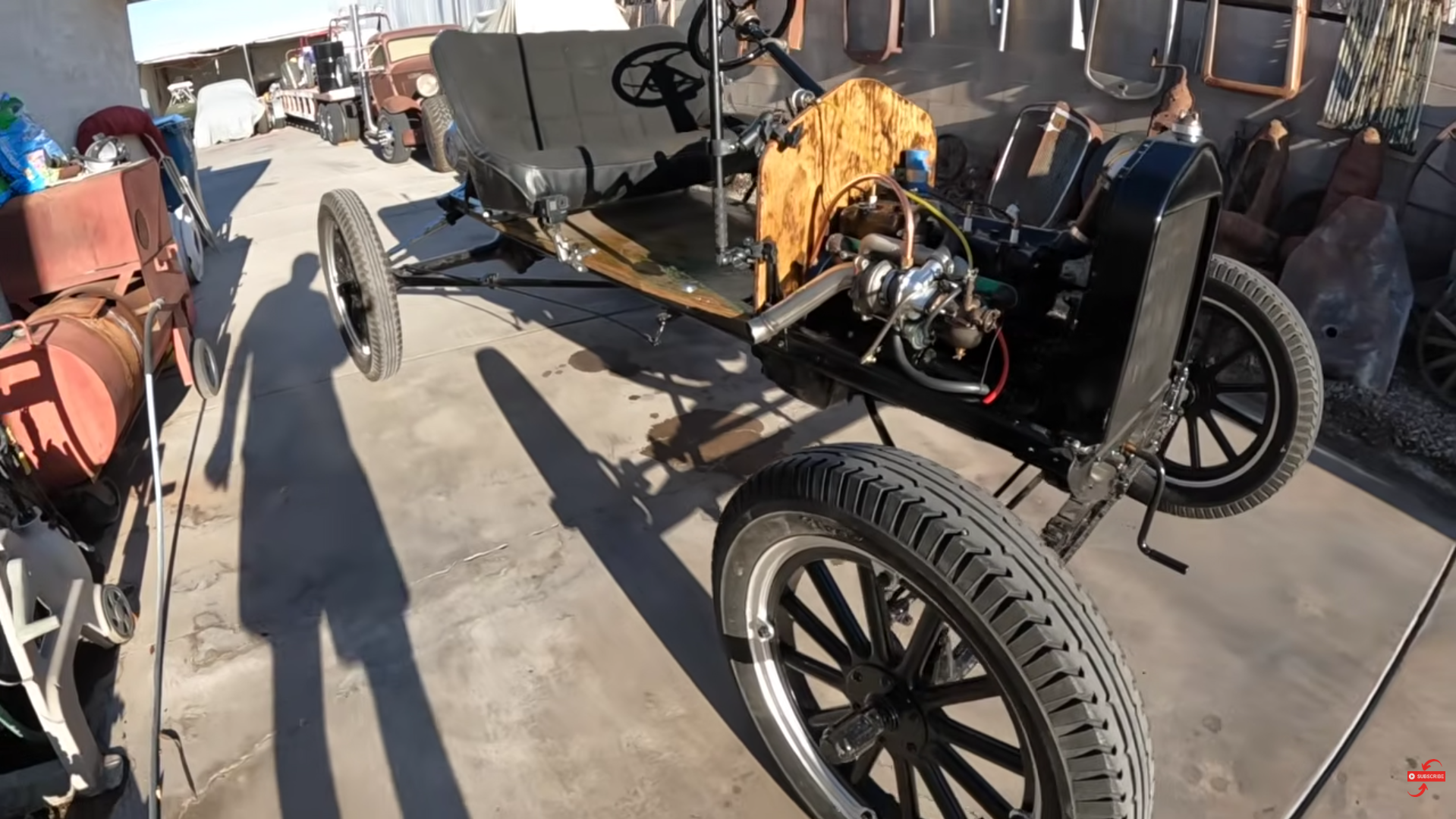
The Ford Model T was never designed with boost in mind. Its four-cylinder engine dates back to an era when 20 horsepower was respectable and turbocharging belonged to engineering theory, not production cars.
That hasn’t stopped hot-rodders from experimenting with them for generations. Merlin Johnson of Merlin’s Old School Garage recently decided to find out what happens when a very old Ford meets a very small turbocharger.
The donor hardware came from a three-cylinder Kubota tractor, while the Model T kept much of its original personality, including a stock-style carburetor. The result is a wonderfully strange mashup of century-old engineering and modern forced induction.
The main question was whether this project would actually work. As Johnson quickly discovered, bolting on the turbo was the easy part.
The Model T Doesn’t Even Have An Oil Pump
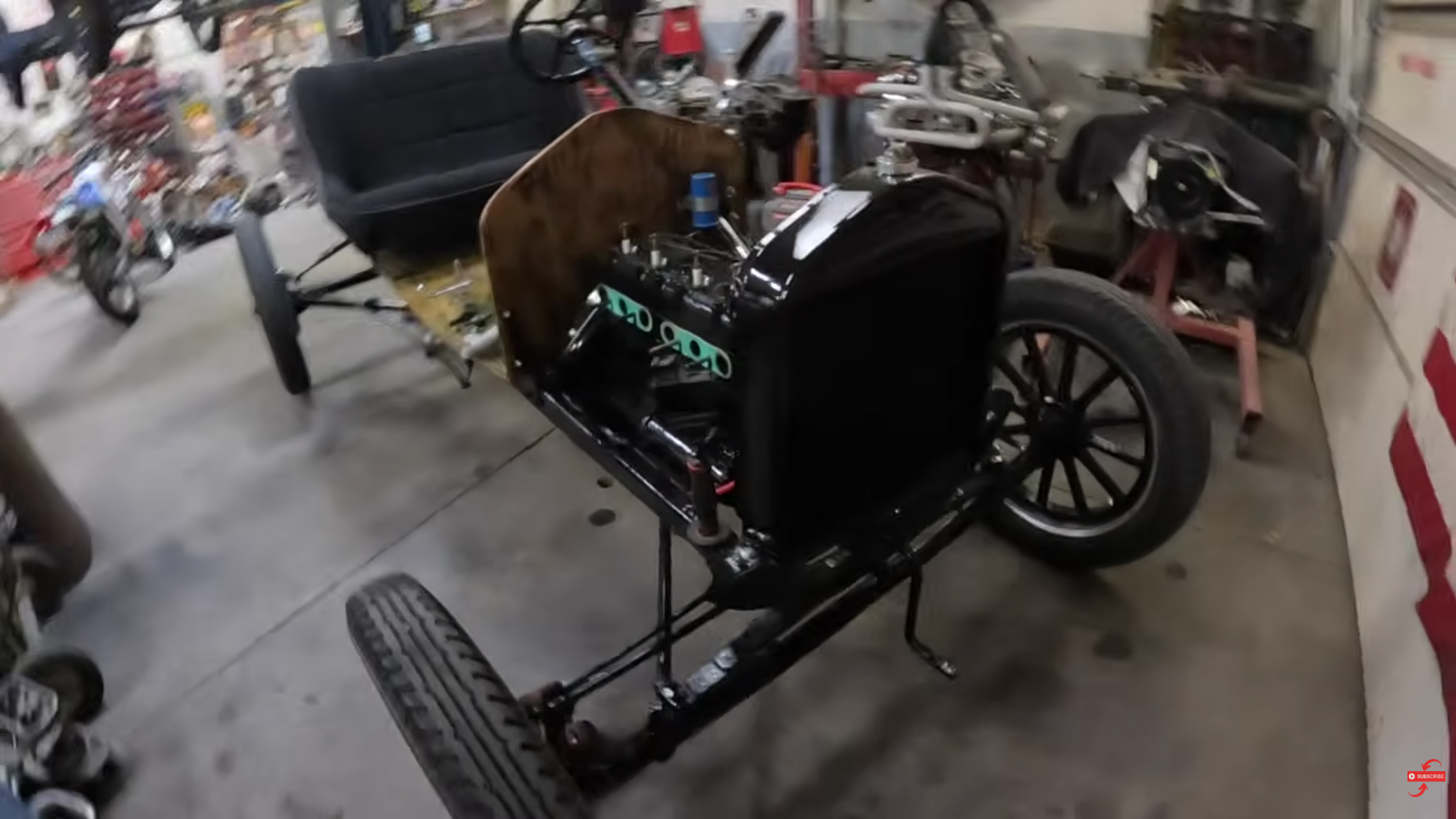
Johnson fabricated a custom flange and adapted the original-style manifold so the turbo could sit low beside the engine. Intake plumbing was routed over the top, with the factory-style Model T carburetor retained at the front.
Lubrication posed a challenge because the Model T engine doesn’t use a conventional pressurized oiling system. Johnson explained that the engine relies on a dipper-and-slinger arrangement, with the engine and transmission sharing the same oil supply.
Since a turbocharger needs lubrication, he created a homemade feed system using centrifugal force generated by the flywheel. Oil travels through copper tubing to the turbo before draining back into the engine through a siphon-style return.
Somehow, It Actually Works
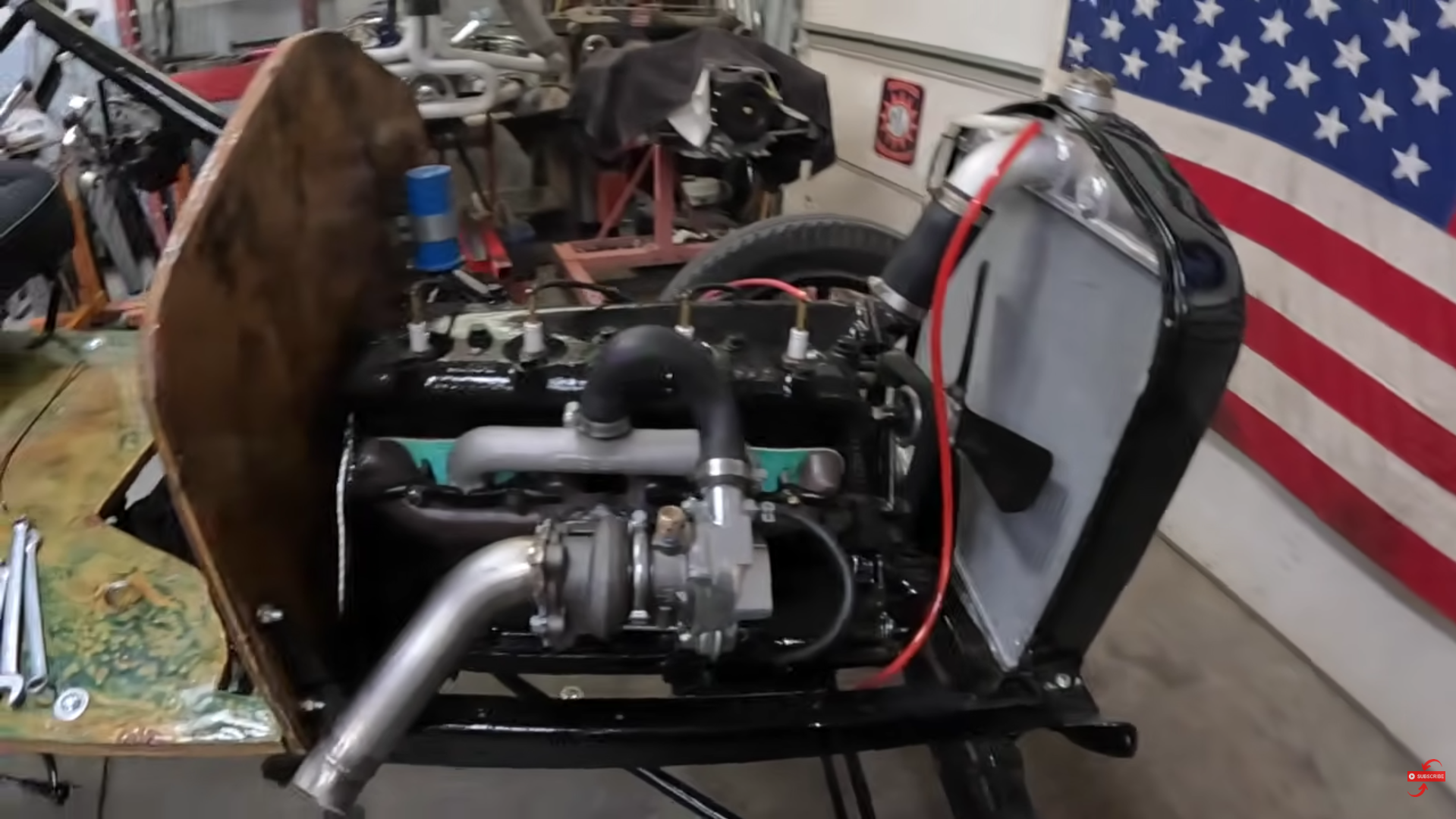
The first garage startup suggested the improvised system was functional. More importantly, Johnson later confirmed that oil was successfully flowing through the turbo rather than leaving it to cook itself within minutes.
He openly acknowledged that the setup isn’t ideal and that the turbo will probably wear faster than it would with a proper pressurized oil supply. For an experimental Model T build, however, simply keeping the turbo alive is already a win.
The engine itself is largely recognizable as the same basic four-cylinder Ford used more than a century ago. Johnson said stock examples made around 20 horsepower when new, while his own dyno testing has shown roughly 12 horsepower reaching the ground.
The Turbo Added Actual Speed
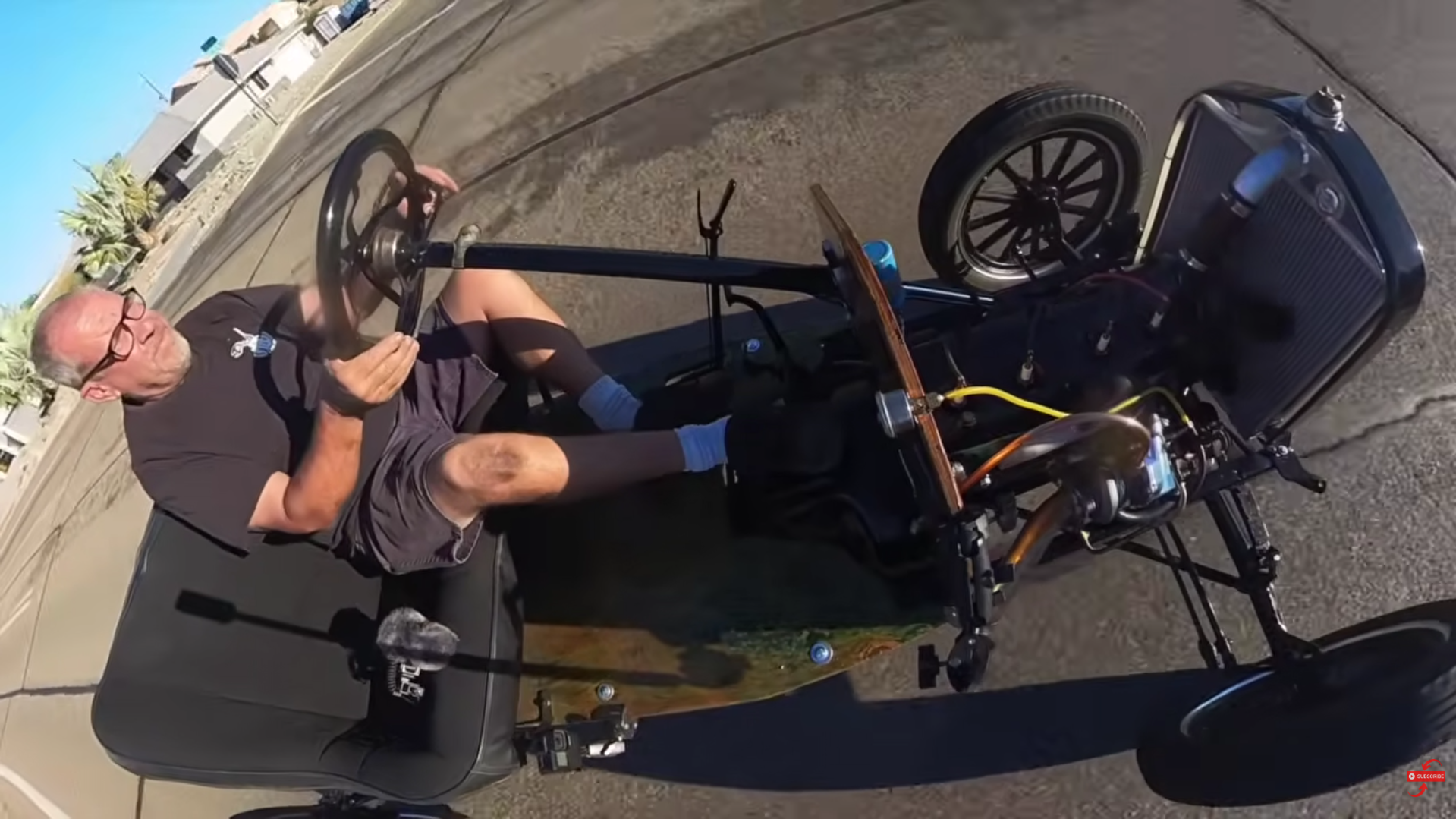
On the road, the experiment produced a measurable improvement. Johnson reported just over 28 mph during one run, roughly 5 mph faster than the car had managed before the turbo installation.
Boost initially appeared to sit around 2.5 to 3 psi during the run. Later testing showed the little tractor turbo could generate roughly 6 psi, with Johnson saying the Model T remained happy after a drive of around two miles.
In modern performance terms, gaining 5 mph sounds laughably small. When the starting point is a roughly century-old drivetrain producing little more power than some riding lawn equipment, however, the improvement is much more entertaining.
It’s Probably Not The Start Of A Model T Turbo Craze
There are easier, cheaper, and more proven ways to extract additional performance from an old Ford. Johnson’s project was clearly driven by curiosity rather than an attempt to develop the definitive Model T performance package.
That said, the build demonstrates that even an extremely simple, low-output engine can respond to forced induction when someone is determined enough to solve the supporting problems.