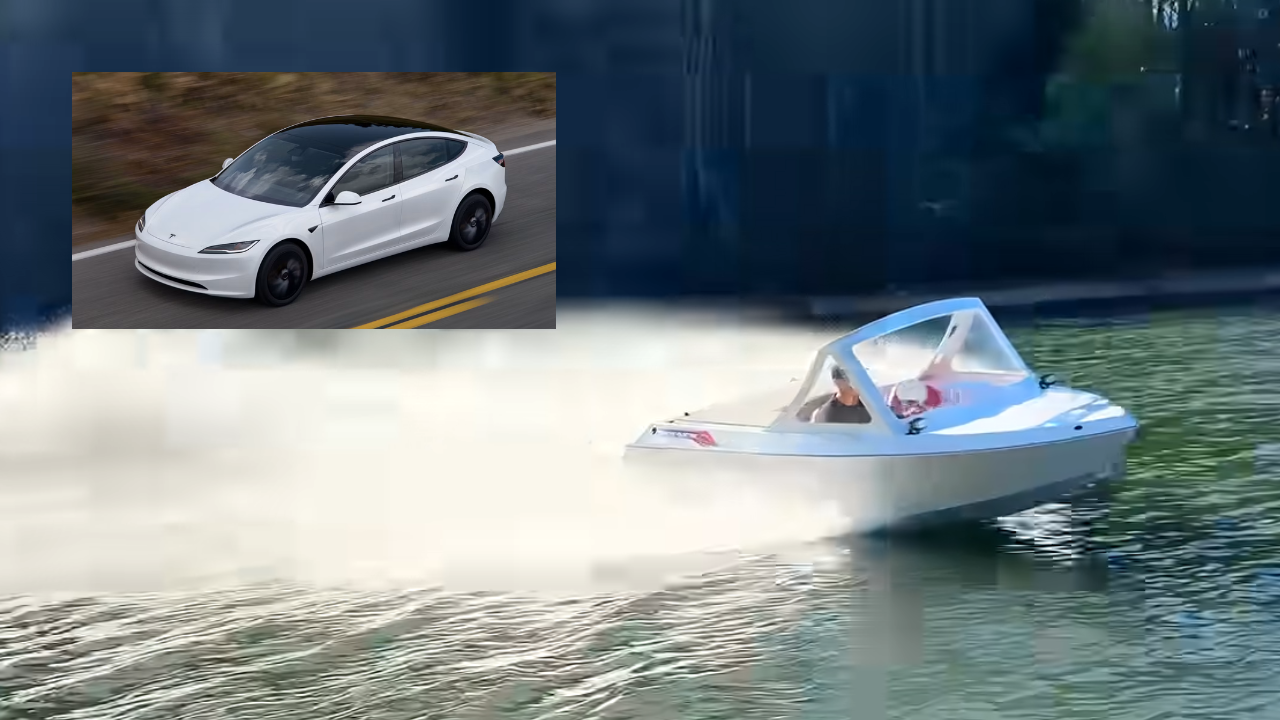
A YouTuber spent three years building a tiny jetboat using parts from a Tesla Model 3. After hundreds of hours of work, he finally got it onto the water. Unfortunately, getting it to run properly was another challenge.
Tyler Fever, who runs the Prop Department YouTube channel, started with a 2021 Tesla Model 3. Rather than converting an existing boat, he decided to build an entirely new one around the electric car’s parts.
The project involved stripping down the Tesla, building an aluminum hull, designing custom motor components, and finding a way to fit the car’s large battery modules inside a small boat.
In a video published July 30, 2026, Fever showed how he put everything together. The finished boat looked impressive, but its first trip across the lake revealed several problems.
Taking Apart a Tesla
Embedded media follows; please allow a moment to load.
The project began with Fever removing the Tesla’s battery pack and electric motor. He also showed footage of the stripped-down car being driven into a pond.
For the boat itself, he purchased a mini jetboat kit containing aluminum pieces for the hull. He then assembled the hull and installed a water-jet propulsion system.
However, connecting the Tesla motor to the jet pump wasn’t as simple as bolting everything together.
The motor’s original gearbox reduced its output speed by a ratio of 9:1. Fever needed more revolutions per minute to drive the jet pump, so he designed a custom shaft that connected directly to the motor’s rotor.
He also had to preserve the motor’s internal oil passages. After designing and testing several parts, he had the final pieces made at a machine shop.
Making Everything Fit
The Tesla battery pack created another problem. It was too large to install in the boat without major changes.
Fever took apart the pack and arranged its four battery modules inside two custom aluminum boxes. Each module weighed about 150 pounds, making installation difficult.
The electrical system proved even harder.
Fever initially tried using Tesla’s original controls with an aftermarket controller. When the systems failed to communicate properly, he decided to replace more of the factory electronics.
That meant purchasing a new battery management system, changing the wiring, and modifying the battery assemblies again.
He also installed an exterior charging port so the boat could connect to a compatible EV charging station.
Throughout the build, Fever warned viewers about the dangers of working with high-voltage batteries. The system operated at roughly 385 volts, and he repeatedly stressed that people should not attempt the same work without the necessary knowledge and equipment.
First Trip Goes Wrong
After roughly a year of building the boat itself, Fever finally brought it to a lake for testing.
Before the boat even entered the water, he realized he had forgotten to install the drain plug.
Once that problem was addressed, he powered up the motor and carefully moved away from shore.
At first, everything seemed to work. The boat moved under its own power, and Fever celebrated with his friend Brady.
Then the motor stopped.
The two tried restarting the system and clearing error codes. Fever eventually determined that one shutdown was caused by a power setting that was too low.
He adjusted the settings and tried again, but the problems continued.
The boat’s battery management system was limiting power because the batteries were showing signs of trouble. The water pump also appeared to stop working, creating another reason to end the test.
Despite several attempts, the boat couldn’t get fully up on plane, the point where a hull rises and skims across the water instead of pushing through it.
Three Years of Work
Fever eventually decided to return to shore rather than risk damaging the equipment.
Although the first test fell short of his expectations, he was pleased that the boat floated, stayed dry, and moved under electric power.
“There’s just a little bit more tweaking in the shop,” he said.
Later testing suggested that some of the Tesla battery cells had become badly unbalanced after spending a long time in storage.
The July 30 video ended with Fever planning further repairs and upgrades.
His project continued in subsequent episodes, including replacing weak battery modules and upgrading to a more powerful Tesla Model S motor. The later build was documented in the Tesla-Powered Boat series, which followed the project through additional testing.