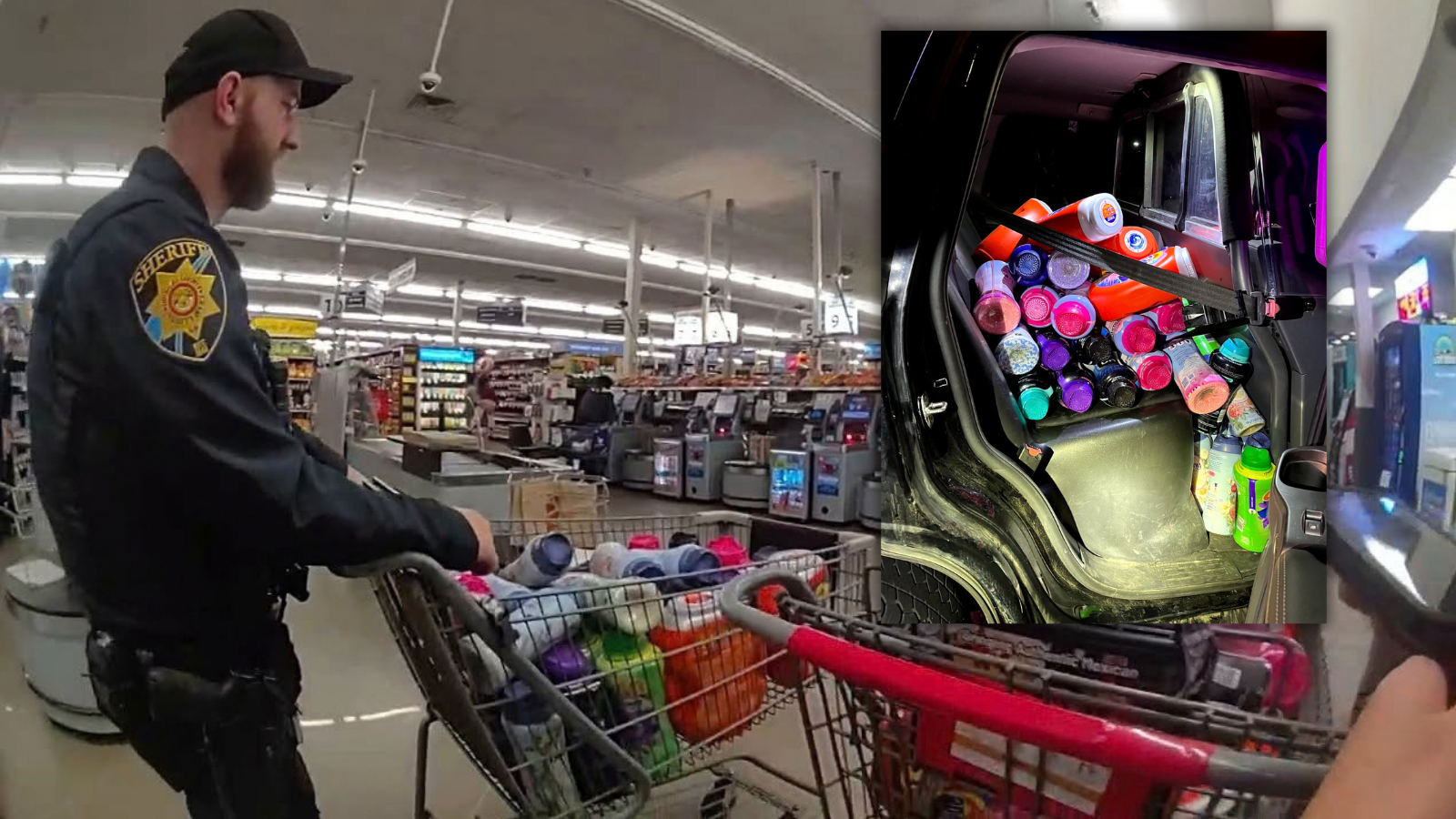
The back seat of the black sedan looked as if somebody had emptied a laundry aisle into it. Large containers of Tide and Gain were wedged together, with Downy products and scent boosters filling the gaps. More bottles sat outside the car under deputies’ lights.
On Wednesday night in Highlands Ranch, Colorado, the Douglas County Sheriff’s Office responded after a grocery store employee reported several people running out with more than $1,000 in merchandise.
Deputies found a black sedan nearby. Four people ran into a field, where drones equipped with thermal cameras helped officers locate them. All four were arrested, and three collectively had 13 outstanding warrants from other jurisdictions.
By the time the merchandise went back inside, deputies needed two shopping carts to move it.
Two Carts After Midnight
Embedded media follows; please allow a moment for it to load.
Laundry detergent looks like a remarkably unremunerative thing to steal: lots of bulk, lots of weight, and not much value per armful.
So why detergent?
Liquidity
A former thief interviewed for research on stolen-goods markets described his calculation plainly: “the first thing I think of before I take it is can I sell it.”
Priceonomics reported that prolific thieves developed what researchers called a “mental loot list,” shaped by what they already knew they could move through fences, acquaintances, street sales, home-based sellers and online markets. Some said stolen property could be gone within minutes.
Sgt. Aubrey Thompson of the Prince George’s County Police Department spent time trying to figure out why thieves kept targeting Tide.
“People just jump right on it,” Thompson told WTOP. “It’s a product that everybody uses. There’s no serial numbers, no way you can track it.”
He later put it even more simply to CNN: “It’s just a popular product, and everybody washes clothes.”
A Government Accountability Office study described organized retail theft as a chain in which “boosters” stole merchandise and “fences” moved it through flea markets, pawn shops, small retailers, online listings or fraudulent returns; retailers interviewed for the study estimated that traditional fences might pay about 30 percent of retail value, while online sales could bring considerably more.
The Tide Years
By 2012, Prince George’s County police were calling Tide “liquid gold.”
The Washington Post found $20 bottles selling for about $5 in parking lots, on street corners and through neighborhood stores. One Capitol Hill CVS clerk said a repeat thief might take a dozen bottles in a week.
Prince George’s County officers had found about 20 bottles in the home of a suspected drug dealer. Cpl. Henry Tippett told the Post that some stolen Tide was being traded for drugs. In another case, police spent months following four men they said moved from Safeway to Safeway, filled carts with Tide and ran them outside to waiting vehicles.
At one Washington CVS, economist Mark Perry photographed an anti-theft device on every $12 bottle of Tide while smaller, more expensive merchandise sat loose on the shelves. A nearby CVS in Dupont Circle kept Tide behind glass.
Charlene Holton, who worked at a 24-hour CVS in northwest Washington, said some thieves would grab several bottles, run, then cut the electronic tags off later with wire cutters.
“It’s a hot item!” she said. “It’s gotten out of hand.”
In 2024, the Florida Attorney General’s Office of Statewide Prosecution charged three people after more than 35 alleged thefts involving over $15,000 in detergent, fragrances and clothing. It said the goods were advertised on Facebook Marketplace and Instagram and delivered to customers.
All parties are presumed innocent unless and until proven guilty in a court of law.