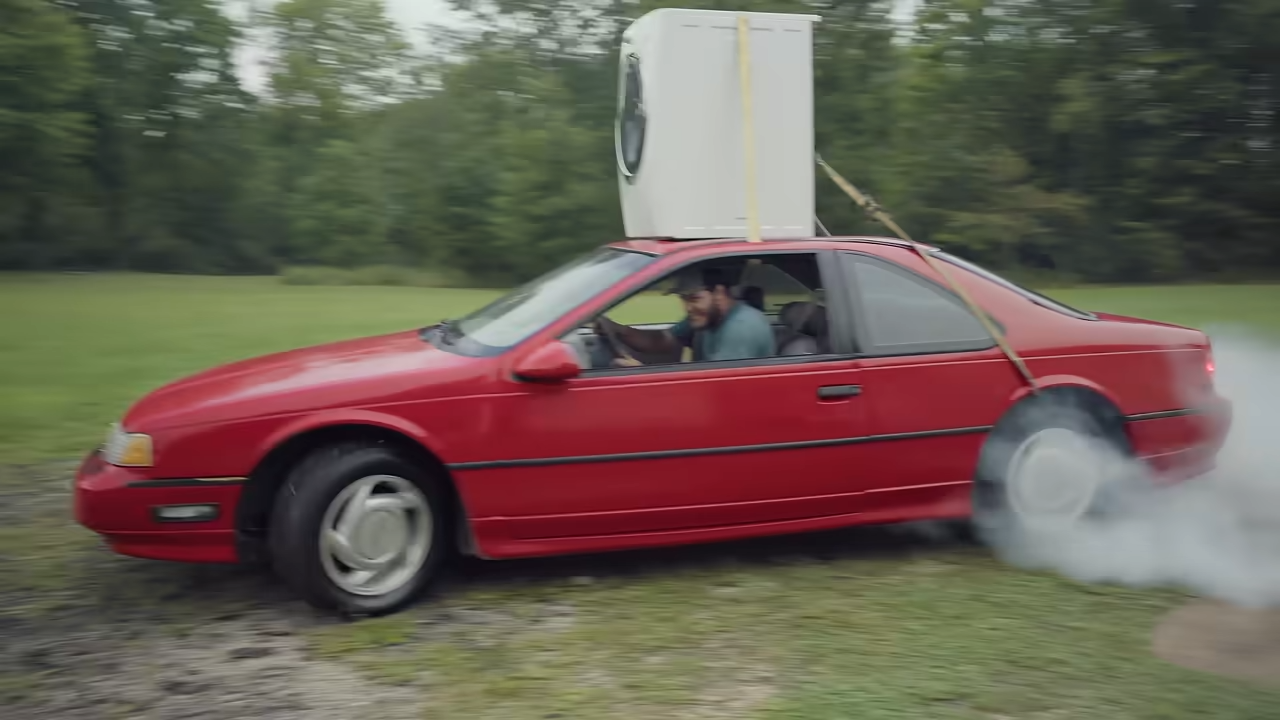
A 1992 Ford Thunderbird Super Coupe came from the factory with a supercharged engine. That wasn’t good enough for the crew at Airborne Entertainment, who decided an electric conversion would be more interesting. Their choice of replacement motor was a little unusual.
Rather than buy an electric drivetrain, they pulled a washing machine from a dumpster. The plan was to use its motor to power the Ford while keeping the washer itself in working order.
It sounds like a joke, and much of the build is played for laughs. Still, the crew wanted to find out whether their homemade setup could move a full-size car. They had the Thunderbird’s transmission to work with and a collection of parts that weren’t exactly made for automotive use.
What followed was a series of changes that eventually put the car on public roads. The Thunderbird would get a much larger electric motor, a gas-powered generator, and even a household ceiling fan before the experiment was over.
Out With The V6
Embedded media follows; please allow a moment to load.
The crew started by removing the Thunderbird’s supercharged engine. Before pulling it, they even tried using the supercharger as a vacuum to clean the filthy interior. That experiment ended with dust flying everywhere and the engine appearing to seize.
With the engine out, they lowered the washing machine into the empty bay. A sprocket connected its motor to the car’s transmission, and a controller managed the motor’s speed.
The washer still had its original controls, which made starting the car rather strange. After selecting a wash cycle, they waited for the drum to spin before attempting to drive.
For a few moments, it worked. The Thunderbird moved under its own power, but the drive ended after roughly 15 feet. The chain came loose, and smoke began pouring from the washing machine motor.
A Bigger Motor
Instead of giving up, the crew found a three-phase industrial electric motor. It was much larger than the washer motor and had enough power to turn the Thunderbird’s wheels during testing.
Their new setup used a variable frequency drive to control the motor. A knob served as the throttle, and a breaker panel handled the electrical supply.
There was one major problem. The Thunderbird had to remain plugged into an outside power source, which limited how far it could travel.
A 220-volt gas-powered generator solved that issue. Mounted in the car, it supplied electricity to the industrial motor without the need for a long extension cord.
The result was a homemade gas-electric vehicle with no large traction battery. The crew kept joking about its environmental benefits, even though the generator burned gasoline to make the electricity.
Roadside Trouble
Once the Thunderbird reached public roads, its limits became clear. Acceleration was slow, hills placed a heavy load on the generator, and the motor controller kept displaying error codes.
At one point, the car was moving slowly enough to hold up traffic. A police officer also approached the crew and asked about the vehicle.
They eventually reached an O’Reilly Auto Parts store, hoping someone could diagnose the electrical problems. The employees couldn’t identify the controller’s faults using a normal automotive code reader.
On the trip back, the generator ran out of fuel while the Thunderbird was in an intersection. The crew managed to find a small amount of gasoline and get moving again.
Household Upgrades
Changes to the gearing later helped the car reach roughly 40 mph, according to the crew. With the original engine gone, however, the Thunderbird had also lost its normal air conditioning.
Their solution was to buy a household ceiling fan and install it inside the cabin. The spinning blades hung close enough to the occupants that one member of the crew refused to ride with it running.
They eventually decided to use the fan while parked and turn it off before driving. A toaster also made an appearance, drawing power from the same system.
During a later fuel stop, the crew put about 1.3 gallons of gasoline into the generator and joked about how quickly their homemade electric car could be refueled.
By the end of the Airborne Entertainment video, the Thunderbird was still driving with its industrial electric motor, generator, and original manual transmission. The crew described it as a Sunday cruiser, with a top speed of around 35 mph during their final drive.