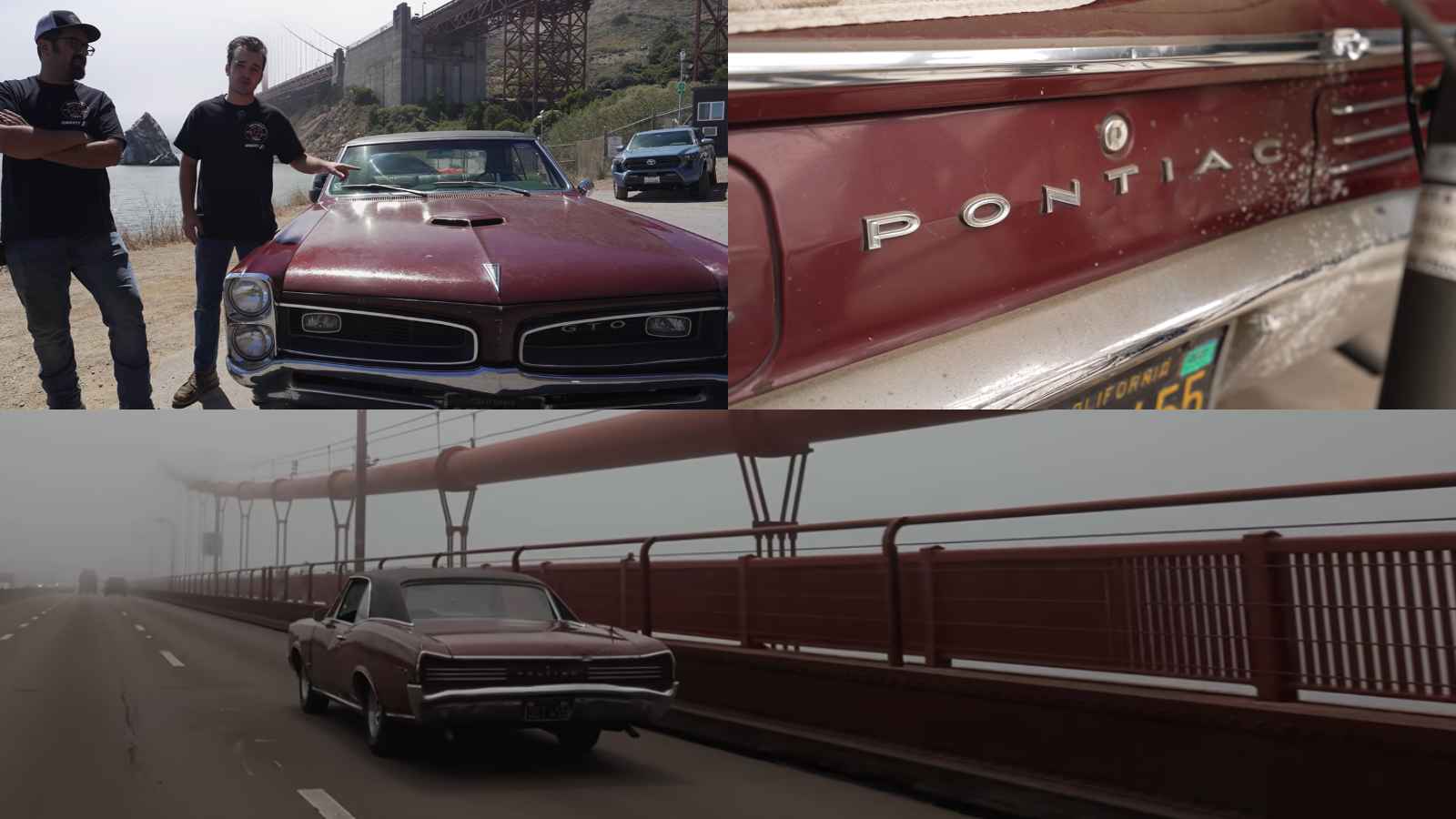
A 1966 Pontiac GTO spent more than 25 years sitting in a San Francisco garage, despite being one of the more desirable muscle cars of its time. The maroon coupe was still largely original, right down to its 389-cubic-inch V8 and three-carburetor setup.
Its current owner, Doug, had bought the car from a friend’s family more than a decade earlier. He knew about its history and wanted to get it running, but the Pontiac remained parked as the years passed.
When Dustin Hallinan and John Brito from Hagerty’s Driveway Finds arrived, they found an unusually complete car. The interior was moldy, the body had dents from years of city life, and the brakes needed work. But much of what made the GTO special had survived.
Getting it running would take more than a fresh battery. Its rare Tri-Power engine had several problems, and the crew would spend much of the project chasing issues that kept the Pontiac from running properly.
A Family Favorite
The GTO’s history goes back to a Pontiac dealership on Van Ness Avenue in San Francisco. Bob, whose parents bought the car new, remembers helping them choose it.
“They weren’t much on cars, but I liked hot rods,” he recalled. After leaving the showroom, Bob took the GTO to show his friends. He also used it on his wedding day, and photographs from that celebration survived with the family.
Doug eventually bought the car after Bob’s daughter, a longtime friend, told him it might be available. Although he had owned it for more than 10 years, he told the Hagerty crew he had never even sat behind the wheel.
Inside the Pontiac, the mechanics found its original window sticker, build sheet, owner’s manual, and warranty paperwork. They also found old insurance documents and information about the salesman who sold the car.
Three Carburetors, Plenty Of Trouble
Under the hood was Pontiac’s 389-cubic-inch Tri-Power V8, rated at 360 horsepower when new. Its three two-barrel carburetors made it a really intriguing option, but they also gave the mechanics plenty to work on.
Before attempting to start the engine, the crew lubricated its cylinders and checked compression. One cylinder measured around 70 PSI, far below another that reached 120 PSI.
The engine eventually fired, but running smoothly was another matter. A damaged accelerator pump, corroded carburetor parts, and vacuum leaks made tuning difficult. At one point, the mechanics removed the two outer carburetors to focus on getting the engine to idle properly. If anything, they just wanted it to run.
The car also needed brake repairs, fuel-system work, and shifter attention. Its original radiator leaked badly, and attempts to patch it failed. A temporary replacement eventually allowed the road testing to continue.
Back Across The Bridge
Once all three carburetors were working, the GTO felt surprisingly strong. During a test drive, the crew took it onto the freeway, where it cruised at 60 mph without trouble. It’s smooth sailing from here.
“This is definitely one of the best cars we’ve brought back to life from a driving standpoint,” one mechanic said. The steering felt tight, the shifter worked properly, and the car handled better than they had expected.
They also used a basketball to improve a large dent in the driver’s door, cleaned the paint, and replaced the worn fan clutch.
Four days after towing the Pontiac across the Golden Gate Bridge, the crew drove it back across under its own power.
Doug finally took the wheel when the car was returned. They asked whether the drive was everything he had hoped for, and he said, “Absolutely.”
He had no plans to sell the Pontiac for a profit. “I didn’t buy a car to turn around and sell it,” he explained. “I want to keep it.”
One final compression test also brought good news. The cylinder that initially measured around 70 PSI had climbed to nearly 120 PSI after the engine had been running again.