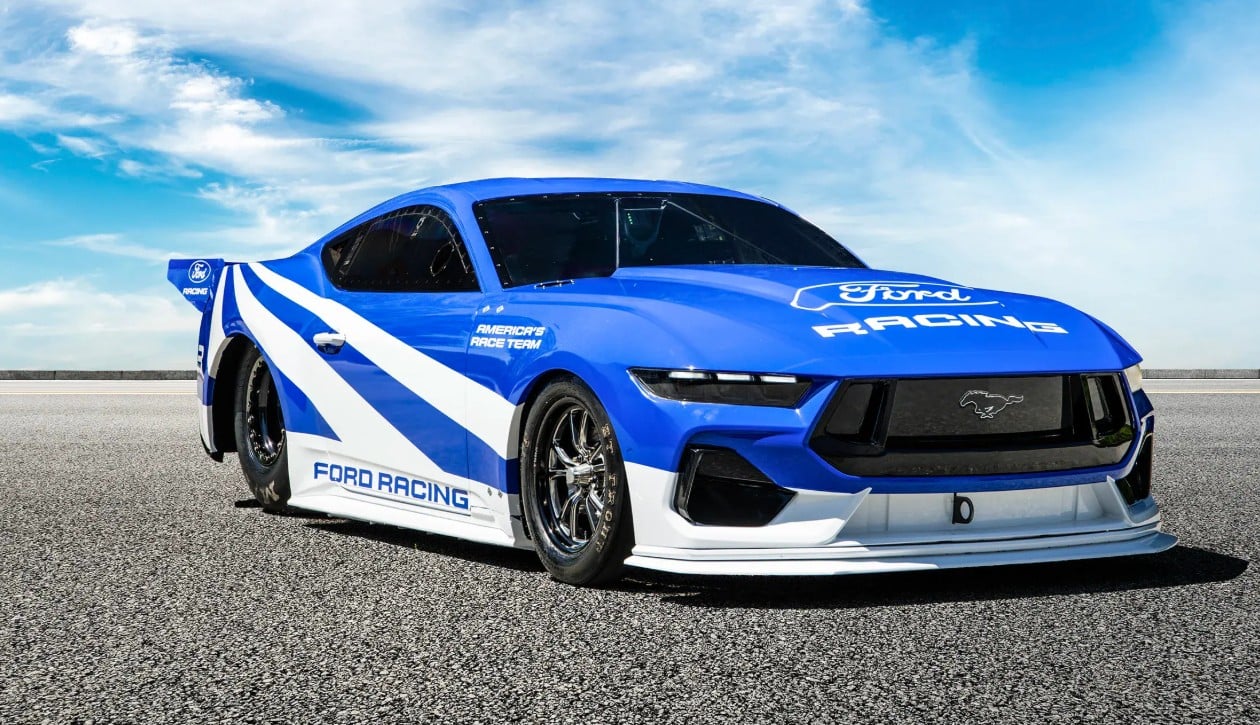
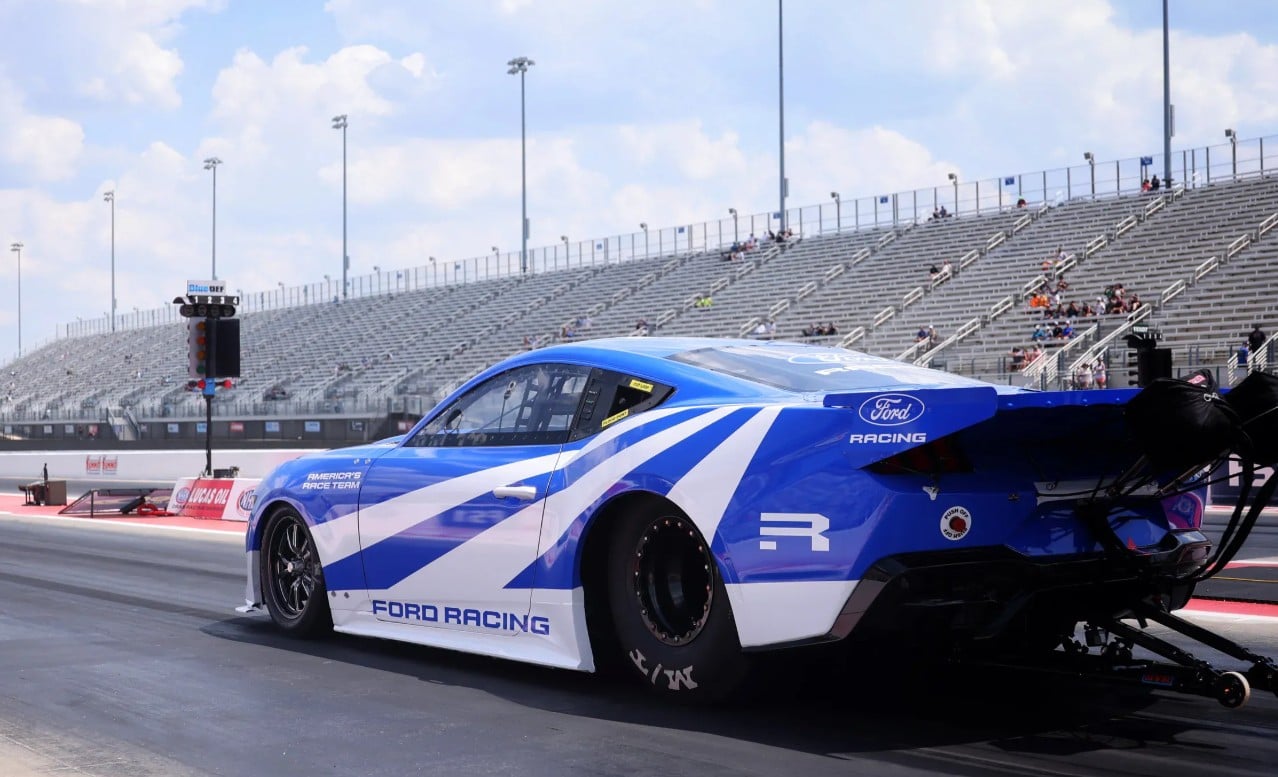
Through innovations in the world of motorsports, Ford Racing has been finding new ways to understand the future of performance and accelerate development through projects, such as the Mustang Cobra Jet 2200.
Most automakers use motorsports as a platform not only to compete against other manufacturers but also to develop their own technology, and with Ford’s foray into electric vehicle development in recent years, even partnering with Red Bull Powertrains to develop power units for Red Bull’s F1 car, Ford’s ambitions in electrification are clearly running deeper than most anticipated.
But hardly did anybody think that the Blue Oval was working on a 2,200-horsepower monster to break the world record at NHRA Charlotte, sending a message to the industry, competitors, and customers about what Ford can do and the kind of technology it is currently developing.
Turning up in Ford’s white and blue colors, the Mustang Cobra Jet 2200 broke a big record, becoming the fastest electric car in the quarter mile with “a low ET of 6.76 and top speed of 222 mph in the quarter mile.”
Big Leap From the Mustang Cobra Jet 1400
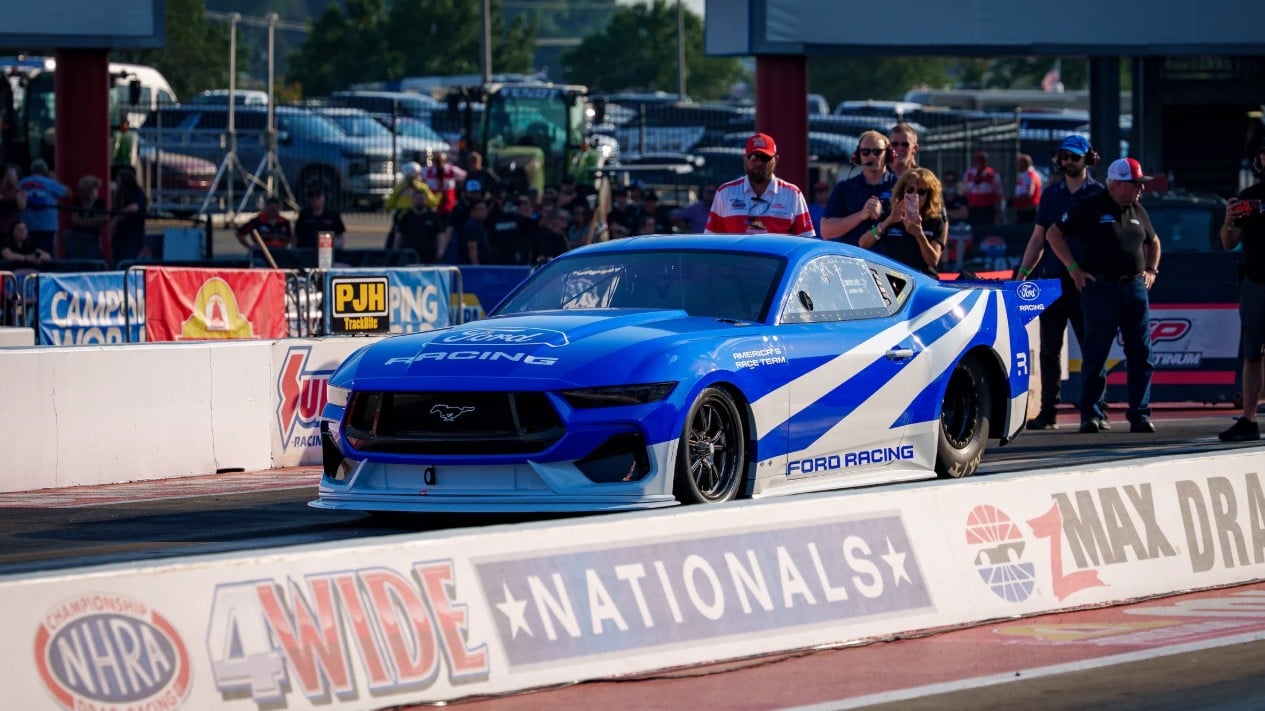
Ford developed several variants of the Mustang Cobra over time, such as the Cobra Jet 1400 and the Super Cobra Jet 1800, which helped the team push the envelope of electric drag racing. One of the three main aspects Ford covered with the Cobra Jet 2200 record-breaking car was severe weight reduction.
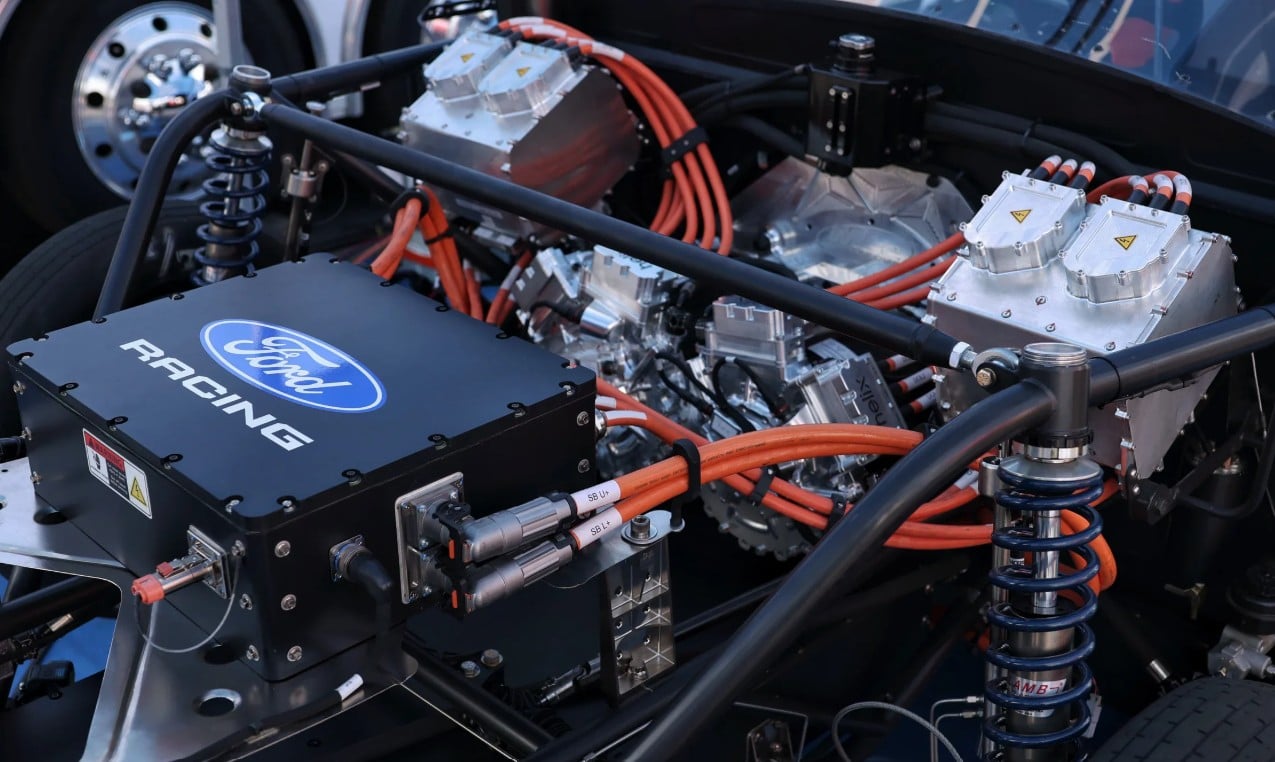
Ford revealed in a statement that the Cobra Jet 2200 is over 900 pounds lighter than the Super Cobra Jet 1800, which was 1,000 lbs lighter than the Cobra Jet 1400. The brand has achieved that despite using two 1,200-horsepower electric motors, thanks to the carbon-fiber body and NASCAR-inspired vinyl wraps, which are lighter than standard wraps by 20 pounds.
Then there is the power. The Cobra Jet 2200 delivers 2,200 horsepower and 1,340 ft-lb of torque to the wheels in a smart way that the tires can handle. The Reverse-Acting Centrifugal Clutch (RACC) that Ford patented, paired with a 5-speed clutchless transmission, helps prevent the tires from slipping through a controlled torque application, helping the car maintain composure as it catapults its way forward on the drag strip.
Lastly, Ford infused a modern motorsport aspect into the Cobra Jet 2200: safety. This is courtesy of a pyrotechnic circuit breaker (pyrofuse), which helps isolate the high-voltage system on demand to enhance safety in a real racing environment.
The system is isolated by breaking the high-voltage circuit entirely through a minor detonation. Ford partnered with NHRA to develop a cut loop system, enabling safety workers to activate the pyrofuse from outside in emergency situations.
Motorsports Has Been a Part of Ford’s DNA
Ford revealed in a statement how motorsport has been a part of its DNA, helping it push boundaries that have led to several breakthroughs in recent years, and the Cobra Jet 2200 is one of them. Nick Kuhajda, Ford Racing Engineering Manager, wrote:
“Motorsports has long been one of the clearest ways to accelerate development because it concentrates effort around a hard target. It forces clarity. It reveals strengths. It reveals weaknesses. It pushes engineering teams to solve real problems with real consequences. A racing environment does not let you hide behind theory for very long. You either perform, or you learn exactly what needs to improve.
“That has always been part of Ford’s racing DNA, and it remains true here. Cobra Jet 2200 is a demonstration of speed, yes. It’s also a demonstration of capability, of intent, and of a mindset that says innovation should be tested where the standard is high and the outcome is measurable.
“The official results from the event matter, and we are proud of what the team achieved. But what excites me just as much is what comes next. Every pass of the Mustang Cobra Jet 2200 gives us information and adds to our understanding. Every milestone creates a new target. That is how serious racing programs evolve, and that is how meaningful technical progress happens to make better products for our customers.
“The timeslip tells one part of the story.
“What we learn from it tells the rest.”