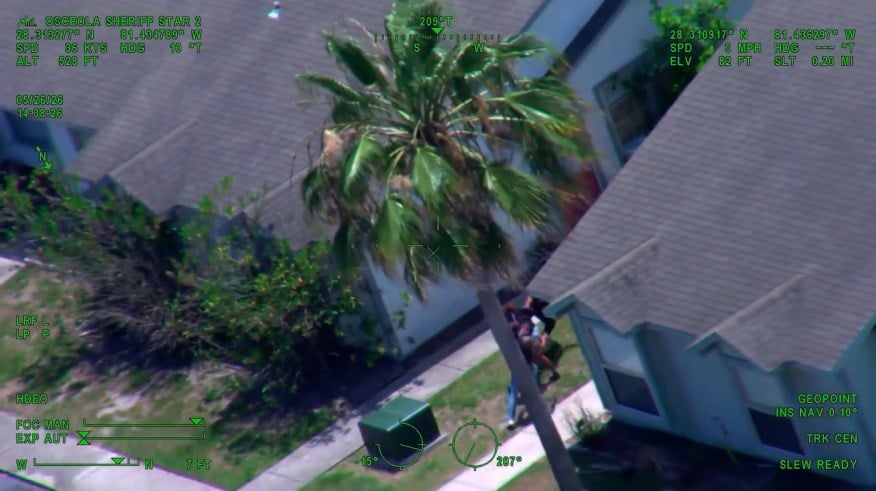
A Kissimmee man with an outstanding warrant thought he could outrun the Osceola County Sheriff’s Office through busy public streets. He was wrong on nearly every count. The multi-mile pursuit on May 26 put countless innocent drivers and pedestrians at risk before a Florida Highway Patrol trooper stepped in with a precision driving maneuver that brought the whole charade to a screeching halt.
What happened next pushed the incident from a garden-variety pursuit into something considerably more disturbing.
Michael Nathaniel Deregla led deputies on what the Osceola County Sheriff’s Office described as a “dangerous multi-mile” vehicle pursuit through Kissimmee before apparently deciding that four wheels were no longer working in his favor. Rather than surrendering on the spot, he bailed from the vehicle and made a run for it on foot. That decision alone was not particularly original. What followed, however, raised the stakes considerably.
After exiting his car and attempting to flee, Deregla grabbed a bystander and used that person as a human shield before deputies were able to apprehend him. The bystander, an uninvolved member of the public who presumably had no intention of becoming part of a law enforcement takedown that afternoon, was fortunately not seriously harmed. Deregla was taken into custody without further incident, according to the sheriff’s office.
The incident stands as a reminder that the danger in a vehicle pursuit rarely ends when the car stops. When a fleeing suspect decides that a random stranger makes a convenient bargaining chip, the situation graduates from a traffic and criminal matter into something law enforcement trains specifically to counter.
Kissimmee may be best known to most Americans as the front door to Central Florida’s theme park corridor, but its roadways see their share of incidents that have nothing to do with rollercoasters.
What Set the Chase in Motion
The Osceola County Sheriff’s Office said the incident began when deputies identified Deregla as having an active warrant. A deputy attempted a traffic stop, but Deregla chose to run. That decision set off a chain of events that would wind through Kissimmee’s public roads and ultimately involve both OCSO and the Florida Highway Patrol working in tandem to track the vehicle.
Active warrants are not an uncommon trigger for pursuits. A driver who knows law enforcement wants them for a prior offense faces an immediate calculation the moment blue lights appear in the rearview mirror. Many comply. Some do not. Deregla landed firmly in the second category, and the public roads of Kissimmee became the proving ground for that choice.
Weaving Through Traffic, Driving Into Oncoming Lanes
Video released by OCSO shows Deregla weaving through traffic and driving the wrong way on a busy road. According to the sheriff’s office, he “drove aggressively, violated traffic laws and traveled against traffic, posing a serious risk to motorists and pedestrians.”
Wrong-way driving during a pursuit is one of the most dangerous variables officers face, because it introduces a head-on collision threat not only for the fleeing vehicle but for every other driver approaching from the opposite direction. Reaction time at combined closing speeds leaves almost no margin for error.
The fact that this particular chase wound through a heavily traveled urban corridor, rather than a rural stretch of highway, made the hazard considerably more acute.
Anyone who has navigated the arterial roads around Kissimmee during a typical afternoon knows those roads are rarely quiet. Mix in a driver deliberately going against traffic to evade police, and the potential for catastrophic collateral damage becomes very real.
How the Florida Highway Patrol Ended It
OCSO and the Florida Highway Patrol continued to track Deregla before a trooper executed a Precision Immobilization Technique maneuver. The PIT, as it is commonly known, is one of the more tactically elegant tools in a pursuit trooper’s kit. The maneuver involves a deputy using the front fender of a patrol vehicle to make contact with the rear bumper of the suspect’s vehicle, causing it to turn and come to a complete stop.
The technique was developed in the late 1980s by BSR Inc., a law enforcement training center in West Virginia, and was first used by the Fairfax County Police Department in Virginia in 1988. For car enthusiasts who follow motorsport history, the concept will sound familiar.
The PIT maneuver was adapted from the bump-and-run technique once used in stock car racing, where drivers would make contact with a competitor to induce a spin. The racing world eventually moved away from it at high speeds for obvious reasons. Law enforcement adapted and refined it for controlled, lower-speed application. WikipediaIssuu
When performed below 35 mph, the maneuver is generally regarded as safe, with the fleeing car consistently spinning before rolling to a stop, followed by the arrest of a disoriented suspect. However, as speeds increase beyond 45 mph, outcomes become increasingly unpredictable.
In this case, the trooper’s execution of the technique brought the vehicle to a stop and forced Deregla onto his feet, where he made one final poor decision before being taken into custody.
The Bystander Factor
The use of an uninvolved civilian as a shield is not merely an aggravating circumstance. It is a separate and serious act that transforms a pursuit and flight offense into something far more personal for whoever happened to be in the wrong place at the wrong moment.
The sheriff’s office reported that Deregla was arrested without further incident following the confrontation, which is the best possible outcome given how quickly that kind of standoff can deteriorate.
Law enforcement in Florida, and in Kissimmee specifically, operates in a region where the density of residents, tourists, and commuters on any given stretch of road is substantial. The consequences of a pursuit that goes sideways, literally or figuratively, extend well beyond the driver trying to escape.
Deregla’s decision to drag a stranger into his exit strategy is a detail that sets this incident apart from the dozens of Florida pursuits that end with a spun-out car and a suspect in handcuffs. The roads around Kissimmee are not a stage. The people on them are not props.