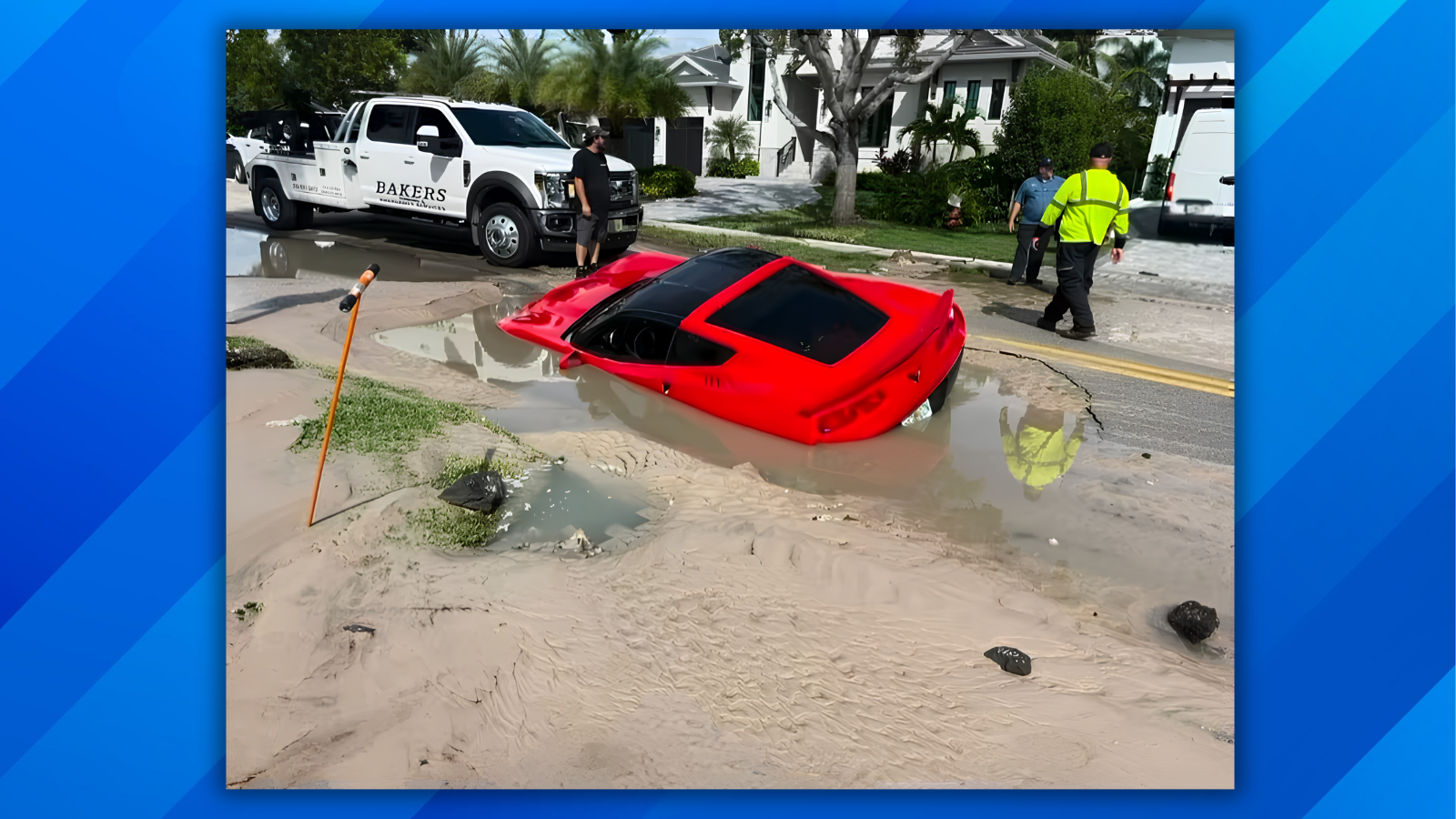
A red Chevrolet Corvette Stingray ended up nose-down in a water-filled hole on a Florida roadway, leaving a towing crew with the unusual task of getting the low-slung sports car back onto solid pavement.
The Corvette was recovered from Crayton Road in Naples on October 8, 2026, after a sinkhole opened near the 3500 block. Video from Bakers Towing & Emergency Service shows the C7 Corvette tilted sharply into the collapsed pavement, with water surrounding much of the driver’s side.
The recovery came one day after heavy thunderstorms brought flooding to the Naples area. The National Weather Service reported that 3 to 4 inches of rain had fallen across part of western Collier County by Wednesday afternoon, with another 1 to 2 inches possible.
The Naples Police Department confirmed the sinkhole in an October 8 traffic alert, announcing road closures and detours around the damaged pavement. The department did not identify what caused the collapse.
Getting the Corvette Back on Solid Ground
Embedded media follows; please allow a moment for it to load.
Bakers Towing posted the footage with a fitting description: “When it’s just not your day,” followed by “Sinkhole+corvette=oh shit!!!!”
The video begins with the Torch Red Corvette resting at a steep angle inside the roadway opening. Its driver’s side sits partly in the water, while the passenger side remains elevated.
Recovery workers use cables attached near the wheels to pull the car out. As the Corvette moves, its tires emerge from the cavity and the body gradually returns to street level.
Despite the awkward extraction, the bodywork looks surprisingly intact in the footage. The driver’s-side headlight flickers during the recovery, although the video alone cannot establish whether water damaged the electrical system. Damage to the suspension, underbody, and other components would require an inspection.
The footage also leaves an important part of the story unanswered: how the Corvette entered the hole. Its final position does not establish whether the driver encountered an existing opening or the pavement collapsed beneath the vehicle.
A Road Closure After a Soaking
At 4:59 p.m. Thursday, Naples police issued a traffic alert identifying a sinkhole near 3505 Crayton Road, in the city’s Moorings area.
Crayton Road was closed between Parkview Drive and Binnacle Drive. Police directed traffic on Mermaids Bight northbound and installed barricades and detour signs around the damaged section.
The previous afternoon, the National Weather Service had issued a flood advisory for western Collier County, including Naples and East Naples.
At 3:52 p.m. on October 7, weather radar indicated that 3 to 4 inches of rain had already fallen in the advisory area. Additional thunderstorms threatened another 1 to 2 inches, and the agency warned of flooding in low-lying locations and areas with poor drainage.
That rainfall provides important context for the water surrounding the Corvette, but it does not establish why Crayton Road failed. A detailed investigation would need to determine what happened beneath the pavement.
Florida Roads Have Been Giving Drivers Some Surprises
The Corvette is hardly the first Florida vehicle to encounter a roadway that suddenly stopped behaving like a roadway.
On September 16, just three weeks earlier, a white Infiniti sedan and a tractor-trailer became trapped when pavement collapsed at Northwest 79th Street and 30th Avenue in Miami-Dade County.
The Infiniti’s driver, Mattias Wettergren, told Local 10 that he saw water rushing beneath his car before an 18-wheeler attempted to pass and became stuck nearby. Miami-Dade Water and Sewer officials attributed the roadway failures to a broken water main.
Heavy rain contributed to another collapse in Palm Bay on June 3, when an already deteriorating underground pipe failed beneath Turkey Creek Drive.
According to FOX 35 Orlando, the resulting washout cut off vehicle access to a senior community of approximately 120 residents. Because the damaged road was the neighborhood’s only entrance and exit, authorities prepared welfare checks and emergency transportation arrangements involving a police boat and golf carts.
Both incidents illustrate how failed underground infrastructure can remove the support beneath otherwise ordinary pavement.
Not Every Hole Is the Same Kind of Sinkhole
People tend to call any enormous hole in the road a sinkhole, but the explanation can be considerably more interesting than the name suggests.
A broken water main or drainage pipe can wash away supporting soil until the asphalt above it gives way. A geological sinkhole develops through a different process, commonly involving water dissolving soluble rock such as limestone and gradually creating underground voids.
Florida supplied an impressive example of the geological variety in February, when a section of Empire Church Road near Groveland collapsed into a cavity estimated at 200 feet long, 90 feet wide, and 50 feet deep.
In a February 12 announcement, Lake County said geotechnical engineers confirmed a sinkhole and identified the area’s underlying limestone geology as a contributing condition.
The distinction matters when identifying the cause of a collapse, although geological sinkholes and infrastructure-related subsidence can produce remarkably similar scenes at street level.
Naples police used the term sinkhole for the Crayton Road failure. Whether it involved geological conditions, underground infrastructure, or another mechanism has not been established in the information released so far.
One More Problem for the Corvette
For the owner, getting the car back onto pavement may be only the beginning.
Even when a vehicle survives a recovery with relatively little visible body damage, water exposure can affect electrical connectors, wiring, control modules, wheel bearings, and other components. Saltwater exposure can create additional corrosion concerns, though the water surrounding this Corvette has not been identified as fresh or saltwater.
The C7 Corvette’s low ground clearance also leaves little room for error when the road surface disappears beneath it. Components underneath the vehicle may have sustained damage that cannot be assessed from the towing footage.
Whether the Corvette can return to the road will depend on an inspection, the extent of any water intrusion, and the damage sustained during the original incident and recovery.
Not a Great Week for Florida Corvettes
While we’re on the subject of Florida Corvettes having a bad day, another driver recently had a considerably faster encounter with trouble.
Florida Highway Patrol troopers pursued a 19-year-old driving a Corvette at speeds reaching 130 mph before ending the chase with a PIT maneuver. Investigators also connected the driver to an earlier crash that caused approximately $140,000 in damage.
Watch the pursuit and the moment troopers brought the Corvette to a stop.