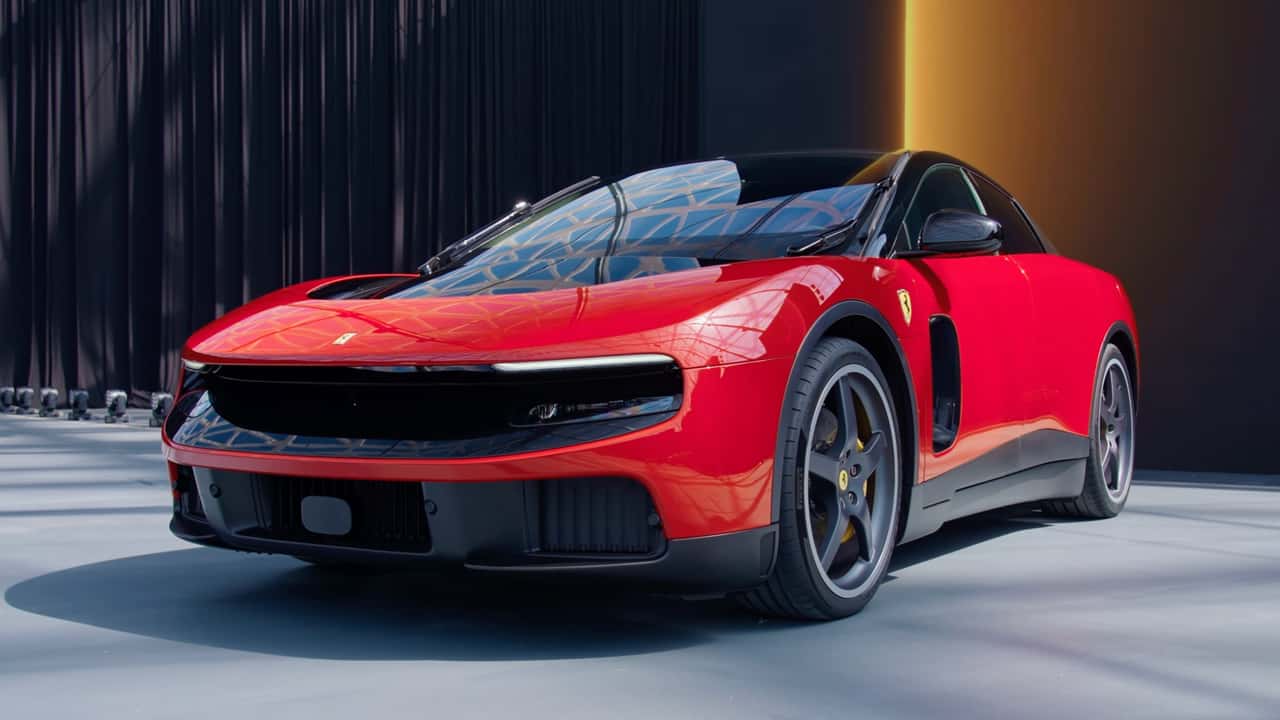
Ferrari made history this week by unveiling the Luce, its first-ever fully electric vehicle. The Italian automaker chose an appropriately dramatic backdrop for the occasion: a Rome sports complex that looks like something out of a science fiction film. The reveal was tightly controlled, with event security reportedly blocking attendees from taking photos on their phones. That kind of secrecy is either a sign of supreme confidence or a warning that someone in the room knows the internet is not going to like what they are about to see.
As it turned out, it was a little of both. The Luce is a genuine technological achievement, packed with performance credentials that would impress any serious driver. But the design landed about as warmly as a cold espresso in Naples, and the markets responded accordingly. Ferrari shares fell sharply on Tuesday, the day after the company launched the Luce. By the end of the week, Ferrari’s stock had dropped as much as 8%, wiping out billions in market cap, though it has since partially recovered.
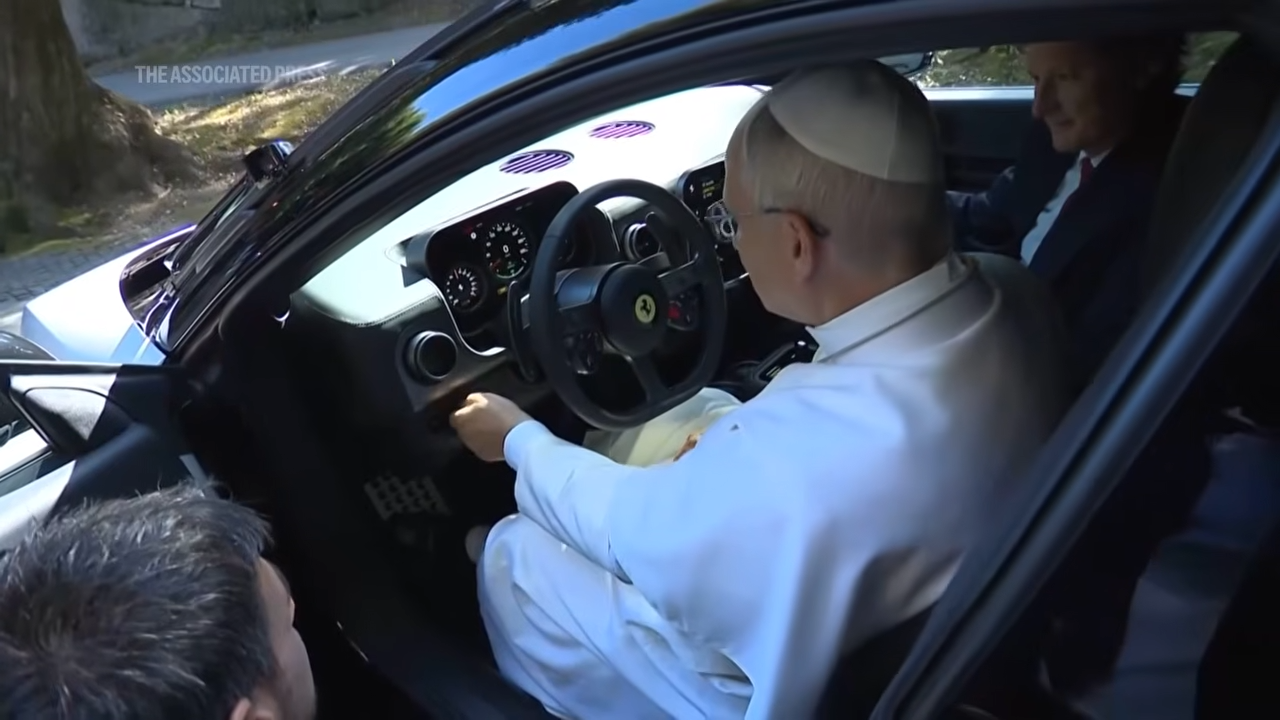
To try to turn the page on a rough news cycle, Ferrari did what any Italian luxury brand worth its salt would do: it went to see the Pope. Pope Leo XIV received the steering wheel of the Ferrari Luce as a gift, and had the opportunity to sit in the driver’s seat of the new vehicle during a visit from a Ferrari delegation led by chairman John Elkann and CEO Benedetto Vigna at the papal residence of Castel Gandolfo on the morning of May 26. Not exactly a standard product launch stop, but then again, Ferrari has never been a standard kind of company.
The papal visit made for good optics, but it did not quiet the critics. Former Ferrari chairman Luca di Montezemolo told Italian media to, as one report put it, “at least take the prancing horse off.” Italy’s own transport minister weighed in negatively. Analysts compared the Luce’s styling to a Honda Accord EV and a Tesla Model 3. For a brand built entirely on the idea of being the most desirable car in any room it enters, that is a genuinely uncomfortable place to be.
What the Luce Actually Is
Before passing judgment, it is worth looking at what Ferrari has actually built here. The Luce uses four electric motors, one on each wheel, and delivers up to 1,040 horsepower. Ferrari estimates a driving range of 530 kilometers, and acceleration from 0 to 100 km/h takes 2.5 seconds. The electric platform features F80-derived motors at each wheel, independent torque vectoring, active suspension with no anti-roll bars, rear-wheel steering, and a center of gravity 95 millimeters lower than the Purosangue.
That last detail matters more than it might initially seem. One of the biggest structural challenges with electric vehicles is that battery packs under the floor raise the car’s ride height and push the center of gravity up, making the car feel less athletic than buyers expect. Ferrari’s engineers have worked hard to counter that, and the result is a platform that, on paper at least, looks seriously impressive. Whether it delivers on that promise will not be known until deliveries begin in October 2026.
The Design Debate That Broke the Internet
Here is where things get complicated. Ferrari tapped LoveFrom, the creative firm founded by former Apple chief designer Jony Ive and Marc Newson, to shape both the exterior and interior of the Luce. Ive is the man responsible for the iMac and the iPhone, objects that genuinely changed the world.
But designing a consumer electronics product and designing a Ferrari are exercises in very different aesthetics. Apple products are meant to disappear into your life. A Ferrari is supposed to make everyone else stop and stare.
Overall, the Luce’s surfaces are smooth, continuous, and convex, with no sharp edges or angles. Critics have pointed out that the constraints of EV packaging, particularly the battery-under-floor layout, tend to make cars look taller and less sleek, and the Luce is not immune to that reality.
Analysts and social media influencers compared the four-door, five-seater’s design to mass-market EVs. One research analyst described it bluntly as looking like a combination of a Honda Accord EV and a Tesla Model 3. For a car that costs 550,000 euros, that comparison stings.
Ferrari’s commercial chief, Enrico Galliera, offered a candid explanation for the direction: the company wanted to “test something completely different with different approaches,” deliberately moving away from its current design language to try something new with the Luce. Whether that honesty will satisfy longtime enthusiasts is another question entirely.
The Price Tag and the Market It Is Chasing
Ferrari CEO Benedetto Vigna sought to defend the 550,000-euro price tag by noting that the Luce had received strong customer interest, including from new super-wealthy clients. He added that the Luce “has nothing to do with Chinese EVs or those by other brands,” a pointed comment aimed at the critics who saw mainstream-EV styling in Ferrari’s flagship electric model.
The broader luxury EV market is not exactly a calm sea to sail into right now. Rival Lamborghini canceled its upcoming EV due to a lack of demand, while Bentley has delayed its first EV on multiple occasions, though it remains on track to debut later this year. Porsche’s Taycan and Lucid’s Air sedans have been struggling with sales. Ferrari is entering this segment with confidence, and a price point that puts it in a category almost entirely by itself.
Still, orders are reportedly extending into late 2027 for a car that begins deliveries in October 2026, which suggests the customer base, meaning the people actually writing checks, is more receptive than the online reaction would indicate. Ferrari has a consistent track record of selling out everything it makes. Demand has historically exceeded supply across nearly every model in its lineup.
What the Purosangue Precedent Tells Us
Analysts at RBC Capital Markets pointed to the Purosangue as a useful parallel, noting that investors voiced similar concerns when that model was unveiled in 2022. Since then, it has become one of Ferrari’s bestsellers, with demand exceeding supply. That comparison is worth sitting with for a moment.
The Purosangue was Ferrari’s first-ever SUV, a category the company had categorically refused to enter for decades. The response from purists was immediate and unfavorable. Today, it is one of the more sought-after vehicles in the Ferrari lineup.
That said, an SUV and a fully electric vehicle represent different kinds of concessions for Ferrari loyalists. A V12 SUV still sounds like a Ferrari. A silent, battery-powered grand tourer is a fundamentally different sensory experience. The question is not whether Ferrari can sell the Luce; it almost certainly can and will.
The question is whether it will satisfy the people who have spent their lives associating the Ferrari name with a very specific sound, feel, and presence that no electric motor can replicate the same way.
Ferrari CEO Vigna described the Luce launch as a “very, very important day” for the company and the opening of “a new chapter” in its history. He is probably right on both counts. Whether that chapter reads as a bold evolution or a cautionary tale will depend entirely on how the car drives when it finally reaches customer hands this fall. The Pope has already had a look. Now Ferrari has to convince the rest of the world.