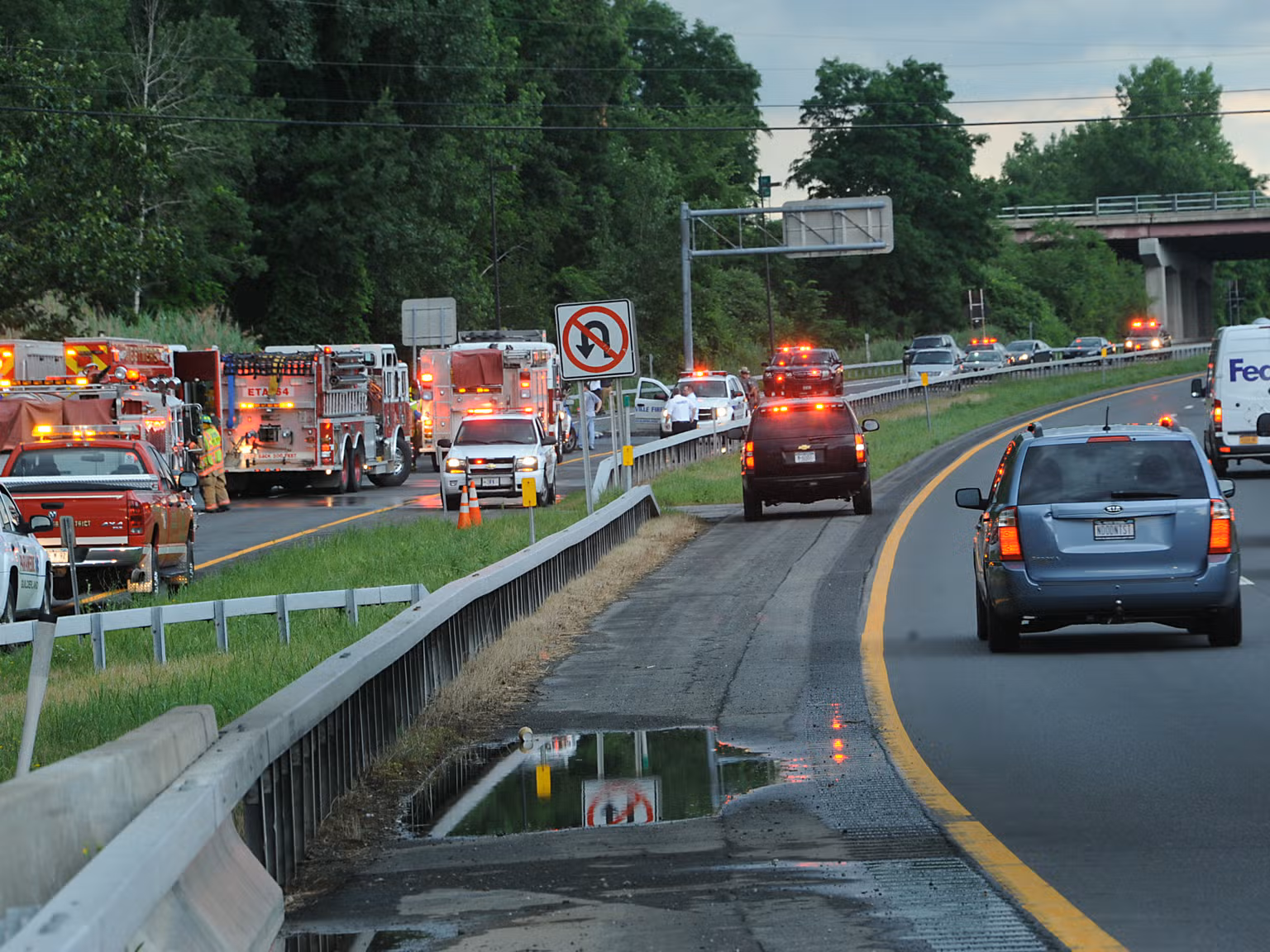
A deadly afternoon on I-70 westbound in Washington County, Pennsylvania turned a normally busy freight corridor into a standstill Thursday, May 7, 2026. Just after 1:22 PM EDT, a Ford Focus traveling eastbound crossed the grass median near mile marker 10.5 in Buffalo Township and slammed directly into a westbound tractor-trailer. The result was catastrophic.
Pennsylvania State Police confirmed that the driver of the Ford Focus was pronounced dead at the scene. The tractor-trailer driver, by contrast, walked away with only minor injuries, a contrast that, while fortunate for one, underscores just how differently two vehicles can absorb the same collision. Emergency crews responded quickly, but there was little they could do for the Focus driver upon arrival.
The crash shut down I-70 westbound between Exit 11 near Taylorstown and Exit 6 near Claysville, effectively closing about five miles of one of the region’s most critical freight routes for roughly three hours. That stretch sits between Pittsburgh and the West Virginia state line, meaning trucks hauling goods through the Pittsburgh-to-Wheeling corridor had to find another way through.
By 4:25 PM EDT, westbound I-70 had reopened, but only partially. As of Thursday evening, traffic was being squeezed into a single lane while Pennsylvania State Police finished their reconstruction work and the coroner’s office wrapped up its scene investigation. Drivers checking conditions can find live updates at 511PA.
The Detour: Route 40 and the Old National Road

With I-70 closed, PennDOT District 12 pushed all traffic onto Route 40, the old two-lane road that has been running parallel to the interstate since before the highway existed. Route 40, known historically as the National Road, winds through Claysville and Taylorstown and was, for a long time, the main artery connecting the mid-Atlantic to the interior of the country. These days, it handles detour traffic about as gracefully as you might expect a two-lane highway to handle modern freight volume.
Off-peak, drivers could expect to add roughly 20 minutes to their trip. During the afternoon commute, especially with commercial trucks in the mix, that number climbed considerably. Anyone who has watched a fully loaded semi try to negotiate a small-town traffic light knows that “roughly 20 minutes” can become something far more frustrating in a hurry.
Why Median Crossover Crashes Are So Deadly
Crashes like Thursday’s are not anomalies. Median crossover accidents rank among the deadliest categories of highway incidents, particularly on rural interstates where vehicle speeds are high and median barriers are sometimes absent. When a passenger car crosses into oncoming traffic and meets a fully loaded semi head-on, the physics are brutal. Modern vehicles are engineered with impressive safety systems, but airbags and crumple zones have limits, and a highway-speed head-on with a large truck pushes well past those limits in most cases.
This particular stretch of I-70 does not have cable median barriers, and PennDOT District 12 has previously flagged the corridor in safety reviews precisely because of that gap. Cable median barriers, when properly installed, are specifically designed to catch and redirect errant vehicles before they can cross into opposing traffic. Their absence on a road carrying this kind of freight load is a detail worth paying attention to.
Research from the Insurance Institute for Highway Safety has shown that lane-keeping assist and lane departure warning technology can cut median departures by approximately half. Body-on-frame trucks and SUVs also tend to fare measurably better than unibody sedans in cross-over crash scenarios, though no vehicle is truly built to survive a direct head-on at highway speed.
What Drivers and Policymakers Can Learn From This Crash
Incidents like Thursday’s serve as a reminder that highway safety is not just an engineering problem or a driver behavior problem. It is both at once. On the driver side, median crossovers can happen for a number of reasons: a medical event, a distraction, a tire blowout, or a moment of inattention. No amount of infrastructure can eliminate human unpredictability entirely.
But infrastructure still matters enormously. Cable median barriers have a well-documented track record of preventing crossover fatalities on divided highways. When a state agency flags a corridor as lacking those protections and the barriers still are not installed, that is a policy and funding conversation worth having publicly. For everyday drivers, this is also a practical argument for prioritizing vehicles with modern driver assistance technology. Lane-keeping assist and similar features are no longer premium extras in many vehicles; they are increasingly standard. Using them could, in some cases, be the difference between a close call and a fatality.
As for I-70 in Washington County, state police and the coroner’s office were still on scene into the evening hours Thursday. This article will be updated as more information becomes available.