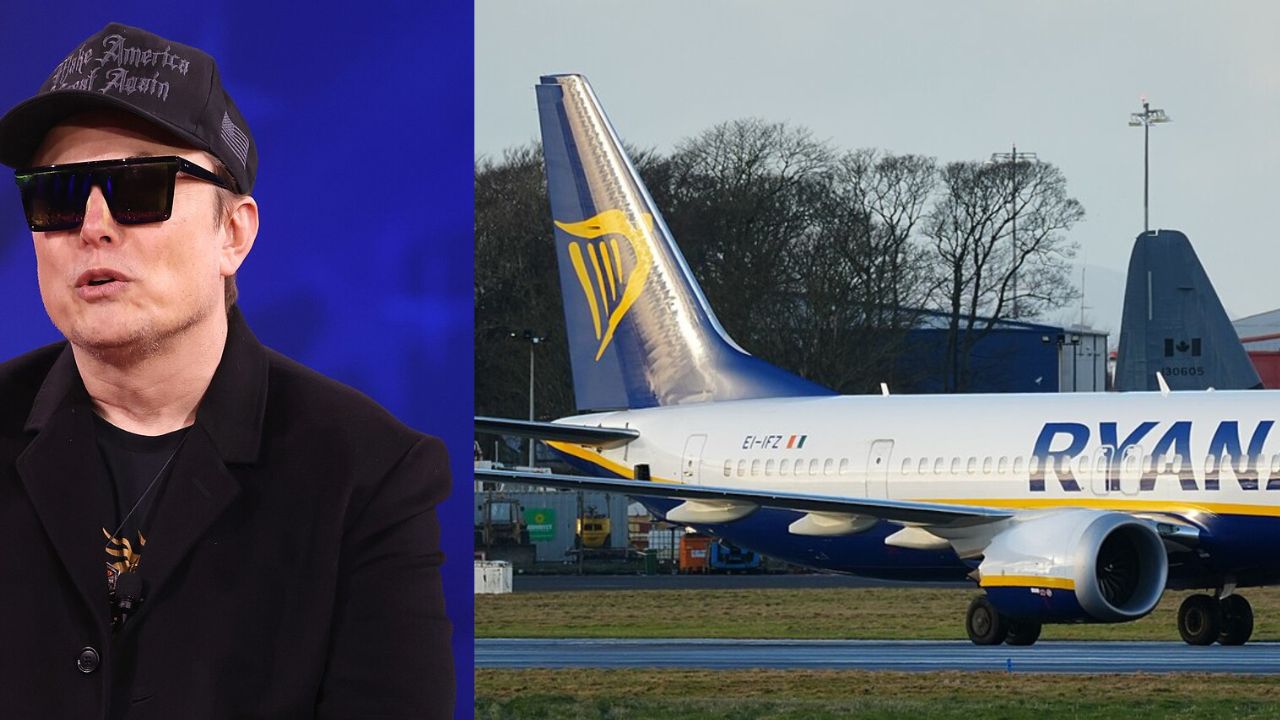

This could prove to be the most surreal business duel of 2026: Elon Musk, the world’s richest individual, has publicly flirted with buying Europe’s largest low-cost airline Ryanair after an online squabble with its outspoken CEO, Michael O’Leary.
This comes as California governor Gavin Newsome describes European leaders as “pathetic” in their response to President Trump’s tariff threats, saying he might as well have gone to the Davos World Economic Forum with a bunch of kneepads.
What started as a disagreement over in-flight Wi-Fi has ballooned into a high-stakes spectacle of billionaire egos, industry disruption, and viral social-media theater.
A Man Called Ryan
The spark? Starlink. The satellite internet service owned by Musk’s SpaceX. And Ryanair’s refusal to adopt it. O’Leary dismissed the idea of installing Starlink on Ryanair’s fleet because the equipment would increase aerodynamic drag and cost the airline up to $250 million annually in extra fuel costs. He further argued that Ryanair’s budget passengers, flying short haul across Europe, simply would not pay for Wi-Fi.
Musk, never one to back down from a public challenge, took to X to hit back. He branded O’Leary “misinformed” and — in characteristic Musk fashion — escalated to personal insults. The exchange quickly spiraled into a full-blown feud, with both men calling each other “idiots” in increasingly colorful terms, prompting Ryanair to even trademark a tongue-in-cheek “Great Idiots Seat Sale.”
Ryanair CEO is an utter idiot. Fire him.
— Elon Musk (@elonmusk) January 16, 2026
Then came the takeover tease. In a tweet that has now gone viral, Musk asked his hundreds of millions of X followers whether he should buy Ryanair and “put someone whose actual name is Ryan in charge,” a playful tip of the hat to the airline’s origins. A Musk-pinned poll quickly gathered hundreds of thousands of votes, with roughly three-quarters backing the idea.
Buy Now Before Musk Gets One
On its surface, this might read like billionaire banter. But beneath the spectacle lies something more textured about power, technological rivalry, and modern corporate gladiatorial conflict.
First, consider raw firepower. Musk’s net worth hovers near the trillion-dollar mark, dwarfing Ryanair’s roughly $30-billion market capitalization. He has a track record of turning jokes into landmark deals, most notably with his $44-billion acquisition of Twitter (now X). The purchase began with an offhand tweet years earlier.
I really want to put a Ryan in charge of Ryan Air. It is your destiny.
— Elon Musk (@elonmusk) January 19, 2026
O’Leary, by contrast, was briefly a billionaire once upon a time but slipped off the rich list as Ryanair’s share price retreated. His influence is immense in low-cost aviation circles, but by any metric he stands in Musk’s shadow in terms of financial clout and media reach.
So, is Musk seriously threatening a hostile takeover? The short answer is no. EU airline ownership rules mandate that carriers like Ryanair must be majority-owned by EU or EFTA nationals, effectively blocking any majority acquisition by a non-EU individual like Musk.
This is not a liability but a regulatory reality that would stop a full takeover in its tracks. Ryan Air released a statement to this effect, joking (or are they) that the airline is launching a “Great Idiots” seat sale for the Tesla CEO. “Buy now before Musk gets one,” the statement read.
Ryanair responds to Elon’s constant jabs about buying the airline and put someone named Ryan as CEO
byu/HimelTy inEnoughMuskSpam
Sneaking Tactics
What’s far more plausible is that Musk’s comments are strategic theater — a way to puncture Ryanair’s brand with global attention and perhaps pressure the airline to reconsider Starlink on its own terms. In that sense, the “buy Ryanair” trope functions less like a genuine financial bid and more like a lever in the court of public opinion.
This pattern is not new for Musk. His public spats frequently mix provocation with market influence. Whether the subject is artificial intelligence regulation, electric vehicle subsidies, or free-speech debates on X, Musk often applies pressure via spectacle first and substance second. Observers have drawn parallels to the US president’s controversial playbook of strongarming perceived enemies into submission.
Economically, the dispute underscores a broader tension between legacy business models and next-generation tech ambitions. Ryanair built its empire on efficiency, ultra-low costs, and nickel-and-dime pricing. Musk’s integrated Starlink narrative is about ubiquitous connectivity, premium service, and technological edge. These philosophies collide not just in rhetoric but in customer experience expectations.
A 2026 to Remember
Culturally, the Musk/O’Leary spat reflects something about 2026’s social media-shaped leadership dynamics. Corporate leaders now operate partly as influencers, partly as CEOs — their public personas inseparable from their strategic agendas. It raises wider questions about how business conflict, amplified by social platforms, changes public discourse and investor psychology.
In the end, the Musk–O’Leary saga is a fascinating fusion of personalities and power. Musk’s wealth gives him a megaphone that can turn a Wi-Fi disagreement into a global headline. O’Leary’s blunt retorts make him a folk hero to budget travelers.
Neither side will likely walk away unchanged. But whether this episode ends in real strategic shifts or merely serves as another chapter in billionaire performance art, it has already delivered one of the most entertaining business stories of the year.
Sources: Reuters, The Tribune