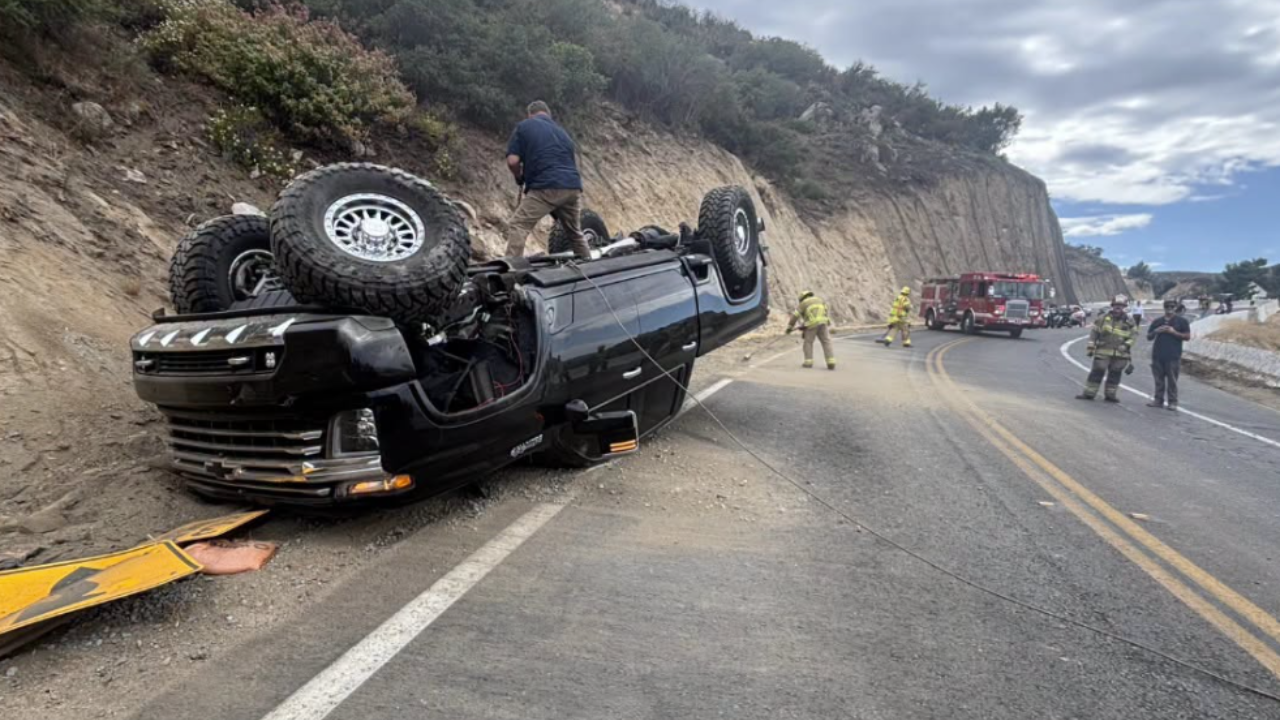
If you’ve ever driven Ortega Highway (SR-74) between Lake Elsinore and San Juan Capistrano, you know it’s not the kind of road where you want your eyelids getting heavy. It’s twisty, it’s narrow in places, and it doesn’t leave much room for error. Unfortunately, one driver found that out the hard way this week when the California Highway Patrol’s Temecula office responded to a rollover crash caused by good old-fashioned drowsy driving.
According to CHP, the driver was fighting off sleep behind the wheel when they drifted off the road, struck an embankment, and flipped the vehicle onto its roof. That’s about as rough a wake-up call as you can get. The good news, and it’s the kind of good news that makes this whole story worth telling, is that the driver walked away without serious injury. Anyone who’s seen photos of a car resting upside down on a hillside knows that’s not always how these things end.
We’ve all been there in some form, whether it’s a long road trip, a late shift, or just a day where sleep didn’t happen the way it should have. But there’s a big difference between feeling a little tired and actually nodding off at 55 miles per hour on a rural highway. CHP is using this crash as a reminder that drowsy driving isn’t some minor inconvenience. It behaves an awful lot like driving drunk or distracted, slowing your reaction time and messing with your ability to judge distance and stay in your lane.
The numbers back that up in a way that’s hard to ignore. This is one of those stories where the vehicle took the hit so the driver didn’t have to, and honestly, that’s the best possible outcome given the circumstances.
Why Ortega Highway Is Particularly Unforgiving
SR-74 has a reputation among Southern California drivers, and not because it’s boring. It winds through the Cleveland National Forest with tight curves, elevation changes, and long stretches without much in the way of streetlights or shoulders. It’s a fantastic road when you’re alert and paying attention.
It is not a road that forgives a driver whose eyes are closing for even a second or two. Add in the fact that fatigue-related crashes tend to spike during late-night and early-morning hours, and you’ve got a recipe for exactly the kind of incident CHP responded to this week.
The Numbers Behind Drowsy Driving
According to the National Highway Traffic Safety Administration, drowsy driving is tied to roughly 91,000 police-reported crashes every year in the U.S., leading to around 50,000 injuries and nearly 800 deaths. Some researchers believe those figures actually undercount the problem, since fatigue is notoriously hard to prove after the fact compared to something like a breathalyzer result. Some estimates put the real death toll as high as 6,400 annually once underreporting is factored in.
What CHP Recommends Instead
CHP’s advice is refreshingly practical. If you’re fading, pull over somewhere safe and take a 20 to 30 minute nap rather than white-knuckling it to your exit. Pairing a nap with a cup of coffee actually works well too, since caffeine takes about half an hour to kick in anyway.
Switching drivers or simply prioritizing 7 to 9 hours of sleep before a long drive goes a long way as well. Your car will still be there in the morning. Better that than upside down on an embankment.