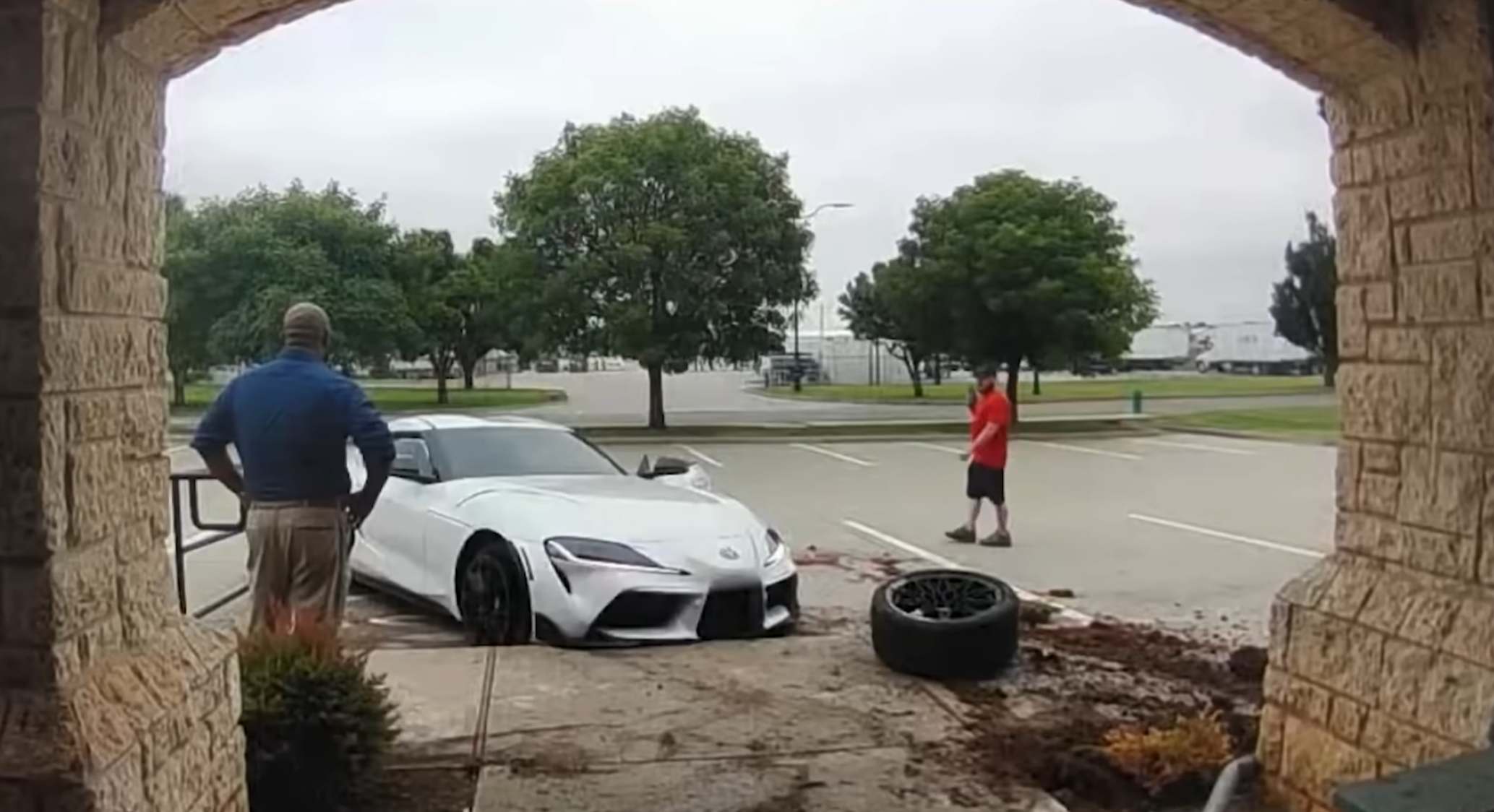
A business owner in Edmond, Oklahoma, is speaking out after a driver going more than three times the posted speed limit lost control and plowed into her building last week. The crash, which could have been far worse, is shining a spotlight on a stretch of road she says has become an unofficial drag strip for reckless drivers. And the attitude she got afterward from the people responsible? Not exactly full of remorse.
On May 20, Sharena Perry received an alert from her Ring doorbell camera. What she saw was not a welcome sight: a flashy white car sitting in front of her business, Utopia Plastics, located near 18th Street and Frets in Edmond, with fresh dirt from her garden scattered across the scene. The car had skidded off the road, crossed nearly 300 feet of grass, clipped a handicap pole, and smashed into a brick column on the building’s exterior. What made it even more unsettling was that Perry had been driving along that same stretch of road just minutes before the crash happened.
According to the police report, the driver admitted to officers that he was traveling somewhere between 70 and 80 miles per hour before losing control and leaving the roadway. The posted speed limit on that stretch of 18th Street is 25 miles per hour. That is not a typo. The driver was going more than three times the legal limit through a commercial zone lined with businesses.
Perry has been vocal about the fact that this was not an isolated event for her. She says she regularly witnesses drivers treating that road like a racetrack, and she’s calling this incident a wake-up call for the community and, frankly, for anyone who thinks a 25 mph zone is just a suggestion.
What Happened the Night of the Crash
The sequence of events is almost hard to believe. Perry says she had just left her business when the white car nearly hit her as she pulled out onto 18th Street. Minutes later, she got the doorbell notification showing the same vehicle had crashed directly into her building.
When she communicated with the driver and passenger through her doorbell camera, she says there was no apology, no concern for the damage, and certainly no accountability. The response she received was essentially that she did not own the road. Given that the car had just taken out a portion of her building, that response is something.
Perry later found out that the driver had reportedly been doing donuts in a nearby parking lot before the crash, despite local dispatch having no record of a call about it. The police report filled in the rest of the picture.
The Numbers That Should Alarm Everyone
Let’s put the physics of this into perspective. A vehicle traveling at 80 mph covers about 117 feet per second. That means in the time it takes to blink, that car had already traveled more than 100 feet past whatever obstacle came next.
The car traveled nearly 300 feet from the curb before hitting the building. While the structural damage was described as not extensive, that is largely a matter of luck. Had Perry still been in the parking lot, had a customer been walking toward the entrance, or had the trajectory been slightly different, this story would be a very different one.
According to the National Highway Traffic Safety Administration (NHTSA), speeding is a factor in roughly 29% of all traffic fatalities in the United States, accounting for more than 12,000 deaths per year. In urban commercial zones with lower speed limits, pedestrian fatality risk increases dramatically as vehicle speed rises. At 40 mph, the pedestrian fatality risk is already around 85%. At 80 mph through a business district, the risk is essentially unsurvivable.
What We Can Learn From This Incident
Stories like this one are a reminder that reckless driving is not just a highway problem. It happens on surface streets in neighborhoods and commercial corridors, and the consequences can be just as deadly.
A few things stand out here. First, doorbell and security cameras have become a genuine accountability tool. Perry was able to document the vehicle, communicate with those responsible in real time, and provide footage to support the police report. That kind of evidence matters in situations where witnesses may be scarce.
Second, community awareness is powerful. Perry chose to speak publicly about what happened not just because she was angry, but because she wants drivers to understand that roads lined with businesses are not venues for speed tests. She specifically called out the use of rideshare vehicles for this kind of activity, suggesting that those who want to drive fast should find a sanctioned location, like a track, to do it.
Third, local road safety improvements are often the result of community pressure. Residents and business owners who raise consistent concerns with city officials and traffic engineers can push for changes like speed cameras, additional signage, traffic calming measures, or increased patrol frequency. If 18th Street in Edmond is seeing this kind of behavior regularly, that is a conversation worth having with local government.
Perry’s Message to the Community
Perry is not letting this go quietly. While she described the incident as a wake-up call rather than a tragedy, she is clear-eyed about how close it came to being the latter. Had she left a few minutes later, she and her car could have been directly in the path of that vehicle.
Her message is straightforward: if you want to drive like that, do it somewhere appropriate. Not through a business district. Not on a road with a 25 mph limit. Not somewhere that a person, a child, or a customer could be standing on the other side of what you are about to hit.
The damage to Utopia Plastics may be repairable. The broader point she is making is one that communities across the country should take seriously. Reckless driving on surface streets does not get the same attention as highway fatalities, but the danger is just as real.
Sources: Oklahoma’s News 4 (KFOR), National Highway Traffic Safety Administration (NHTSA)