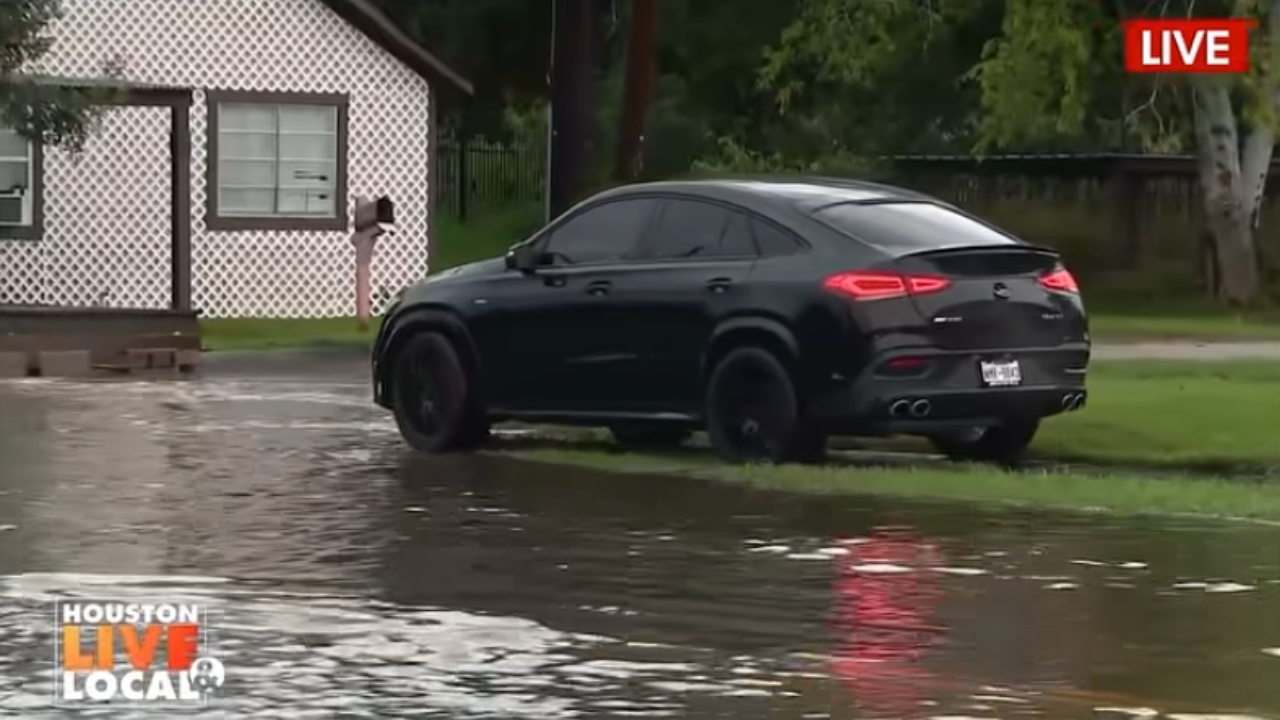
When your car is caught out in rising floodwaters, what do you do? If you’re this crafty driver in the Houston area, you just keep driving after moving to a seemingly safer area. One driver headed to the grassy edge of a residential street to avoid the standing water left by Tropical Storm Bertha in a bit of live TV.
The clip shows a flooded roadway with cars still pushing through, including a white pickup that leaves a large wake across the pavement. And then we see the black car doing its thing, moving away from the water.
The black car follows the grassy shoulder for several seconds, passing in front of homes while staying just outside the deeper water in the road. And that keeps them away from the deeper waters, leaving their car to stay nice and dry. Of course, that little detour didn’t entirely clear the flooding. Near a driveway or crossing point, the driver had to angle back onto the pavement, carefully wade through the water, and work to move forward. It didn’t make the flooding a cakewalk, but it was definitely a creative effort.
The video doesn’t show the full extent of the neighborhood flooding, whether the driver had another route, or whether the vehicle was damaged afterward. But our takeaway here is that they didn’t want to get bogged down trying to navigate the tropical-storm-driven waters that remained after the storm rolled through. And who would if there was a way around it?
Bertha moved through the Houston area in late July 2026 after making landfall in Louisiana. It reached Texas as a low-end tropical storm, and while its winds stayed modest inland, its rain was the bigger problem for Houston. Bands of heavy downpours produced street flooding across the region, with some spots near Missouri City and Sugar Land picking up more than 5 inches of rain and Meyerland seeing about 3 inches.
Why Driving Through Floodwater Is So Dangerous
Floodwater over a road can hide obstacles that you need to know about to get around. That often makes it hard to judge how deep the water is, what condition the road underneath is in, or whether the water is moving. Plus, a road can be washed out beneath water that looks passable.
As little as a foot of moving water can float many vehicles, and Houston’s flooding in particular is known for concealing stalled cars, debris, and dropped-off road edges. Even a vehicle that makes it through can take water damage to its engine, electrical systems, and interior.
This is all why emergency officials always advise for you to turn around rather than drive into a flooded roadway. In fact, that’s the message behind the “Turn Around, Don’t Drown” campaign. Houston floods without needing a hurricane, because tropical rain bands can drop water faster than streets and ditches drain, which is what happened as Bertha’s downpours congealed over the area.
Why the Grass Route is Also Dangerous
Steering onto the grassy shoulder avoids the deepest water in the road, but it’s really just trading one set of issues for another. After heavy rain the ground can be soft and saturated, which can let a car’s tires sink and bog down. The grass can also hide a curb, a ditch, a drainage culvert, or other obstacles that are not visible beneath standing water or thick grass, any of which can stop or damage a vehicle.
The uneven ground, absolutely covered in water, beside a flooded street is as unpredictable as the road surface. It might seem like a good idea just to move away, but you’ve also got to take in the rest of the terrain into account.
So was this flooding detour worth it? We can’t say for sure, but we can definitely say it was 100% creative and a good attempt.