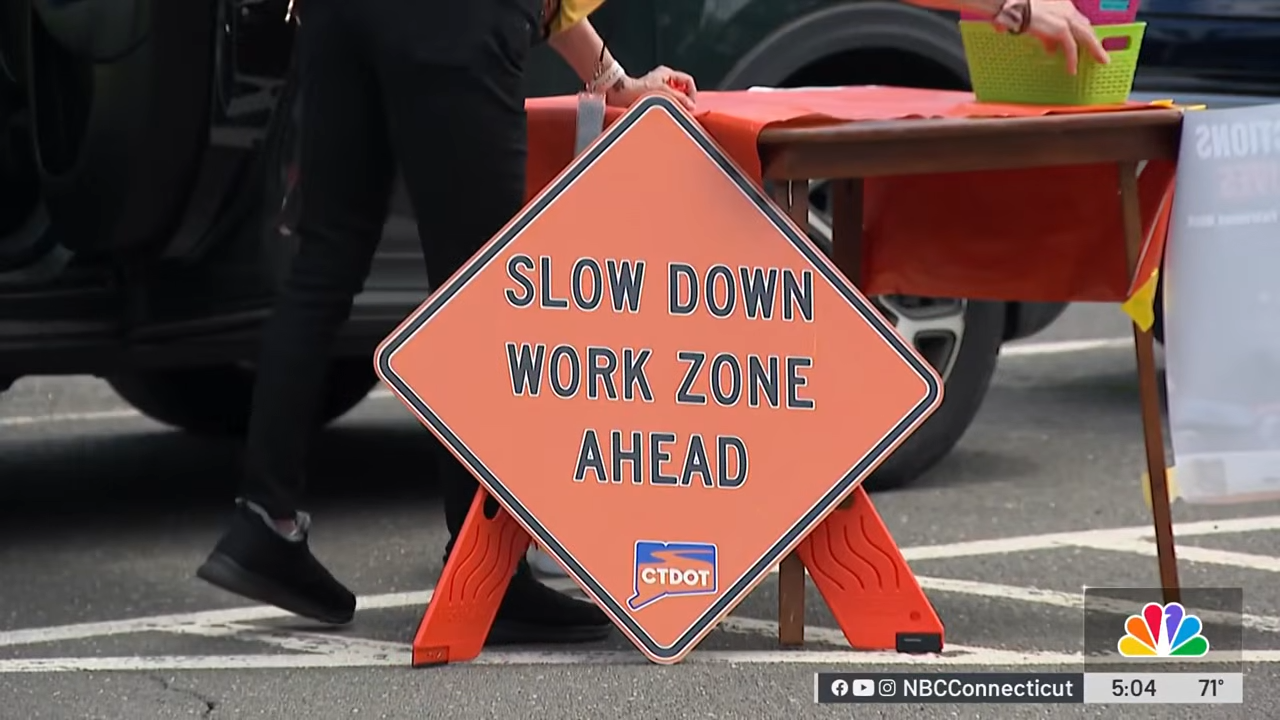
If you’ve driven through a Connecticut highway work zone lately and figured the posted speed limit was more of a suggestion, the state has a message for you: that grace period is officially over. The Connecticut Department of Transportation launched its automated work zone speed camera program on June 1, 2026, targeting active highway construction zones across the state.
This isn’t a trial run or a discussion about future policy. The cameras are up, they are recording, and they are already capturing data that should give any reasonable driver pause.
The program didn’t appear out of nowhere. Testing began back in October 2025, and by the time the cameras went live, they had already detected more than 8.4 million vehicles passing through monitored work zones, with approximately 1.36 million of those vehicles traveling above the posted limit. That’s not a rounding error. That’s a significant chunk of Connecticut’s driving public treating orange barrels and reduced speed signs as background noise. The data makes the case for the cameras better than any press release could.
What separates this from the usual law enforcement talking points is the velocity of the violations, not just the volume. More than 4,000 drivers were clocked exceeding 85 mph in active work zones, and 150 of them were topping 100 mph while workers were physically present on the road.
These aren’t instances of someone drifting a few miles per hour over the limit in an empty construction corridor at 2 a.m. These are triple-digit speeds in zones where human beings are standing feet from live traffic. The program’s defenders don’t need to stretch for justification.
For now, the rollout is measured and the penalties are relatively modest, at least to start. From June 1 through July 5, cameras will issue warning notices for anyone caught going 10 mph or more over the work zone limit. Starting July 6, a second offense within a year brings a $75 fine, and anyone caught doing 85 mph or faster receives that fine on the first strike, no warnings involved.
Importantly, violations under this program do not result in insurance points or appear as moving violations on a driver’s record, which removes one of the more common objections to automated enforcement.
Where the Cameras Are and Where They’re Going
Initial deployments are focused on three active construction projects, including sites in East Lyme, West Haven, and Colchester. These locations were selected based on traffic volume and the level of risk present for road crews. But this is not the ceiling.
The state has been approved to use up to 15 cameras simultaneously, with the flexibility to deploy them both as stationary units and in mobile configurations loaded into SUVs. That last detail is worth noting. Mobile enforcement means the cameras are not fixed to a location that a frequent commuter can simply memorize and react to. The enforcement zone, functionally, can move.
CTDOT has also indicated that camera coverage could eventually extend beyond traditional construction zones to maintenance operations, citing concerns about dangerous driving behavior on secondary roads like Route 2 and Route 7. That broadens the program’s reach considerably and signals that the state views this as a long-term enforcement tool, not a temporary construction-season measure.
The Testing Phase Already Proved the Point
One of the more credible aspects of this rollout is that Connecticut did not simply install cameras and hope for the best. The CTDOT spokesperson noted that speeds dropped by close to 20 percent in some zones during active enforcement testing, and the program has been showing consistent results throughout 2025.
That kind of behavioral shift in real-world conditions is meaningful, and it’s the kind of outcome that tends to give these programs longevity regardless of how any particular driver feels about them.
Connecticut’s earlier pilot program, which ran from April to November 2023, resulted in more than 24,900 warnings and 750 fines issued across five locations, suggesting enforcement wasn’t just symbolic even in its earliest form.
The 2023 pilot generated enough data to support a permanent program, which the state legislature subsequently authorized. By the time June 2026 arrived, the infrastructure, legal framework, and data collection had all been in place for years.
What Drivers Need to Know Before Hitting the Orange Cones
The mechanics of the program are straightforward. Cameras can only be placed in work zones on highways where the posted work zone speed limit is 45 mph or greater, and only images of vehicles traveling 10 mph or more over that limit are captured and retained.
Advance signage is required to alert drivers that a camera is active in the zone, so there’s no argument to be made about hidden or deceptive enforcement. The signs will be there. The question is whether drivers read them.
The program is authorized to run through at least December 2030, with CTDOT permitted to continue it indefinitely after that point. Anyone banking on this fading away after a news cycle or two should recalibrate that expectation. Connecticut is treating this as infrastructure, not a seasonal initiative.
Why Work Zones Are More Dangerous Than Most Drivers Realize
Work zone fatalities are a persistent problem across the country, and Connecticut’s experience reflects a national pattern. The Federal Highway Administration has documented for years that work zones present a uniquely hazardous combination of narrowed lanes, sudden configuration changes, unpredictable worker movement, and drivers who are often distracted or impatient. The human cost of that combination falls disproportionately on the workers themselves.
The highway workers who participated in the testing phase made clear that this is not an abstract policy concern for them. Spending a shift in close proximity to 85-mph traffic is not something that becomes routine or acceptable over time, regardless of how many years someone has spent in that environment. The camera program may be modest in its fines, but the problem it is responding to is not modest at all.
For Connecticut drivers, the math is straightforward. Slow down in the orange zones, read the posted limits, and put the phone away. The cameras are not going anywhere.