Road rage incidents happen every day across the country, but most of them do not involve a family of five staring down the barrel of what they believed to be a loaded handgun. That is exactly what happened recently in Commerce City, Colorado, when a driver in a fit of rage allegedly pointed a weapon at a family before speeding off into the night.
For the family, the nightmare did not end when the other car disappeared. They had no way of knowing whether the suspect would return, whether police would find him, or whether anyone else on the road would become a target. It was the kind of incident that leaves people shaken for weeks.
What happened next, however, is where this story takes a turn that feels almost pulled from a sci-fi procedural. Instead of dispatching a fleet of cruisers to canvas the area and hope for the best, Commerce City police had something a little more high-tech on their side.
The department fired up its Drone as First Responder program, and within a short time, officers had eyes on the suspect vehicle from above, guided a ground team directly to it, and made an arrest without a single dangerous car chase. Oh, and the terrifying “Glock”? It was a BB gun.
How the Drone Program Actually Works
The Commerce City Police Department operates its drone fleet out of what the department calls a Real-Time Crime Center located at police headquarters. Think of it as a modern dispatch hub, except instead of just relaying radio traffic, operators can launch and pilot drones directly from the facility.
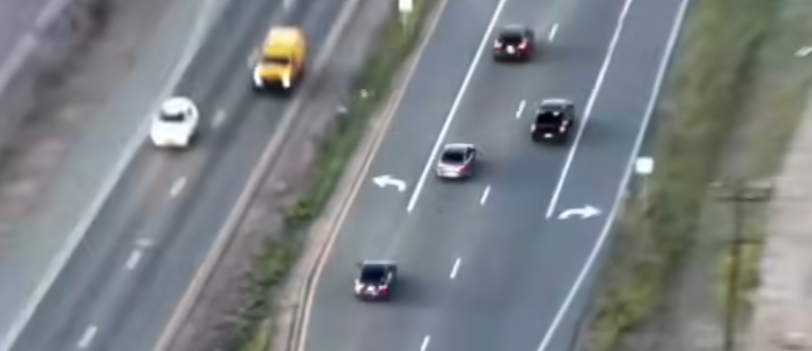
When the call came in about the road rage incident, operators were able to get a drone airborne quickly and begin scanning for the suspect vehicle. Once located, the drone fed live footage and positioning data directly to officers on the ground, allowing them to coordinate a precise intercept without having to rely on guesswork or witness descriptions alone.
The result was a textbook “high-risk” traffic stop, which is the procedure law enforcement uses when they believe an armed or dangerous individual may be inside a vehicle. In this type of stop, officers approach with weapons drawn and instruct the driver to exit with hands visible. It is a controlled, deliberate process designed to keep everyone as safe as possible, and in this case, it went exactly as planned.
Spike Strips Were on Standby, and the Drone Was Ready to Chase
One of the more interesting details the department shared is what would have happened if the suspect had decided to run again. Officers had spike strips ready to deploy, and the drone was prepared to follow the vehicle continuously so that no officer would have needed to initiate a high-speed pursuit.
That last part deserves some attention. Pursuits are one of the most dangerous things that can happen on public roads. They put officers, suspects, and innocent bystanders at serious risk. Speeds climb, judgment suffers, and the outcomes can be fatal. Having an aerial asset that can shadow a fleeing vehicle without anyone having to race after it at dangerous speeds is a significant safety upgrade.
In this particular case, the suspect cooperated and nobody had to find out how the spike strip scenario would have played out. But knowing the contingency was in place is reassuring all the same.
What This Incident Teaches Us About Modern Policing
There is a larger lesson buried inside this story, and it is worth pulling out. The traditional model of responding to a fleeing suspect has always involved a reactive, ground-level pursuit that carries enormous risk. Drone technology fundamentally changes that equation.
When police can track a vehicle from the air without announcing their presence, they can take their time, coordinate resources, and choose the right moment to make a safe stop. Nobody has to run a red light at 90 miles per hour. Nobody has to make split-second decisions with incomplete information.
There is also something to be said for what the drone did not have to do here. It did not have to confront anyone. It did not have to make a judgment call in a stressful, fast-moving situation. It simply watched and guided. That kind of calm, aerial perspective is exactly what chaotic situations need more of.
As departments across the country continue debating how to modernize policing in ways that are both effective and safer for communities, Commerce City is offering a pretty convincing proof of concept. A family of five got to go home. A suspect was taken into custody without incident. And not a single officer had to initiate a chase.
That is a pretty solid argument for more drones.