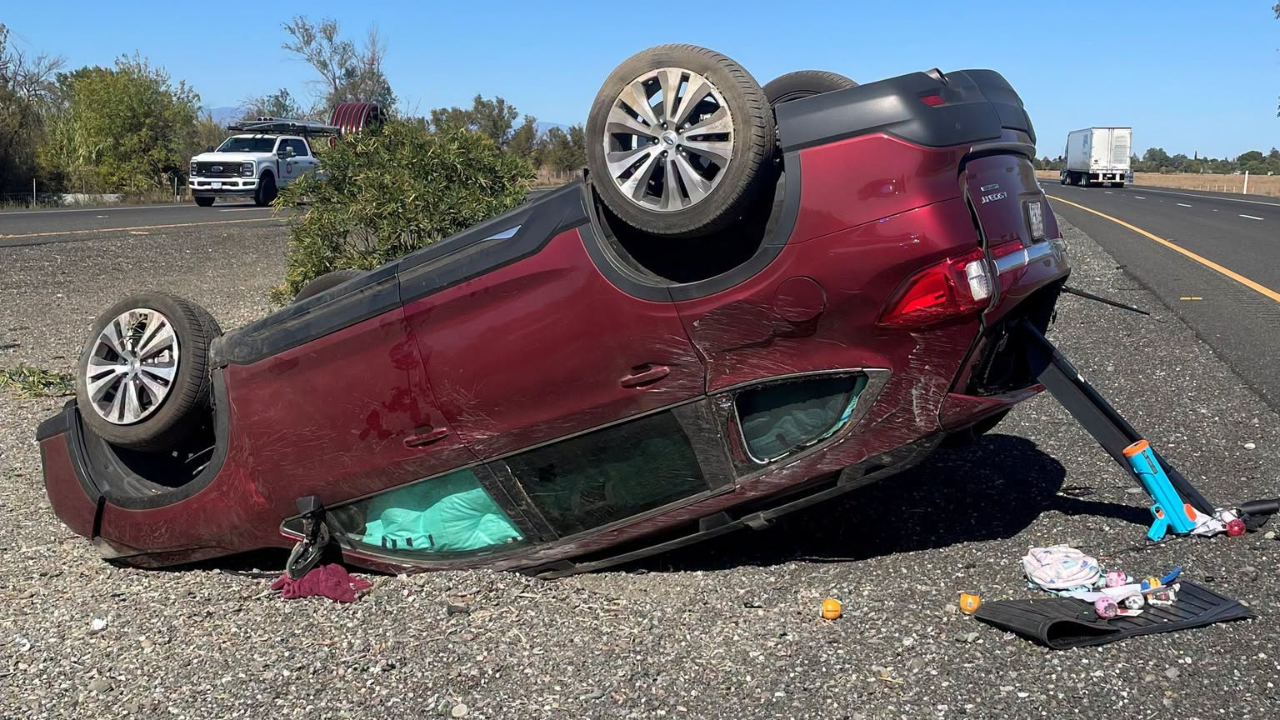
A rollover on Interstate 5 near County Road 57 prompted CHP Willows to warn drivers about treating driver assistance as self-driving technology.
When officers asked the driver what had happened, she initially replied that she wasn’t sure. She told them she had cruise control and lane assist switched on.
In her account, the car left the road and entered the gravel. When she tried to correct, she lost control and the car rolled over.
CHP opened its public warning with a pointed line about relying on a “self-driving” vehicle: “it might only take you to the scene of a crash.”
Still Driving
Embedded media follows; please allow a moment for it to load.
The National Highway Traffic Safety Administration describes Level 2 assistance as continuous support for both steering and acceleration or braking. The person behind the wheel must remain engaged and attentive throughout, even while the system performs those tasks.
The names of individual features also matter. In its driver assistance guide, NHTSA explains that adaptive cruise control adjusts speed to maintain a selected following distance, while lane centering provides continuous steering to keep a vehicle centered.
Lane keeping assistance intervenes to help prevent a vehicle from drifting out of its lane. Lane departure warning alerts the driver to a lane departure without steering the car back. Those functions do different jobs, so the driver’s reference to “lane assist” alone cannot establish which system was operating during this crash.
Her account also does not establish why the car first left the road or whether a feature malfunctioned.
NHTSA recommends checking the vehicle’s owner’s manual to understand its specific technology and safety features. Manufacturers may use different names for driver assistance technologies.
A Different Role
Higher levels of automation change the human’s role. Under Level 3, the system handles the driving task when engaged, but the driver must remain available to resume control when requested.
At Level 4, occupants can ride as passengers while the system handles the driving within its permitted operating area and conditions. Human intervention is not required while it operates within those limits.
Level 5 describes a system capable of handling the driving on all roadways and under all driving conditions without a human driver. NHTSA lists that technology as unavailable for consumer purchase.