Color, noise, and museum-grade metal are headed for Earls Court. From September 12 to 14, Goodwood Revival 2025 hosts five BMW Art Cars as part of a 50-year celebration of the series. It is a one-stop viewing of works that usually live on different continents. Saturday is sold out; a few tickets for Friday and Sunday remain via Goodwood.
Since 1975, BMW has invited artists to reimagine its racers and road cars. The collection now spans 20 vehicles, featuring names such as Frank Stella, Roy Lichtenstein, David Hockney, and Jeff Koons, and it sits at the intersection of contemporary art and motorsport. Here’s a quick look at the five cars that will be on display.
Frank Stella’s BMW 3.0 Csl (1976)

Stella wrapped the Group 5 CSL in a precise black-and-white grid that resembles oversized graph paper, a visual “blueprint” that transformed pure engineering into a pattern. BMW highlights the car’s Le Mans connection and the era’s 750 hp turbo CSLs, which lend this piece a genuine racing aura even when at rest.
Roy Lichtenstein’s BMW 320I Turbo (1977)

Lichtenstein brought his Pop Art language to the 320i, characterized by flowing lines and Ben Day dots that evoke the road, the landscape, and the passage of time. The car competed at the 24 Hours of Le Mans, driven by Art Car instigator Hervé Poulain and Marcel Mignot, and recorded a class win that cemented its legend.
Ernst Fuchs’ BMW 635 CSI “Fire Fox on a Hare Hunt” (1982)

The first Art Car based on a production BMW, Fuchs used the 635 CSi as a canvas for a dreamlike, symbolic scene, earning it the nickname “Fire Fox on a Hare Hunt.” It marked a turn from pure race cars to road-going art you could imagine driving.
David Hockney’s BMW 850 CSI (1995)

Hockney “peeled back the skin” and painted the car to reveal its inner life, from mechanical forms to the outline of a driver on the door. This one was created as an exhibit rather than a racer, and Hockney described the approach as letting you look inside the car.
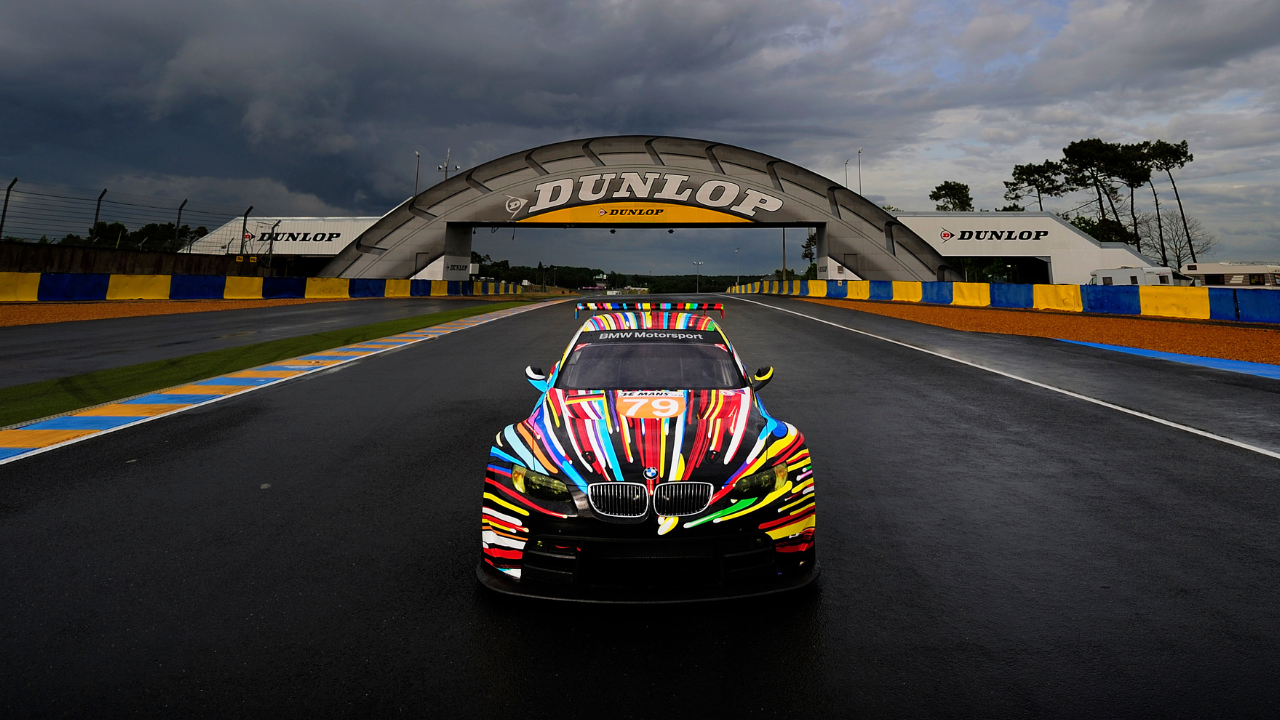
Jeff Koons’ BMW M3 GT2 (2010)

Koons used vivid colors and energy lines to suggest motion and power, then numbered the car 79 as a nod to Warhol’s 1979 M1 Art Car. The M3 GT2 took the start at Le Mans in 2010, drawing huge crowds, and retired early due to technical trouble, which only added to its lore.
What It All Means

Goodwood Revival celebrates period style and historic racing. Dropping five Art Cars into that setting connects museum-grade artwork with the noise, stories, and human scale of motorsport. It is a quick walk through five decades of art history told in paint, aluminum, and tire rubber.
BMW’s Art Cars are not just pretty paint. They are a running conversation between art, design, and speed, illustrating how each era perceived technology and its relationship to identity. Stella’s CSL turns engineering into a visible grid, Lichtenstein paints the road and the passage of time across a Le Mans racer, Fuchs brings myth to a road car, Hockney invites you to look inside the machine, and Koons turns motion and power into color and lines. Seen together at Revival, they read like a timeline of ideas as much as a lineup of cars.
This display also shows why the program matters beyond the museum. These cars were built to move audiences as well as to move fast, and they influenced how brands, artists, and race teams think about liveries, collaboration, and storytelling. If you go, view each one twice. First, step back and take in the entire shape as a work of art. Then walk close and examine how the art wraps around functional elements, such as vents, panel gaps, and splitters. The cars tell different stories at each distance, and that is the real magic of an art gallery with a heartbeat.