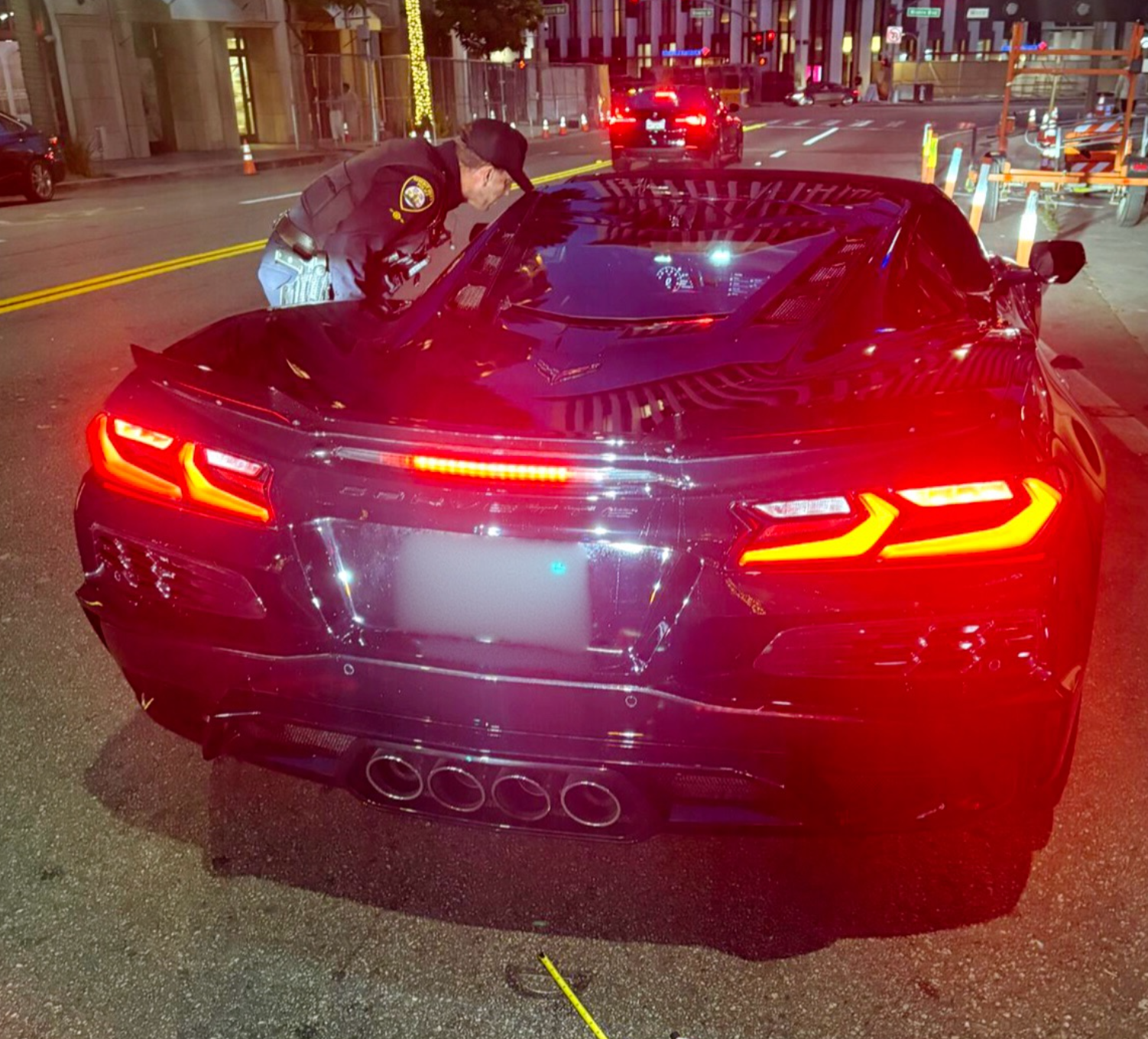
The Beverly Hills Police Department has never been shy about going after traffic violations, but their latest enforcement effort is getting a standing ovation from residents. BHPD recently partnered with PipeDown Solutions to bring specialized loud exhaust enforcement training to Southern California for the very first time, and the results were exactly what fed-up neighbors had been waiting for.
After officers completed classroom instruction and hands-on testing with decibel-measuring equipment, BHPD motor officers took the training to the streets, pulling over and citing vehicles with unlawful exhaust noise. Among the stops: several high-end and exotic cars that are a familiar sight throughout Beverly Hills. Because of course they were.
The department shared the news on their official Facebook page, noting that community members who stopped to ask what was going on during setup had a pretty uniform reaction: “Finally” and “About time.” That kind of response tells you everything you need to know about how long locals have been waiting for this kind of enforcement.
Beverly Hills sits at the center of one of the loudest car cultures in the country. Ferraris and Lamborghinis regularly flock to the Golden Triangle to show off along Rodeo Drive, with drivers revving engines and filming for social media. Head west to West Hollywood, and the Sunset Strip has its own exhaust-fueled soundtrack. Further into LA, modified sports cars are a staple at illegal street takeovers. The BHPD’s new enforcement effort is a direct answer to that noise creep.
What the Law Actually Says About Loud Exhausts in California
California has clear rules on this, even if enforcement has historically been inconsistent. Under California Vehicle Code Section 27151, no person may modify a vehicle’s exhaust system in a way that amplifies or increases noise beyond legal limits, and no one may operate a vehicle with such a modification. For vehicles under 6,000 pounds, the legal ceiling is 95 decibels, measured according to SAE International standards. For reference, that is roughly the volume of a gas-powered lawn mower.
Citations for modified exhaust carry a $1,000 fine. Drivers cited are required to have their vehicle inspected and tested at a licensed facility, and to remove modifications and bring noise levels back under the 95-decibel threshold before the citation can be resolved.
The challenge historically has not been the law itself; it has been the tools available to enforce it. Without decibel-measuring devices, officers had to issue citations based on judgment alone, requiring drivers to visit an outside facility for official testing. PipeDown Solutions is helping bridge that gap by training officers and equipping them with gear that documents sound levels right at the roadside. BHPD has indicated it is also in the process of purchasing two dedicated decibel-measuring devices to mount on motorcycles for ongoing enforcement.
Why This Program Is a Big Deal for Southern California
PipeDown Solutions bringing their training program to the BHPD marks the first time this type of specialized exhaust noise enforcement has come to Southern California, according to the department. That is significant because the region has one of the highest concentrations of exotic car ownership in the world, along with a well-established aftermarket modification culture.
Research has long shown that noise complaints represent more than a minor inconvenience. Sustained exposure to loud noise can produce uncontrollable stress and trigger hormonal and nervous system changes, even in otherwise healthy individuals. Residents living near popular driving corridors in Beverly Hills are not just annoyed; they may be experiencing real health consequences.
Police agencies are often on the front lines of noise complaints but have historically been hampered by inadequate measurement equipment and insufficient officer training. Programs like the one PipeDown Solutions is delivering aim to fix that gap by giving officers the technical foundation to make defensible enforcement decisions and document violations in a way that holds up in court.
The fact that other agencies like Seaside Fire and Police have also partnered with PipeDown Solutions suggests this model is gaining traction across California. Beverly Hills may be the most high-profile adoption yet.
The Comment Section Said the Quiet Part Loud
The reaction on social media was, predictably, a mix of cheers and jokes. One commenter declared that a Porsche Carrera GT “can come in front of my house and rev all it wants,” to which another responded that the same car should have been cited for being too quiet, since the V-10 engine deserves to be heard by everyone. The Carrera GT crowd has opinions.
Others were a bit more pointed. One commenter noted that showing up with straight-piped cars registered in areas near air bases, where noise ordinances do not apply, might be a clever workaround. Another took a gentle shot at the type of driver who modifies exhaust specifically to be seen and heard, writing: “But, but… people might not see me and my loud car!”
The humor tracks. Law enforcement agencies in other cities have noticed that some drivers treat noise fines as a kind of “fun tax,” willingly paying the fine rather than reverting to stock exhaust. That attitude is exactly what makes training, equipment, and consistent enforcement so important. A $1,000 citation tends to land differently than a $250 fine.
What We Can Learn From Beverly Hills Getting Serious About Exhaust Noise
There is a broader lesson buried in this story. BHPD did not invent new law or lobby for tougher penalties. They invested in training and technology to enforce a rule that already existed, and residents responded with overwhelming relief. That gap between what the law says and what actually gets enforced is exactly where quality-of-life issues tend to fester.
A Beverly Hills-area law enforcement source told a local outlet that the department had been educating the public about modified exhaust enforcement for years, using sign boards and public outreach, while also conducting directed enforcement operations. But education without teeth only goes so far. Having officers trained to document violations with actual decibel readings changes the equation entirely.
California has been working on this problem at the state level too. A 2022 law required the California Highway Patrol to study sound-activated enforcement devices from at least three companies and evaluate their ability to support enforcement action, with a report due to the legislature in January 2025. The results of that study will shape how California approaches automated noise enforcement going forward.
The takeaway for other cities dealing with the same complaints is straightforward: the tools and training exist. The community support is there. The law is on the books. Getting all three aligned is the actual hard part, and Beverly Hills just showed it can be done.