Alfa Romeo’s roots go back to 1910 in Milan, when a small group of investors set up a company to build cars for Italy’s growing love affair with speed. They called it A.L.F.A., short for Anonima Lombarda Fabbrica Automobili. A few years later, engineer Nicola Romeo took over, added his name to the badge, and the company started building everything from race cars to military vehicles. By the 1920s and ’30s, Alfa was a force in motorsport, with legendary names like Enzo Ferrari and Juan Manuel Fangio tied to its history.
That racing DNA shaped the coupes that followed. They weren’t designed just to look good parked outside a café—they were built to handle fast roads, mountain passes, and long stretches of open countryside. From lightweight bodywork to precise steering and engines that begged to be revved, Alfa coupes have always been about making the drive itself the main attraction.
A Selection Guided by Emotion and Legacy
By the time Alfa Romeo really hit its stride in the postwar years, the brand had already proven it could mix competition pedigree with everyday usability. The coupes that rolled out of Milan in the 1950s and ’60s were part transport, part ambassadors for Italian design, carrying a piece of la dolce vita into driveways around the world.
This list is a nod to that heritage, spotlighting vehicles that nail Alfa’s mix of sharp engineering and head-turning style in a way that is notable to the brand, so as they pass by, you know exactly what it is, even if you’ve never seen that specific model before. With decades of files, models, and special editions to look through, not everything could fit into this list, or we’d be writing a novel on Alfa.
Alfa Romeo 8C Competizione

The 8C Competizione was Alfa Romeo tipping its hat to its own glory days. The “8C” name revived the badge worn by the company’s pre-war 8-cylinder racers, while “Competizione” paid tribute to the 1950 6C 2500 Competizione that tackled the Mille Miglia. Under its long, sculpted hood sat a 4.7-liter Ferrari-Maserati V8 producing 444 horsepower, paired to a 6-speed automated manual mounted at the rear for better weight distribution. It wasn’t built to chase lap records, but it could sprint from 0 to 60 in about 4 seconds and sounded like it belonged on a starting grid at Monza.
Production was capped at just 500 coupes worldwide between 2007 and 2010, each wearing hand-formed carbon fiber bodywork finished in rich colors like Rosso Competizione. The proportions of the long nose and short tail were pure Alfa tradition, with the trademark shield grille and triple side vents linking it to classics like the 33 Stradale. Inside, it paired modern luxury with a cockpit built around the driver, using Poltrona Frau leather, exposed carbon fiber, and straightforward, functional controls. For many enthusiasts, the 8C was proof that Alfa still knew how to combine heritage, style, and performance in a way few others could match.
Alfa Romeo Montreal

The Montreal began life as a showpiece, unveiled as a concept at Expo 67 in Montreal, Canada, where it was intended to represent the best of Italian automotive design. Public reaction was so strong that Alfa decided to put it into production, but with a twist: instead of the Giulia’s familiar four-cylinder, the road-going Montreal was fitted with a 2.6-liter V8 derived from Alfa’s Tipo 33 race car.
Those signature slatted headlight covers weren’t just for show; they gave the car a distinctive face that became one of its defining features. The louvers over the C-pillars hinted at the engine’s mid-mounted heritage, even though the Montreal was front-engined. Inside, it was every bit a product of the early ’70s, blending Italian craftsmanship with futuristic shapes and textures. Today, it remains one of Alfa’s boldest coupes as a car that captured the optimism of its era and wrapped it in a shape you can’t mistake for anything else.
Alfa Romeo Giulia Sprint Speciale

The Giulia Sprint Speciale was Alfa Romeo’s way of proving that a road car could look and feel like a piece of rolling aeronautical engineering. Its low, pointed nose, curving flanks, and Kamm-style tail weren’t just for beauty, they gave the car an impressively low drag coefficient for its time, helping it slip through the air with ease.
Underneath, it shared mechanical roots with the Giulia and Giulietta, meaning it had the lively twin-cam four-cylinder and balanced handling Alfa was known for. Inside, the thin pillars and wraparound glass made the small coupe feel airy, even as the snug cockpit wrapped itself around the driver.
Alfa Romeo GTV6

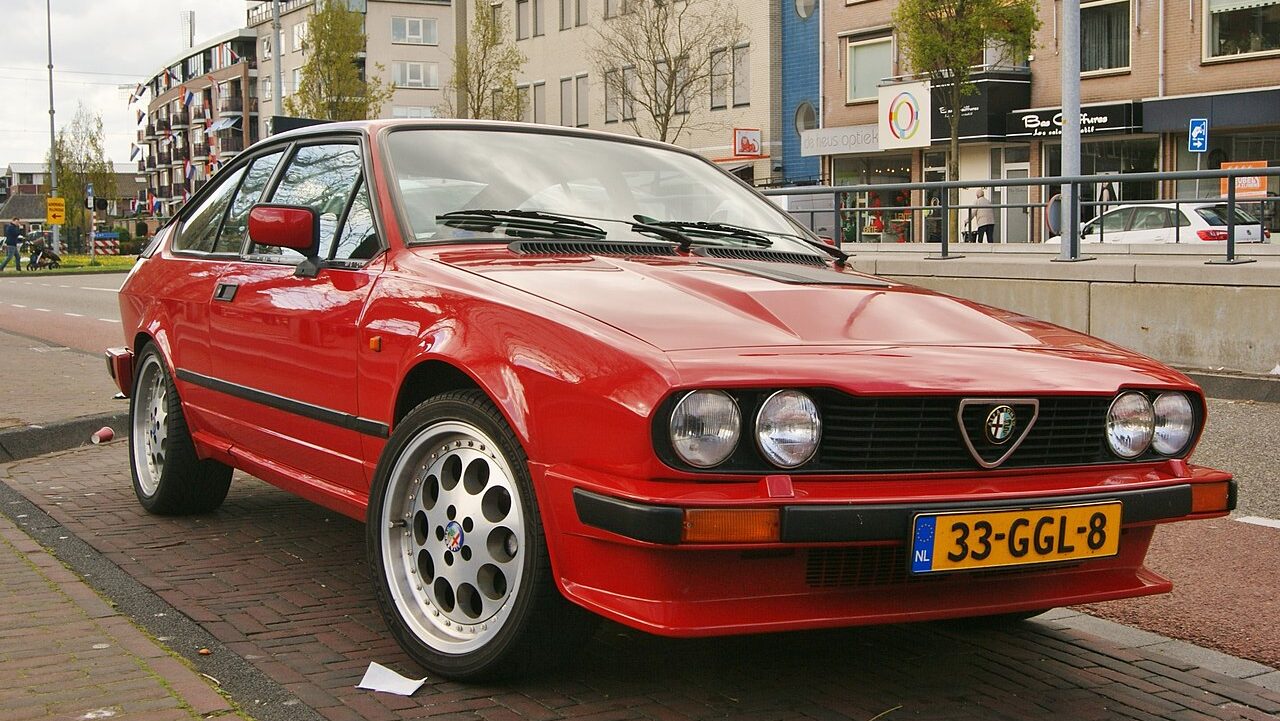
The GTV6 was Alfa Romeo’s answer to the performance coupes of the 1980s, and it wore its heritage proudly. Introduced in 1980 as an evolution of the Alfetta GT, it kept the sharp wedge profile penned by Giorgetto Giugiaro but gained a distinctive hood bulge to clear the intake of its new 2.5-liter Busso V6. That engine was smooth, sonorous, and willing to rev, becoming one of Alfa’s most celebrated powerplants, giving the car a soundtrack that set it apart from its rivals.
Its transaxle layout, with the gearbox mounted at the rear for near-perfect weight distribution, made it as engaging in corners as it was on the straights. The hatchback design brought a dose of practicality, while the airy cabin and driver-centric dash kept the focus on the road ahead. The GTV6 never relied on flash to win admirers; instead, it built a loyal following through its balance of style, engineering, and that unforgettable V6 song.
Alfa Romeo Brera

The Brera began life as a concept car in 2002, wowing crowds with its dramatic proportions and bold detailing. When Alfa brought it to production in 2005, much of Giugiaro’s original vision survived, like the low, wide stance, the sculpted hood, and those signature triple headlamp clusters that made it instantly recognizable at night. Beneath the skin, it shared its platform with the 159 sedan, giving it a solid, planted feel on the road.
Engines ranged from a lively 2.2-liter four-cylinder to a throaty 3.2-liter V6, and while it leaned more toward grand touring than razor-sharp sports car handling, the Brera delivered its performance with style and comfort. Inside, the driver sat low in a cockpit trimmed with leather, aluminum, and Alfa’s trademark deeply recessed gauges. It was a modern Alfa that honored the brand’s tradition of making cars you could fall in love with before even turning the key.
Alfa Romeo 2600 Sprint

The 2600 Sprint was Alfa Romeo’s last straight-six grand tourer, and it wore that distinction with an easy sort of class. Introduced in 1962 and penned by Bertone, the 2600 Sprint carried the clean, no-nonsense lines that defined early ’60s Italian style. Beneath its long hood, a 2.6-liter inline-six with twin overhead cams delivered smooth, easy power, paired with a soundtrack that seemed built for long stretches of open road.
Its airy greenhouse and slim pillars gave excellent visibility, making long drives less tiring, while chrome accents framed the glass and grille with just the right amount of ornamentation. Inside, the 2600 Sprint featured a wood-rimmed steering wheel, Jaeger gauges, and well-shaped bucket seats, all reminders of an era when the cabin was designed to be savored as much as the drive.
Alfa Romeo Junior Zagato

The Junior Zagato was Alfa Romeo’s answer for drivers who wanted something a little left of center. Built on the nimble GT Junior underpinnings, it was handed over to Zagato in 1969 for a body that looked nothing like the rest of the Alfa lineup. The result was a sharp-edged, compact coupe with an abrupt Kamm tail that wasn’t just a stylistic quirk—it was there to help the car slip through the air more cleanly.
Up front, the familiar Alfa grille was pared down and flanked by slim headlights, giving it a focused, almost futuristic face for its time.
The roofline swept straight into the rear glass, a detail that made the car look light on its wheels and gave it a distinctive side profile. Zagato kept the interior honest and purposeful, with just enough comfort to make the most of a weekend drive without weighing it down. Under the skin, the twin-cam four kept things lively, and the car’s light build made it quick to respond on twisty roads.
Alfa Romeo Sprint GT Veloce

The Sprint GT Veloce was Alfa Romeo’s sweet spot in the mid-1960s—small enough to feel agile, yet refined enough to cover long distances with ease. Introduced in 1965 as an evolution of the original Giulia Sprint GT, it brought a number of subtle improvements: a more powerful 1.6-liter twin-cam engine with a higher compression ratio, better interior trim, and detail changes that sharpened its already timeless shape. The signature “step nose” front end framed the familiar Alfa shield between twin round headlights, a design that gave it an approachable yet confident look.
Bertone’s clean, flowing bodywork was accented by thin chrome bumpers and trim that caught the sun without ever overpowering the car’s lines. Inside, the upgrades were immediately noticeable, like deeper seats, improved materials, and a layout that made everything fall to hand. Out on the road, the rev-happy engine, precise steering, and balanced chassis made it a monster in the corners. In an era filled with heavy, overstyled coupes, the Sprint GT Veloce stood out for its simplicity and honesty, a car that delivered exactly what it promised every time you turned the key.
Alfa Romeo 4C
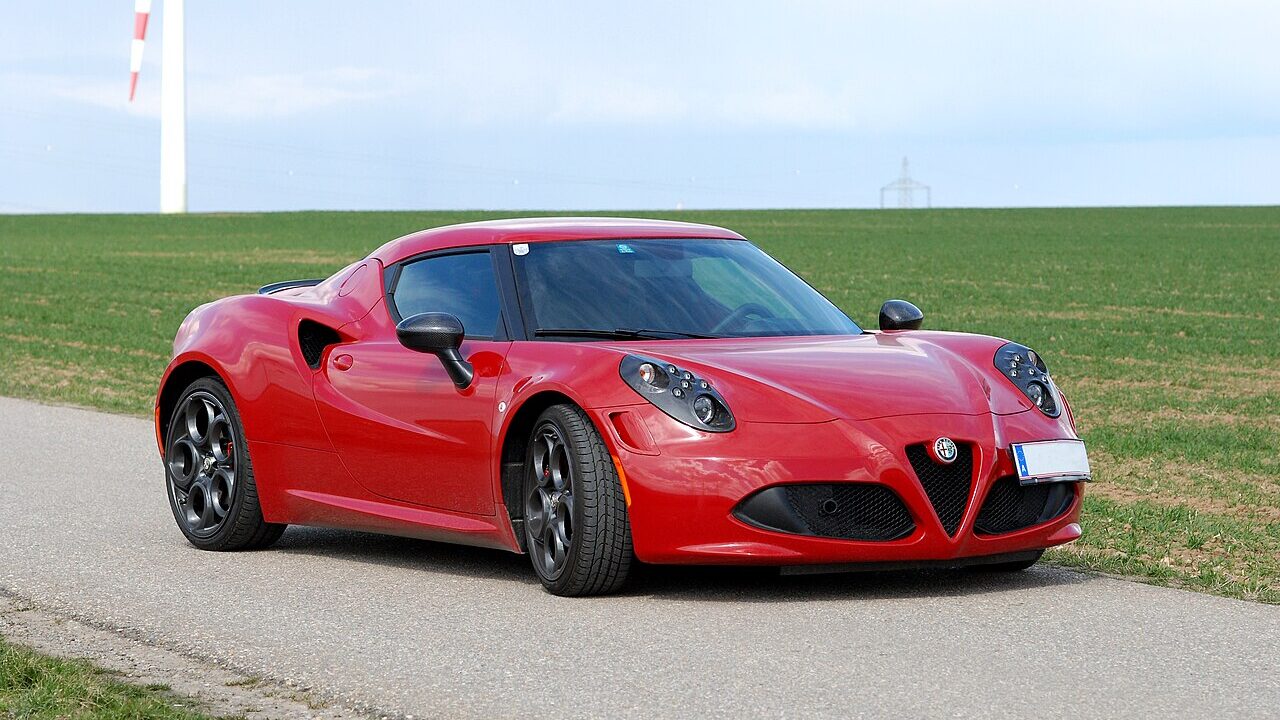
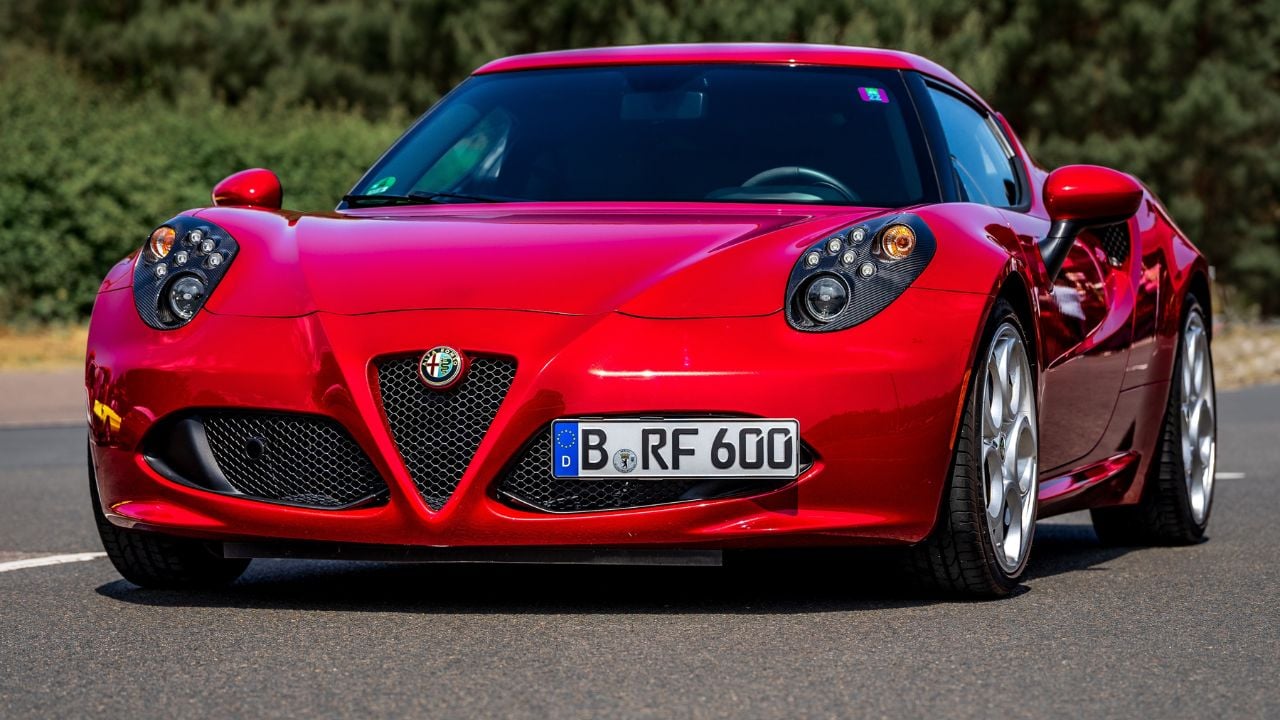
The 4C was Alfa Romeo’s bold return to the U.S. market in 2014 and a statement that the brand still knew how to build a pure driver’s car. With a carbon fiber monocoque chassis—a feature usually reserved for exotic supercars—it tipped the scales at under 2,500 pounds. This featherweight build gave it razor-sharp handling and allowed its mid-mounted 1.75-liter turbocharged four-cylinder to feel far more potent than its numbers suggested.
Its compact footprint, minimal overhangs, and wide stance gave it the stance of a miniature supercar, while the sweeping side intakes and muscular rear arches hinted at its mid-engine layout. Inside, creature comforts took a back seat to purpose, with exposed carbon fiber, slim bucket seats, and controls placed exactly where a driver would want them. The 4C wasn’t built for everyone—it was loud, firm, and utterly unapologetic—but for those who understood it, this was Alfa at its most unfiltered.
Alfa Romeo Alfetta GT

The Alfetta GT debuted in 1974 as Alfa Romeo’s forward-looking coupe for a new era, built on the same transaxle platform as the Alfetta sedan for near-perfect weight distribution. Styled by Giorgetto Giugiaro at Italdesign, it blended crisp, modern lines with just enough softness to keep it unmistakably Italian. The long hood and short rear deck gave it classic sports car proportions, while the expansive glasshouse offered excellent visibility and a light, open feel from inside.
The front end reimagined the traditional Alfa shield within a wider, more contemporary grille flanked by twin headlights, and the hatchback rear added a level of practicality rare in this class. Inside, the angular dashboard, deep-set instruments, and supportive seats captured the 1970s design language while keeping the focus on driving. The Alfetta GT didn’t need to shout for attention—its balance of engineering sophistication and timeless styling has made it one of the quiet achievers in Alfa’s long coupe history.
Alfa Romeo SZ (Sprint Zagato)

The SZ, short for Sprint Zagato, was Alfa Romeo’s late-1980s statement piece—part design exercise, part race car for the road. Developed with Zagato and built on the Alfa 75’s chassis, it combined a 3.0-liter V6 with rear transaxle balance and suspension tuned by Giorgio Pianta, the man behind Alfa’s touring car successes. Its angular composite body panels and sharply stacked triple headlights looked like nothing else on the road, earning it the nickname “Il Mostro” (The Monster) from fans and skeptics alike.
With only around 1,000 examples built between 1989 and 1991, the SZ quickly became a collector’s item. Its low, wide stance gave the SZ the grip and balance to match its aggressive looks. On the track, it was sharp and predictable, designed to obey driver input without protest. The cabin followed the same philosophy: no clutter, just clear instruments, supportive seats, and everything angled toward the driver.
Alfa Romeo GT (2000s)

The modern-era Alfa GT showed that you could have classic coupe style without sacrificing everyday practicality. Designed by Bertone and launched in 2003, it blended graceful lines with a genuinely usable cabin and trunk—rare for a car that looked this good. The front wore Alfa’s then-modern shield grille with confidence, and the sides were kept clean to let the proportions speak for themselves. The gently arched roofline flowed into the rear deck in a way that gave the car an easy sense of motion, even at a standstill.
The interior aimed to do several things well, offering a sporty appearance and supportive seats without sacrificing quality materials and comfort. It was available with a range of engines, including the sonorous 3.2-liter V6 that gave the GT a proper performance edge. For many, it was the perfect compromise, giving drivers an Alfa with the beauty and character you’d expect, paired with the practicality to be driven every day.
The Lasting Magic of Alfa Romeo Coupes

The Alfa Romeo coupes featured in this list are milestones of elegance and engineering that tie together the same heritage and driving spirit in different design languages. Even if you don’t recognize the model, the styling cues of these coupes are distinct, leaving you nodding after you swivel your head around to watch it drive by.
For those lucky enough to get behind the wheel of some of these vehicles, know that you’re operating a machine created out of passion for automotive design, and for some of us, you’re living out our dreams.