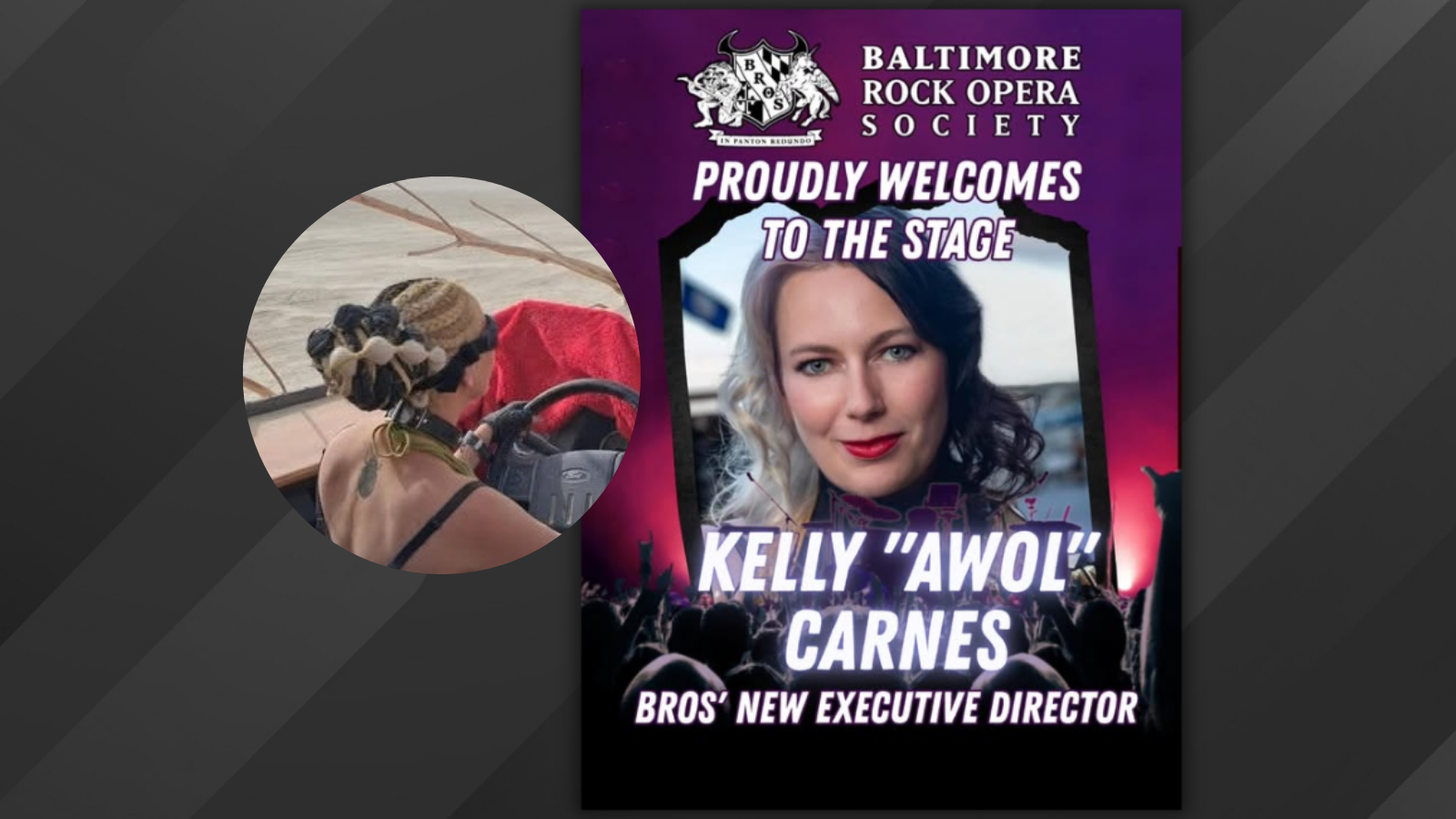
A Baltimore arts organization enthusiastically welcomed its new executive director on September 14. Within days, she was fired following complaints about her hairstyle.
Kelly Carnes, who is White, returned from Nevada’s Burning Man festival wearing cornrows. She said the braids protected her hair from the desert’s wind and dust.
A video showing Carnes at a Baltimore Rock Opera Society fundraiser prompted complaints of cultural appropriation. The nonprofit removed the video, announced anti-racism training and promised changes to its anti-discrimination policy.
Carnes says she was subsequently dismissed because she was “not a good fit.” A Baltimore attorney believes Maryland’s CROWN Act, enacted to protect against discrimination involving race-associated hairstyles, could provide grounds for a legal challenge.
Warm Welcome
Embedded media follows; please allow a moment for it to load.
BROS introduced Carnes as Kelly “AWOL” Carnes, praising her more than 21 years of experience in arts leadership, fundraising, and nonprofit management.
“BROS is wonderfully weird in the best possible way,” Carnes said in the announcement. “It is a place where people build monsters, bands, worlds, friendships, stories, skills, and impossible ideas.”
She began work September 8 and attended the organization’s September 10 Puppet Karaoke fundraiser wearing the braids she brought home from Burning Man.
Carnes told The Baltimore Banner she had discussed the hairstyle with fellow festival campers, including people of color. It consisted of cornrows across the top of her head leading into individual braids and extensions.
“Nobody at the event, including staff members I met that evening, raised any concern about my hair,” she told the newspaper.
Complaints emerged after BROS posted a video featuring her on September 14.
On September 16, the board publicly acknowledged the objections.
“We have received many heartfelt and concerned messages from members of our community regarding a video circulated on social media showing our new Executive Director, who is white, wearing cornrows at a recent BROS public event,” the board wrote.
It promised anti-racism leadership training, revisions to its policy concerning cultural representation and dress, and a racial-equity working group.
“A message from our Executive Director will follow soon,” the statement concluded.
Out of a Job
Carnes says the board instructed her not to attend a September 18 town hall about the controversy.
Just after midnight following the meeting, she received an email terminating her employment. The nonprofit had spent three months interviewing her, including a budgeting exercise, before hiring her.
The termination letter described her as “not a good fit,” without mentioning the hairstyle.
“People can have different opinions about my hairstyle,” Carnes told The Banner. “But someone’s personal opinion about my hairstyle is one thing. Making an employment decision based on my physical appearance is another.”
On September 23, volunteers learned of her departure. An internal email obtained by The Banner also disclosed that four of the organization’s six board members planned to leave at the end of December. The email did not explain either decision.
An Unexpected Legal Twist
Maryland enacted its CROWN Act in 2020 to address discrimination involving hairstyles associated with race, particularly restrictions affecting Black employees wearing natural or protective hairstyles.
Under Maryland State Government §20-101, the definition of race includes hair texture, Afro hairstyles, and protective hairstyles such as braids, twists, and locks.
The law does not prohibit White people from wearing cornrows or reserve those hairstyles for any particular racial group.
Attorney Jeremy Eldridge told WBFF Fox45 Baltimore that the board’s public statements could become evidence if Carnes challenges her dismissal. Whether the complaints motivated the firing would be central to that argument.
The nonprofit’s size presents another complication. Under Maryland §20-601, general employment discrimination protections typically require at least 15 employees for 20 or more calendar weeks in the current or preceding year. Harassment claims have a separate threshold.
BROS’ website listed five part-time salaried staff members, The Banner reported, alongside its much larger volunteer community. Its legally counted workforce has not been established.
Carnes says she is exploring legal options. No filed lawsuit has been confirmed.
The Welcome Wears Thin
The organization’s Facebook posts have since attracted commenters criticizing its response to Carnes’ hairstyle, including some who turned to the theater’s own repertoire for humor.
“I presume you won’t be producing ‘Hair’ anytime soon…” Chris Grum wrote.
Paul Blasternot wondered whether future BROS events would require a barber to determine which hairstyles were appropriate for attendees’ skin colors.
Another commenter questioned whether rock opera itself could be considered cultural appropriation, given rock music’s roots in Black American musical traditions.
The reactions included predictions of a lawsuit and criticism of the board’s approach to cultural expression, although the comments do not establish what motivated the termination.
Cat Litten, BROS’ marketing and communications director, told The Banner the organization would not answer further press questions.
“Our focus is internal at the moment, and we are not engaging further with the press at this time,” Litten wrote.