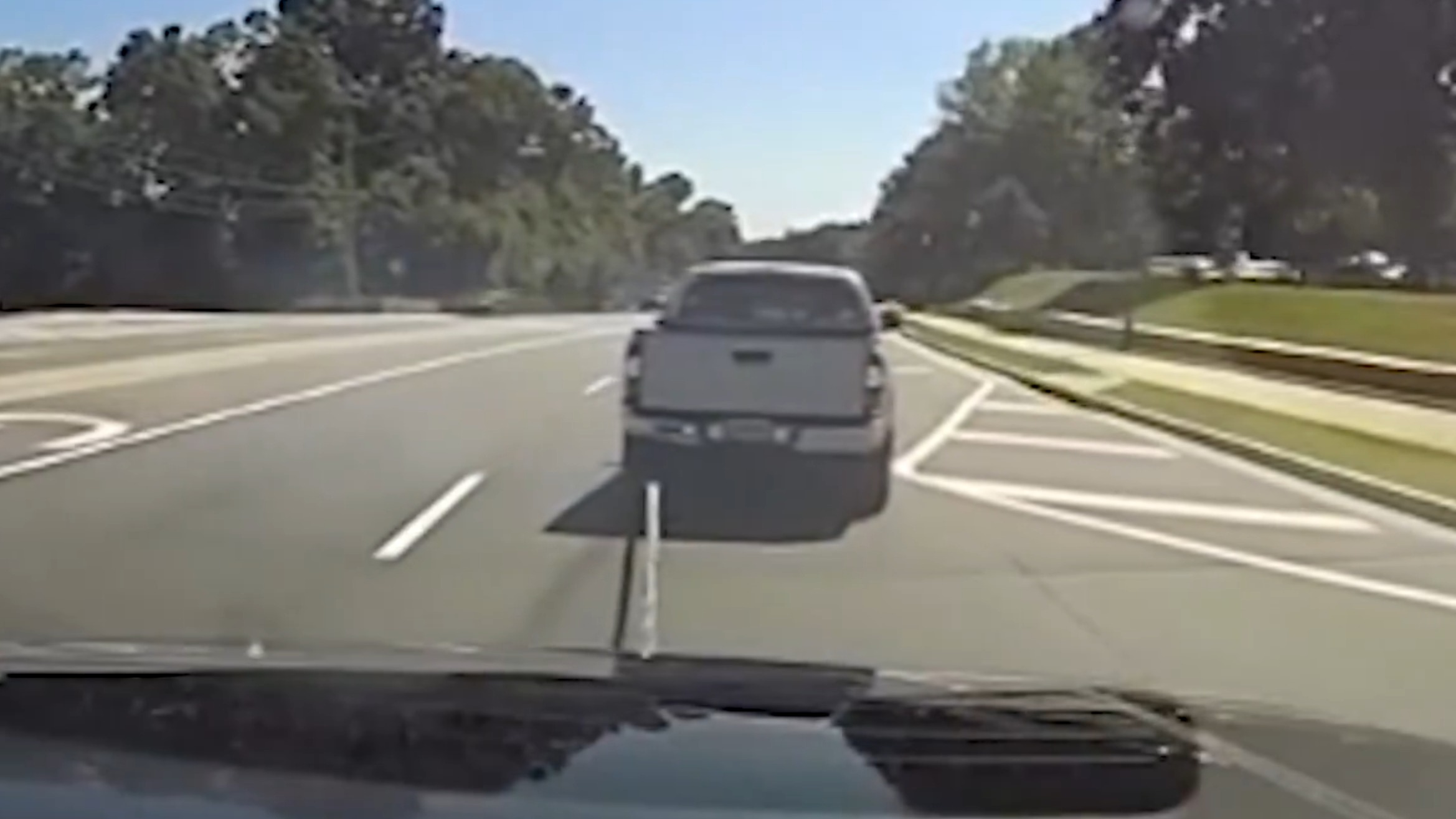
Atlanta police stopped a suspected camera vandal before a full chase could even get going, thanks to a tire-snaring device that is quietly becoming one of law enforcement’s favorite tools. The dashcam footage tells the whole story in a few seconds: a patrol vehicle pulls close behind a truck, a heavy-duty tether launches from the front bumper, wraps itself around the rear tire, and the truck rolls to a stop without drama, fanfare, or a 45-minute interstate spectacle. No spun-out vehicles, no spike strips, no news helicopter hovering over a pile of airbags. Just physics, a net, and a very bad day for the driver.
The suspect was wanted for allegedly destroying multiple Flock Safety cameras, the AI-powered license plate readers that Atlanta and hundreds of other cities have deployed to help officers track stolen vehicles, solve crimes after the fact, and flag wanted suspects in near real time. Flock Safety, ironically enough an Atlanta-based company, has built a network of these solar-powered, LTE-connected cameras that catalog not just license plates but vehicle make, model, color, and unique characteristics like body damage or bumper stickers. Smashing the cameras meant destroying exactly the kind of infrastructure that was likely being used to keep tabs on him.
That detail alone elevates this from a routine arrest into something worth paying attention to. This was not a random act of mischief. The driver reportedly faces charges of property damage and interference with government property, on top of drug charges. In other words, authorities believe he had some motivation to go after that specific surveillance network, and that motivation apparently did not extend to coming up with a better exit plan.
What made the whole thing particularly clean was that the Grappler intervened before a chase even had a chance to develop. Law enforcement has spent decades wrestling with the reality that vehicle pursuits are dangerous for everyone involved, including bystanders who had nothing to do with any of it. The Grappler addresses that problem in a way that is mechanical, low-drama, and, judging by the dashcam video, surprisingly satisfying to watch.
What the Grappler Actually Is
A wanted driver thought he could get away from police on a busy Georgia roadway.
But officers deployed one of the most effective tools being put in the hands of police: the Grappler.
Dashcam video shows Atlanta police firing a Grappler from the front of a patrol vehicle,… pic.twitter.com/4CD9krCoaC
— Fox News (@FoxNews) June 12, 2026
The Grappler Police Bumper mounts to the front fender of a law enforcement vehicle. When activated, it deploys a strong net that wraps around the rear tire of the vehicle in front of the officer, bringing the fleeing car to a safe and controlled stop. The net is reusable and only takes a few minutes to reload.
The device was invented by Leonard Stock, a construction worker with no police background who got the idea after watching a pursuit show on television. He built a working prototype in 2016, posted a video of it to YouTube, and the clip went viral, catching the attention of law enforcement agencies. Border Patrol first used it in 2018, and it has since spread to roughly 120 police departments across 31 states.
The device can engage a rear tire with as little as an 8 km/h approach speed, bringing the vehicle to a gradual stop. It functions across a range of speeds up to 120 km/h, though higher-speed use is reserved for situations that would otherwise warrant more serious force.
Why It Matters More Than the PIT Maneuver
Before the Grappler came along, officers ending a pursuit had a fairly grim menu of options. The standard alternative was the Precision Immobilization Technique, a risky bump using a police car’s bull bar to the rear quarter panel of a fleeing vehicle, which causes it to spin out of control. Effective in some situations, but also dangerous for everyone nearby. Spike strips were the other standby, and as anyone who has watched dashcam footage knows, a car on blown tires traveling at speed is not exactly an improvement over a car with functioning ones.
As one Arizona Department of Public Safety sergeant put it, the Grappler is not putting vehicles into a spin, not deflating tires. It is simply stopping the vehicle. That distinction matters enormously in dense urban environments like Atlanta, where a spinning pursuit vehicle could easily end up in a storefront, an intersection, or worse.
From 2001 to 2021, deadly pursuits in the United States increased by 41 percent, according to the U.S. Department of Transportation. Tools that stop that number from climbing further are not a luxury.
What Flock Cameras Actually Do
It is worth understanding what the suspect allegedly targeted before writing this off as a property crime footnote. Flock Safety, founded in Atlanta in 2017, manufactures automated license plate recognition cameras, video surveillance systems, and gunfire detection hardware, along with the software to integrate all of it into a searchable evidence platform.
According to Flock’s own communications team, the technology has contributed to the recovery of more than 2,000 missing persons and has been credited with helping solve crimes including a mass shooting at Brown University. The company’s position is that when cities remove technology from law enforcement’s toolkit, it creates a negative cycle that makes violent crimes easier to go unsolved.
The cameras catalog vehicle makes, models, and unique identifying details like bumper stickers or body damage to create what Flock calls a “vehicle fingerprint,” and individual agencies can share their network data with other departments across the state or nationwide. Destroying even one node in that network has real investigative consequences, which is presumably why interfering with government property is among the charges the driver faces.
Two Technologies, One Very Efficient Arrest
What stands out about this incident is how two distinct technologies worked together without anyone needing to do much improvising. The Flock cameras identified a target. The Grappler stopped him before anyone had a chance to make things worse. No pursuit, no chaos, no dashcam footage of a pickup truck threading through rush-hour traffic at triple digits.
As of 2026, around 40 to 50 law enforcement agencies were using the Grappler, with more joining each year. Colorado State Patrol alone has logged 75 successful interceptions since 2021. The technology is spreading because it works, and incidents like this Atlanta stop offer a clean, well-documented case for why departments are making the investment.
For the driver, the lesson is a straightforward one: smashing the cameras that track vehicles and then driving away in a vehicle is not a sound strategy. The Grappler had the last word, and it did not need to say much.