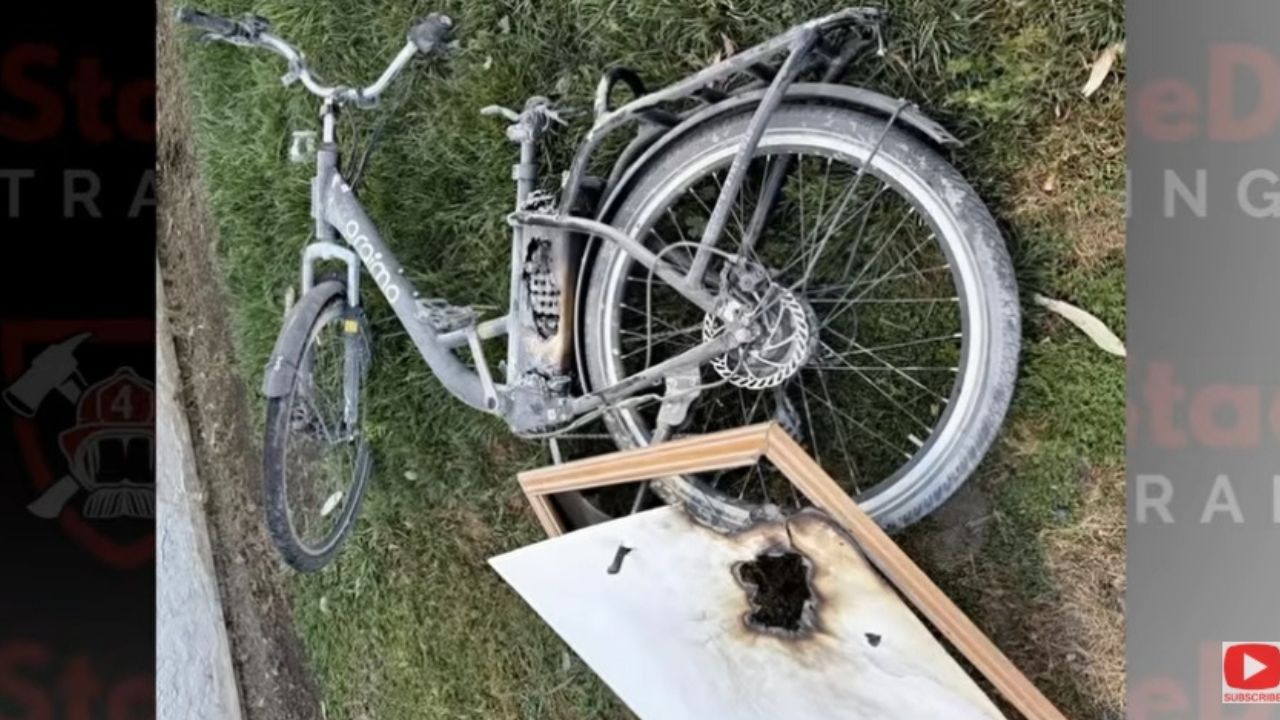

Inside a quiet apartment, an electric bike sits charging. At first, it feels perfectly normal; there is nothing unusual about that. Then a thin stream of smoke begins to rise. Within seconds, the situation shifts from normal to deadly.
Two people are inside. One senses the danger early and escapes. The other stays behind, trying to fight what appears to be a small fire. It is a decision that proves fatal.
Moments later, that second person finally makes it outside. But instead of relief, there is collapse. Life slips away just steps from safety.
This real incident took place on April 3, 2026, in San Jose, California. The source of the fire was an Aromo electric bike, likely a lower-cost model with a battery capacity around 500 watt-hours. That size is not unusual. It is typical for many e-bikes found in homes around the world.
That is what makes this story deeply unsettling.
Why Lithium-Ion Battery Fires Are Different

The danger is not limited to rare or high-performance machines. It sits in everyday devices, often unnoticed, until failure occurs. When a lithium-ion battery goes into thermal runaway, it does not behave like a conventional fire. It becomes something far more aggressive and far more lethal.
In a matter of seconds, the battery begins to release enormous volumes of toxic smoke. A single lithium-ion cell can produce about six liters of smoke. Multiply that across roughly 100 cells in a typical e-bike battery pack, and the result is around 600 liters of dense, poisonous gas flooding a room in under half a minute.
That smoke is not just thick. It is chemically dangerous.
Among the gases released are hydrogen, carbon dioxide, and various metal particles such as cobalt and nickel. But one element stands out for its deadly efficiency: carbon monoxide.
Testing by fire safety researchers has shown that during battery failure, carbon monoxide levels can reach 5 percent concentration. That equals 50,000 parts per million. For comparison, a household carbon monoxide alarm is designed to trigger at around 35 parts per million. At 12,800 parts per million, collapse and death can occur within minutes.
A Lethal Misunderstanding

In this case, the person attempting to fight the fire was likely exposed to levels more than four times that lethal threshold.
The fact that they made it outside at all is remarkable.
The tragedy highlights a critical misunderstanding. Many people believe that staying to fight a small fire can save property and prevent damage. With lithium-ion battery fires, that instinct can cost a life.
The real threat is not the flames. It is the air.
Battery fires create an environment that becomes unbreathable almost instantly. Without specialized respiratory protection, such as the equipment used by firefighters, exposure can be fatal in a very short time.
Even using a fire extinguisher does not eliminate the danger. It may suppress visible flames, but it does not stop the release of toxic gases during thermal runaway. Standing close to the source only increases exposure to a lethal atmosphere.
The hard truth is that in these situations, survival depends on a simple decision.
Get out. Stay out.
Property can be replaced. A life cannot.
E-Bike Battery Fires Are Uniquely Deadly

An e‑bike battery fire is particularly fatal compared to many other household fire causes. Lithium‑ion batteries undergo thermal runaway, a chain reaction that rapidly releases heat and toxic gases. Unlike a typical electrical fire, the danger is not just flames but the atmosphere itself.
A single e‑bike pack can emit hundreds of liters of smoke within seconds, containing lethal concentrations of carbon monoxide—far above the threshold that household alarms detect. This creates an environment that becomes unbreathable almost instantly, meaning even brief exposure can cause collapse.
Attempts to fight the fire with extinguishers do not stop gas release, and without firefighter‑grade respiratory protection, survival chances plummet. In short, while electrical faults or cooking accidents may allow time to escape, lithium‑ion battery failures can overwhelm occupants in moments. They’re uniquely deadly.
With e-bikes, scooters, and other battery-powered devices becoming more common, understanding this risk is essential. These technologies offer convenience and sustainability, but they also introduce hazards that demand awareness and respect.
Thermal runaway is fast. It is violent. And it can be deadly long before fire spreads beyond the source.