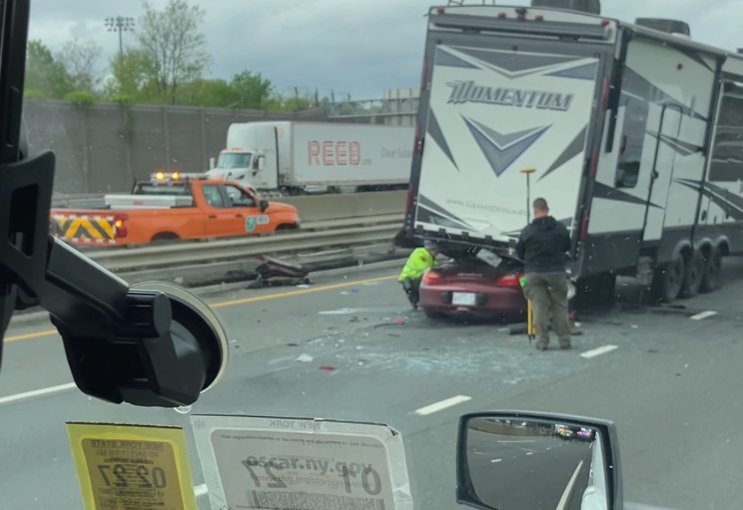
A TikTok that looked like a routine fender-bender turned into one of the most haunting road accident videos to go viral this year. Posted by user @meelthegoatt with the caption “OH. MY. GOD. Ridgefield Park NJ Turnpike North,” the clip starts innocuously enough. You see a pickup truck hauling a travel trailer, a little road chaos, nothing out of the ordinary for the notoriously unforgiving New Jersey Turnpike. Then the camera zooms in.
There, tucked completely underneath the rear of the RV, is a Porsche Boxster. Not crumpled against it. Not rear-ended into it. Underneath it. The kind of sight that makes you do a double take, rewind the video, and then sit in silence for a second.
The comments section erupted immediately, as it tends to do when the internet collectively witnesses something equal parts baffling and horrifying. A second angle shared by another user made it unmistakably clear: the low-slung sports car had slid directly beneath the trailer, nearly disappearing from view. For a vehicle known for its sleek, ground-hugging profile, the Porsche Boxster was in the worst possible place it could be.
What started as a shocking piece of highway footage quickly turned into something far more somber. The Porsche belonged to Gayle Valle-Blake, a 72-year-old woman from Maine. She did not survive the crash. What the video captured was, unknowingly, the final moments of someone’s life, and that reality settled over the comments section like a weight.
How a Porsche Ends Up Under a Trailer
@meelthegoattOH. MY. GOD. Ridgefield Park NJ Turnpike North 🙏🏾🙏🏾🤯🤯🤯
The physics here are grim but worth understanding. The Porsche Boxster sits very low to the ground, which is part of what makes it such a beloved sports car. But that same low profile becomes catastrophic in a rear-end collision with a vehicle like a travel trailer, which sits significantly higher off the ground. Instead of the front of the car absorbing the impact against the trailer’s bumper or frame, the car slides underneath, a phenomenon known as underride.
Underride crashes are one of the deadliest types of highway accidents, and they are disproportionately fatal because standard vehicle safety systems like crumple zones and airbags are designed with conventional collision geometry in mind. When a car goes under rather than into another vehicle, those protections often fail to engage in the way they are intended to. The results are almost always catastrophic for the occupant of the smaller vehicle.
What the Comment Section Got Right (and Wrong)
The internet, being the internet, had opinions. A significant number of commenters placed blame squarely on the Porsche driver, pointing out that tailgating a vehicle you can physically fit under is an obvious recipe for disaster. And while that instinct toward fault-finding is understandable, it is also a bit reductive when you consider the broader picture.
Yes, following distance matters enormously, especially on a highway and especially behind a tall trailer. But the comment section largely skipped past the infrastructure side of the conversation. Many commercial trailers and recreational vehicles lack adequate rear underride guards, which are protective barriers designed to prevent exactly this type of crash. Advocacy groups have pushed for stronger federal standards on trailer underride protection for years, with inconsistent results. The blame is rarely one lane wide.
What This Crash Teaches Us About Highway Safety
There is an uncomfortable lesson embedded in this viral moment. Highway driving lulls people into a false sense of routine. The Turnpike, the RV, the Porsche, the lane changes, the merging traffic: it all looks normal until it suddenly is not. Maintaining safe following distance behind large vehicles is not just common sense, it is one of the most life-preserving habits a driver can build.
Experts generally recommend following the three-second rule at minimum, with additional buffer added for high speeds, poor visibility, or any vehicle with significant height differential. A sports car with a low nose following close behind a travel trailer is essentially driving in a blind spot and underneath a ramp at the same time. That combination does not leave room for error.
Additionally, this incident is a reminder that dashcam footage and bystander video have become unexpectedly important tools for accident documentation and safety awareness. The clip spread widely, and with it, a conversation that might not have happened otherwise.
Remembering Gayle Valle-Blake
Lost in the spectacle of a shocking video is the person at the center of it. Gayle Valle-Blake was 72 years old, from Maine, and was behind the wheel of that Porsche Boxster on the New Jersey Turnpike. She did not make it home.
There is something uniquely disorienting about watching a video that captures someone’s last moments without knowing it, and then learning that afterward. The TikTok comment section, which had been brisk and opinionated, noticeably shifted in tone once her identity became known. People started expressing condolences alongside their driving commentary, which is perhaps the most human response possible.
Road safety statistics are easy to scroll past. A name and a story are not. Gayle Valle-Blake deserves to be remembered as more than a caption on a viral video.