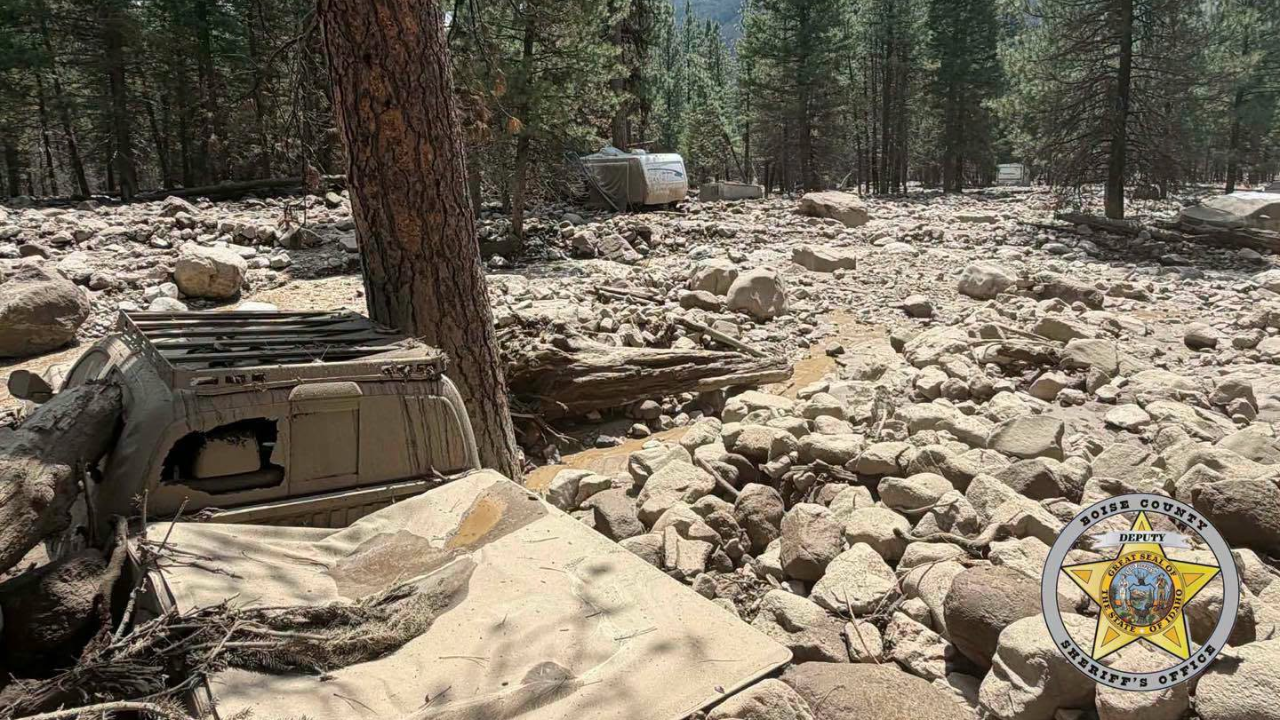
A massive flood-created landslide buried the Grandjean Trailhead and Campground in Boise County, Idaho, on Wednesday, leaving a mess of wrecked cars and closing the site indefinitely. The Boise County Sheriff’s Office reported that the northeast part of Boise County took major hits from flash flooding, and posted pictures of the destruction at both the campground and trailhead. As of Friday morning, Boise County Sheriff Scott Turner said there were no reports of injury from the slide.
The campground is located approximately seven miles down Grandjean Road, which also provides access to multiple trails in the Sawtooths. The sheriff’s office showed images of cars, trucks, and campers buried under mud and rock debris or smashed into trees. It wasn’t apparent how many campers may have been staying at the location when the slide occurred.
The sheriff’s office attributed the flooding to historic burn areas, noting that a lot of the area burned in the 2024 Wapiti Fire, which has produced numerous mudslides. Vegetation stripped of its roots by wildfire does not absorb water but instead allows it to run off quickly and pick up soil, rock, and dead tree material while moving downhill. The office said this would not be an easy cleanup task and asked the public to expect some time before the Forest Service reopens the area.
The Sawtooth National Forest has closed the campground and trailhead until further notice, calling the campground unsafe. Jessica Maddock, a spokesperson for the forest, told the Idaho Statesman the immediate work was focused on rerouting water away from the slide area so it could dry out before crews could start removing debris. The nearby Sawtooth Lodge remained open.
How the 2024 Wapiti Fire Set the Stage
The Wapiti Fire burned across this same part of Boise County in 2024 and left behind the conditions that made this slide possible. When a fire burns hot, it destroys the roots and ground cover that normally hold soil in place and can leave the ground water-repellent, a condition scientists call hydrophobic soil. Rain that would soak into healthy forest instead sheets across the surface and gathers into fast-moving flows.
That is why one storm can trigger a slide years after the flames are out. The sheriff’s office said the burn scar has produced many mudslides across the northeast side of the county, and Wednesday’s slide at Grandjean is the latest. The risk generally stays elevated for several years after a major fire, until vegetation reestablishes and the soil recovers, which means the area can flood again with the next heavy rain.
What This Means for Highway 21 and Access to the Area
The same storm system closed an 11-mile stretch of Highway 21 between Grandjean and Banner Summit, near mileposts 94 to 105, after a separate slide buried the roadway just after 6 p.m. Wednesday. The Idaho Transportation Department brought in heavy equipment and worked long hours to remove thousands of tons of mud and debris, clear plugged culverts and repair the damage. The department has since reopened that stretch of the highway.
Drivers should still expect crews to be working in the area, and the department has asked motorists to stay alert for maintenance personnel and equipment. The campground and trailhead closures are separate from the highway and remain in effect. Anyone planning a trip to the Grandjean area should check with the Sawtooth National Forest before heading out, since the reopening timeline for the recreation sites has not been set.