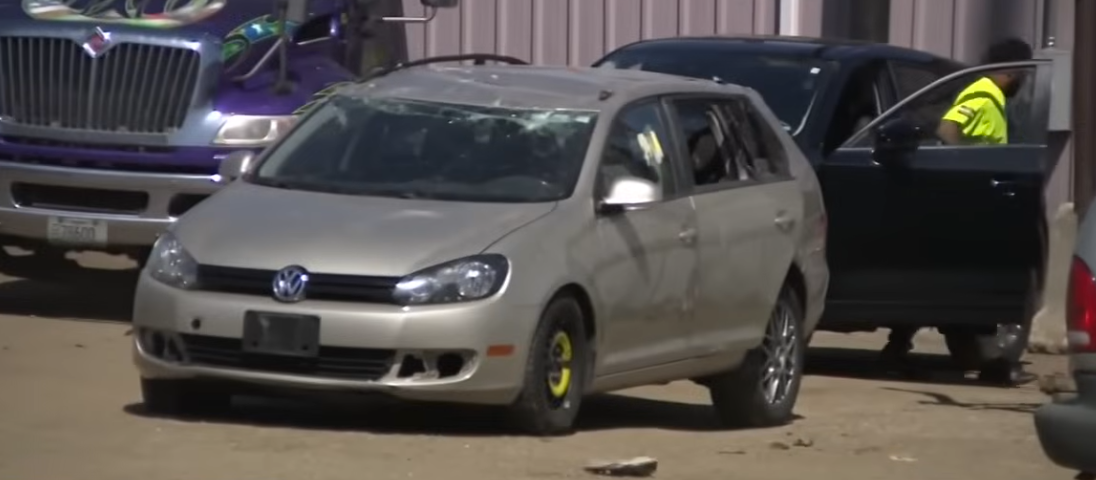
When Teon Thomas hit a pothole in Milwaukee on May 1 and blew a tire, he figured it was just one of those frustrating days. He left his car roadside, called for a tow, and planned to come back for it. What he could not have anticipated was that by the time he returned, his vehicle would already be on its way to becoming scrap metal, crushed and piled with junked cars at a Milwaukee salvage yard, all within a matter of hours.
It was not a complicated theft. It did not require sophisticated tools or a well-organized ring. All it took was a tow truck, a bogus bill of sale, and a system with more than a few holes in it.
What cracked the case open was not a tip line or a surveillance breakthrough. It was a pair of Apple AirPods Thomas had left inside the car. The GPS-traceable devices led him straight to Milwaukee Iron and Metal, a scrapyard on Green Bay Avenue, where he found his gold car already crushed in a pile of junked vehicles. Police were called, an investigation was launched, and it did not take long to identify the man responsible.
A criminal complaint shows that Derrick D. Hutchins, the tow truck driver charged in the case, filled out and signed a form affirming he had the legal right to sell the vehicle, and presented an ID when scrapping it, selling the car for a few hundred dollars using a fraudulent bill of sale.
Hutchins, 30, now faces a felony theft of movable property charge, with a potential sentence of up to 3.5 years in prison and fines reaching $10,000 if convicted. Milwaukee Iron and Metal has since barred Hutchins from scrapping any further vehicles at their facility.
For Thomas, though, the legal proceedings do little to restore what was taken. He has been without a car since the incident, and as he put it, even getting breakfast has become a challenge. His hope now is that sharing his story forces a conversation about a loophole that, it turns out, quite a few people have already fallen through.
After Thomas’s story went public, several other victims came forward to report the exact same thing had happened to them, pointing to what appears to be a pattern rather than an isolated incident. The calls for reform were immediate, with victims and lawmakers alike pushing for tighter documentation requirements before any vehicle can be legally scrapped in Wisconsin.
A Handwritten Note Is All It Takes Under Current Wisconsin Law
Here is where things get genuinely troubling for anyone who owns a car in the state. Under Wisconsin law, all a tow truck driver legally needs to scrap a vehicle is a photo ID and either a title or a bill of sale. The bill of sale can be written by anyone, so long as it includes the names, addresses, signatures, and VINs of both parties.
That is it. There is no cross-reference with police databases, no check against stolen vehicle reports, and no statewide system tracking whether a car being brought to a scrapyard has been flagged as stolen. The scrapyard’s own attorney acknowledged the difficulty in verifying those documents, noting that while the business collects IDs and records everything on video, it cannot always determine whether paperwork is genuine.
The practical effect of this gap is that a stolen vehicle can go from the street to crushed metal faster than its owner can file a police report. Thomas’s car was scrapped within hours of him realizing it was missing. By the time officers were involved, there was no car left to recover, only surveillance footage of the tow truck driving away.
This Is Not the First Time, and It Will Not Be the Last
Thomas’s case drew wider attention in part because the AirPods gave investigators something to work with. Most victims are not so fortunate. Carlton Jackson, a Milwaukee man whose cars were stolen from his own garage and scrapped without a title, spent more than two years arguing that the salvage yard should be held responsible for not requiring proper ownership documentation, ultimately finding little legal recourse because the yard had technically complied with existing Wisconsin law.
A third victim, whose car was taken from an apartment complex parking lot by a tow truck in just seven minutes, similarly found that the driver had sold the vehicle to a scrapyard the following morning. Investigators in that case determined neither the tow company nor the scrapyard had violated the law as written, which is precisely the problem. The law as written leaves a wide open lane for abuse. A tow truck and a handwritten note, and a person’s car is gone before anyone realizes what happened.
Lawmakers on Both Sides Are Pushing for Tougher Scrap Requirements
Rare as it is these days, this particular issue has drawn bipartisan agreement in Wisconsin. State Representative Bob Donovan, a Republican from Greenfield, called the current bill-of-sale standard dangerously easy to fake, pointing out that even a fraudulent ID paired with a fake bill of sale could clear the current threshold.
Democratic lawmakers in Milwaukee have voiced similar frustrations. The proposed fix most commonly cited is straightforward: require a clean title before any vehicle can be accepted at a scrapyard, full stop.
Critics of the current system argue that if a seller cannot produce a title proving legal ownership, accepting the vehicle should not be permitted under Wisconsin law. Title certificates are significantly harder to forge than a handwritten bill of sale, and they create a paper trail that connects the vehicle to a registered owner.
Requiring them would not eliminate theft, but it would close the express lane that currently allows stolen cars to disappear into scrap piles within the same afternoon they are taken.
What Car Owners Can Do Right Now
While Wisconsin sorts out its legislative calendar, car owners in the state and beyond are in a reasonable position to take a few steps that could make all the difference in a situation like Thomas’s. Bluetooth trackers, whether Apple AirPods, AirTags, or competing products from Tile and others, have become increasingly effective investigative tools, and this case is a clear example of that. Thomas would very likely have had no lead at all without the AirPods he had simply forgotten in the car.
Beyond tracking devices, keeping a record of your vehicle’s VIN, license plate, and any distinguishing features in a place separate from the car itself speeds up the reporting process significantly. If your car goes missing, time is genuinely of the essence, especially in a state where the scrapping process can be completed before a stolen vehicle report is even processed. And if your car has been recently towed under circumstances that do not quite add up, it may be worth checking scrapyards in addition to city impound lots, which is a step Thomas’s situation has now made uncomfortably relevant advice for Milwaukee residents in particular.
The scheme is not unique to Wisconsin. A Chicago Ridge tow truck driver was similarly charged with six felony counts in early 2026 after allegedly taking vehicles from crash scenes and selling them to a junkyard using falsified paperwork, suggesting the loophole in salvage law is being exploited in multiple states. Until those laws catch up, a good Bluetooth tracker might be the most practical insurance a car owner can carry.