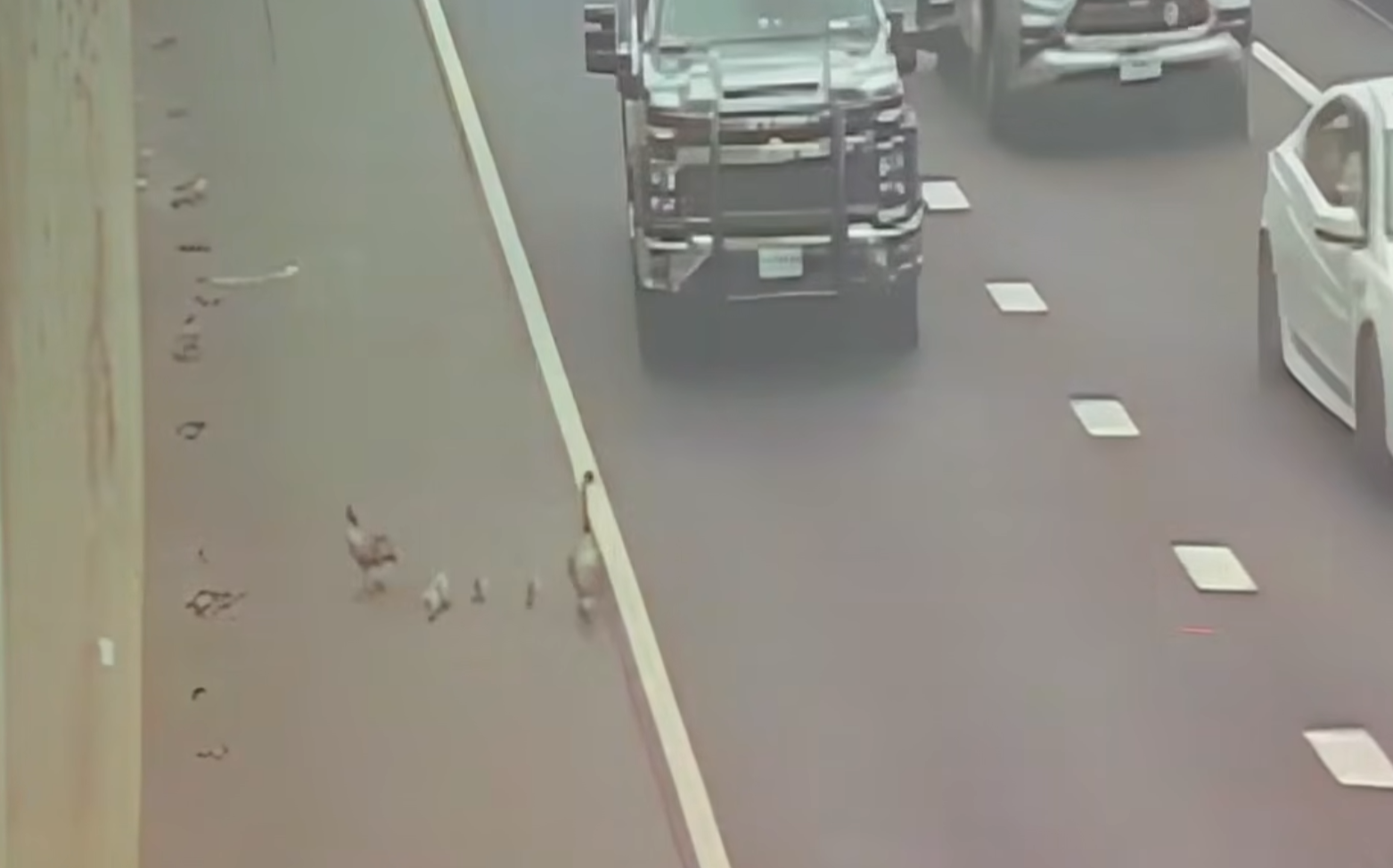
If you were stuck on I-66 in Arlington, Virginia on a recent Wednesday afternoon wondering why traffic had come to a grinding halt, we have some answers for you. The culprits were not a fender bender, a stalled vehicle, or one of the many construction zones that have made I-66 a commuter’s least favorite place on earth. No, this time the traffic jam came equipped with feathers, fuzzy yellow goslings, and absolutely zero regard for rush hour.
A family of seven Canada geese decided that a stretch of westbound I-66 was a perfectly reasonable place to take an afternoon stroll. Two adults and five goslings turned one of Northern Virginia’s most congested corridors into their personal nature walk, and commuters had no choice but to sit back and watch. In a region that regularly ranks among the worst in the nation for traffic congestion, this was truly a new kind of gridlock.
Metro Transit Police Officer James Gioia was the first on the scene, driving along I-66 when he noticed cars ahead braking hard. What he found in front of his vehicle stopped him cold: a goose family holding their ground in the middle of a major interstate. Rather than shooing them into harm’s way, Officer Gioia did what any dedicated public servant would do: he put his truck in first gear and became their personal escort, crawling along at one mile per hour and keeping vehicles at bay.
What followed was a nearly 45-minute operation that eventually pulled in Arlington County Police and the Virginia State Police, all united in the noble mission of getting a family of birds safely off a highway. It is the kind of story that sounds like it came from a children’s book, except it was very much real, and it tied up one of the DC area’s most notoriously congested roads in the process.
One Officer, One Police Dog, and Seven Very Stubborn Geese
Officer Gioia held the line solo for the better part of 45 minutes, keeping his truck between the geese and oncoming traffic while trying to guide them toward the shoulder. At some point during the standoff, he had an idea. He had his K9 partner with him, and he figured that the sight of a police dog might be enough to convince the geese to move in the right direction.
He was right. The adults spotted the dog and began steering themselves and their goslings toward the far right shoulder, slowly making their way toward the Sycamore Street exit area near East Falls Church. The strategy worked, at least initially. Drivers on I-66 who had been sitting in goose-induced traffic finally had reason to cheer.
Arlington County Police confirmed that lane closures were put into effect around 1:30 p.m. to help manage the situation. By the time additional officers arrived and the operation wrapped up, the family had been guided off the highway and into a grassy, tree-lined area away from traffic. Arlington County Police could not resist posting about it on Facebook, writing that the multi-agency response gave them “goosebumps.”
Why Geese Walk on Highways in the First Place
This may seem like a freak event, but anyone who has lived near a park, golf course, or suburban pond knows that geese and roads are not strangers to each other. The real question is: why walk when you can fly?
Geese choose to walk rather than fly short distances because the energy required to run for takeoff and then land again simply is not worth it for a brief trip. The decision comes down to a calculated read of the situation, including how far they need to go, whether food is available, and whether any predators are nearby.
Canada geese in urban environments face few natural predators, which makes them feel comfortable walking rather than flying, even across busy roads. They are also quite used to automobiles and traffic, treating road crossings almost as a learned skill. When goslings are involved, flying is simply not on the table. Young goslings cannot fly yet, so parents will walk them from nesting areas to nearby waterways, with both adults escorting them the whole way.
Geese typically travel in a line when moving with their young, with parents at the front and rear to protect the goslings from predators and keep the group together. On a highway, that instinct does not go away just because the predator happens to be a Ford F-150.
What This Incident Says About Multi-Agency Coordination
Beyond the charm of the story, there is something genuinely worth noting here. A Metro Transit Police officer, Arlington County Police, and the Virginia State Police all coordinated in real time to handle what was, by any measure, an unusual public safety situation. No one agency had jurisdiction over a family of birds on an interstate, and yet all three showed up and worked together.
The fact that Officer Gioia stayed with the geese alone for nearly 45 minutes before backup arrived speaks to the kind of on-the-fly judgment calls officers make constantly. He could not simply leave them in the road, and he could not force them to move faster than geese tend to move. He adapted, used the resource he had (his K9), and kept the situation from becoming something far worse. The goslings and their parents ultimately reached safety, and not a single bird was harmed.
For commuters and local officials alike, the incident is a light reminder that Northern Virginia’s wildlife does not pause for traffic, and that sometimes the most unexpected situations call for patience, creativity, and a well-trained police dog.
What We Can Learn From the Great Goose Standoff of I-66
First and foremost: geese are not going to move faster just because you are late. That is simply not how they operate.
More practically, this incident highlights why slowing down and staying calm around wildlife on roadways matters. A panicked driver swerving to avoid a goose creates a far more dangerous situation than a line of cars patiently waiting. Officer Gioia’s instinct to creep along at one mile per hour rather than try to rush the birds was the right call, and it likely prevented accidents.
Geese are highly capable of making decisions based on their environment, and aggressive or startling behavior from humans tends to make them more unpredictable, not less. They will typically only take flight when genuinely threatened, such as by an off-leash dog, which is exactly what Officer Gioia counted on.
For anyone who finds themselves in a similar situation, wildlife experts generally recommend slowing down, giving animals as much space as possible, and alerting authorities rather than trying to herd animals yourself. Geese in particular are protective of their young and can become aggressive when they feel cornered. The fact that this operation required three law enforcement agencies and nearly an hour of careful maneuvering says everything you need to know about how seriously that family of seven took their afternoon commute.