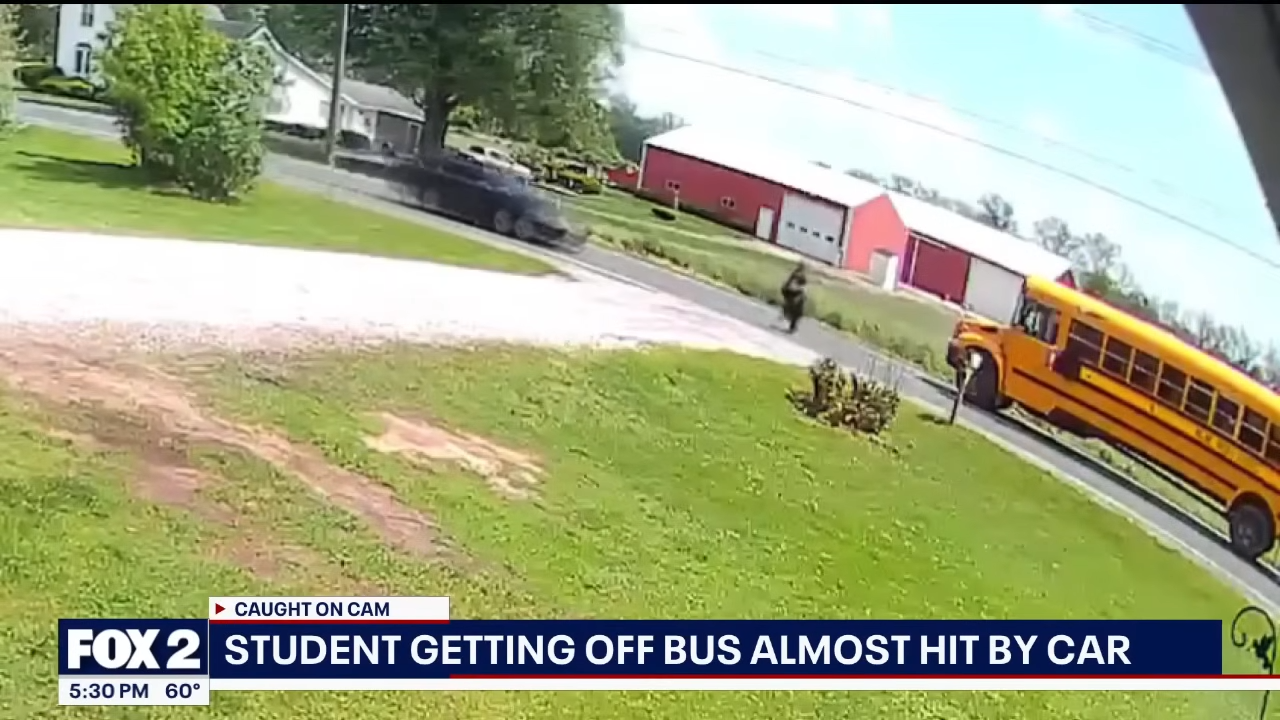
A middle schooler’s walk home from the bus stop turned into a nightmare in broad daylight, and the whole thing was caught on a grandfather’s Ring camera. The incident is raising serious questions about driver behavior, school bus safety equipment, and whether Michigan is doing enough to protect kids at one of the most dangerous moments of their day.
It happened around 3:00 p.m. on a Tuesday in Milan, Michigan, a small community in Monroe and Washtenaw counties southeast of Ann Arbor. An 11-year-old boy had just stepped off his school bus and needed to cross the street to get home. The bus had its flashing red lights activated and its stop sign arm extended, meaning every driver in the area was legally required to stop. Most did. One did not.
A driver veered around other stopped cars and barreled past the bus, barely missing the child as he crossed the street. The boy, startled and frightened, grabbed his chest. His grandfather, William Swope, was watching the video footage afterward and could hardly believe what he was seeing. What should have been a routine Tuesday afternoon almost ended in tragedy because one person simply could not wait.
The story caught the attention of local Fox 2 News, who interviewed Swope on the very street where it happened. His message was not just about anger at one reckless driver but a broader plea: if the bus had had exterior cameras, police might have been able to identify the vehicle and hold the driver accountable. Right now, all investigators have to work with is a description. The vehicle appeared to be a dark-colored Chevy Malibu with tinted windows. That is not a lot to go on.
What Happened, and Why the Bus Cameras Matter
The Milan Area Schools superintendent released a statement saying the district is working closely with law enforcement and calling the incident completely avoidable, urging drivers to stay alert and follow the law whenever a school bus is nearby. The district also confirmed something that makes this situation even more frustrating: none of their school buses are currently equipped with exterior cameras, though they are hoping to secure funding to change that.
That funding gap is not unique to Milan. Exterior stop-arm cameras cost money that many districts simply do not have in their budgets, and without them, identifying a driver who illegally passes a bus becomes nearly impossible unless someone just happens to have a Ring doorbell camera pointed at the right spot at the right time. In this case, that is exactly what saved any chance of accountability.
Swope made the point clearly in his interview: cameras on every bus should not be optional. They should be standard. When your grandson is standing in the middle of a road and a car is flying past him at speed, a description of the vehicle color is not justice.
This is Not a Rare Problem. It Happens Millions of Times a Year.
If you think this kind of thing is unusual, the data will change your mind fast. According to the National Association of State Directors of Pupil Transportation Services, there were approximately 43.5 million school bus stop-arm violations throughout the 2022-2023 school year across the United States. That works out to a staggering number of moments where a child crossing the street was at risk because a driver simply did not want to wait.
According to one senior transportation official at Student Transportation of America, data from buses equipped with cameras showed that any given school bus was being illegally passed an average of five times per day, a number he called “astounding.”
The most recent 2025 survey does show some progress: estimated violations dropped about 13 percent compared to the prior year, falling from roughly 45 million to 39 million annually. Researchers credit increased enforcement, stiffer penalties in some states, and the growing use of automated stop-arm camera programs for the improvement. Still, 39 million violations in a school year is not a success story. It is a crisis that happens to be slightly less catastrophic than it was before.
Notably, the worst time for stop-arm violations is between 3:00 and 4:00 p.m., which is almost exactly when the Milan incident occurred. Afternoon dismissal is consistently the most dangerous window for students exiting buses.
What Michigan Law Actually Says About This
Michigan has clear rules on the books. Drivers are prohibited from passing a school bus that is stopped with its red lights flashing and must stop at least 20 feet away, remaining stopped until the lights are turned off or the bus begins moving again.
The penalties, however, may not feel like much of a deterrent. Failing to stop is classified as a civil infraction with fines ranging from $100 to $500, though if someone is injured or killed as a result, the charges escalate dramatically, with a death resulting in a felony punishable by up to 15 years in prison and a $7,500 fine.
Michigan lawmakers have been working to close some gaps. Late in 2024, the state legislature passed a package of bills allowing school districts to receive a portion of fines collected through stop-arm camera violations, with the money directed back to schools for transportation safety purposes. The idea is to give districts a financial incentive to invest in camera systems while also using the footage to actually catch and fine violators. It is a step in the right direction, though it only helps districts that can afford the cameras in the first place.
What We Can Learn From This Incident
The Milan incident is a useful case study in how multiple things have to go right just to protect one child on one afternoon. The bus driver cleared the student to cross. The flashing lights were on. The stop sign was extended. Most drivers stopped. And still, it nearly ended in disaster.
A few lessons stand out. First, exterior cameras on school buses are not a luxury item. They are accountability infrastructure. Research shows that 99 percent of drivers who received and paid a ticket for illegally passing a school bus did not do it again. Enforcement changes behavior, but enforcement requires evidence, and evidence requires cameras.
Second, the 3:00 p.m. window is dangerous every single day, not just when something goes wrong. Parents, communities, and local governments should treat afternoon bus dismissal with the same caution they give school zones in the morning.
Third, and perhaps most importantly, no law or camera replaces basic human awareness. The driver in Milan did not fail because the system lacked enforcement. They failed because they made a choice to go around other stopped cars and speed past a bus with its lights blazing. That is not distraction. That is indifference.
William Swope said it best: he is not just upset about what happened to his grandson. He does not want it to happen to any other child. That instinct, to turn a personal scare into a push for change, is the kind of community advocacy that actually moves school boards and legislators to act. The Ring camera caught a close call. What happens next is up to everyone else