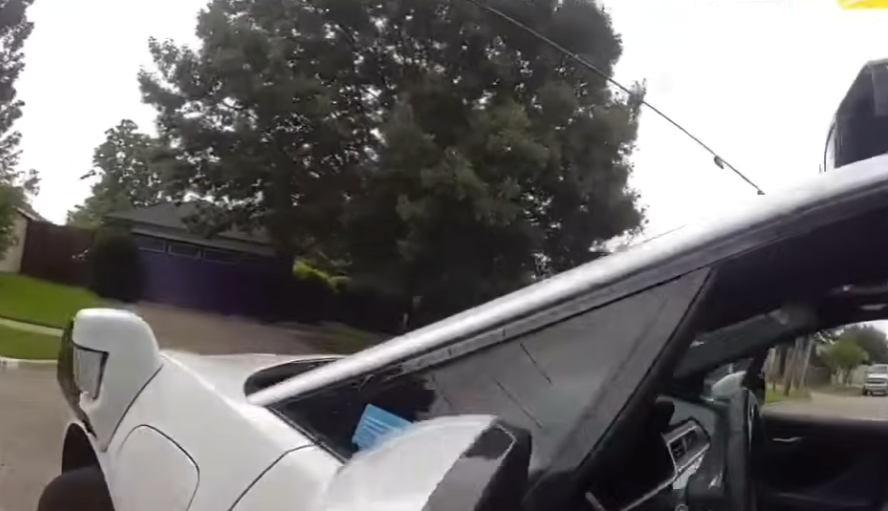
When a five-alarm fire tore through an Oak Cliff apartment complex last week, the immediate concern was getting fire engines to the building fast enough to matter. Three people had died, five others were injured, and more than 100 firefighters were converging on The Clyde apartments near East 9th Street and North Patton Avenue. Every second counted, and a driverless robotaxi was sitting sideways in the road.
Dallas County Precinct 5 Deputy Constable Jonathan Banda was among the first law enforcement officers on scene. His body camera captured what followed: a prolonged, increasingly urgent negotiation with an empty Jaguar I-Pace wearing Waymo branding. Banda tried shouting at it.
He tried reaching in and grabbing the steering wheel. He pressed a button for rider support and waited over a minute for anyone to respond. When a remote Waymo employee finally came on the line and was told there was a fire around the corner and the vehicle was blocking the roadway, the employee’s assessment was that the system was experiencing “a minor issue.”
It would be another two minutes and eight seconds after that contact before Banda was actually given manual control of the vehicle. From first approach to the moment he could drive the car clear, roughly three and a half minutes elapsed. In the arithmetic of emergency response, that is a long time. Fire can double in size in under a minute. The roadway did remain passable to other traffic during the standoff, as Waymo later noted, but the truck access Banda was trying to secure was the whole point of being there.
Waymo’s official response described the vehicle as mid-three-point-turn when Banda approached, yielding to passing traffic as designed. The company maintains that safety is its foundational priority and that its vehicles are specifically designed to work with law enforcement and emergency responders. Whether the outcome here reflects that design working as intended is a reasonable question.
What the Body Camera Actually Showed
Banda can be seen in the footage approaching the empty Waymo as it sits sideways in the street, repeatedly telling the car to move before reaching in to grab the steering wheel, eventually connecting to driver support through the vehicle’s own interface. The scene reads less like a technology demonstration and more like a driver’s ed instructor trying to reason with a student who has completely shut down.
Waymo’s position was that the vehicle was completing a three-point turn to leave the area as other cars were doing, while yielding to passing traffic. That explanation is technically coherent. It is also the kind of answer that makes perfect sense on a whiteboard and somewhat less sense when you are standing in the street watching smoke rise a block away.
This Is Not an Isolated Event
The Dallas incident did not happen in a vacuum. In early March, a Waymo vehicle briefly blocked Austin ambulance crews responding to a mass shooting near a popular entertainment district, coming to a sideways stop in the road as an ambulance approached with lights flashing. An Austin police officer had to enter the vehicle and drive it into a nearby parking garage to clear the way.
Austin first responders subsequently brought their concerns to city leaders, with council members noting the need for greater transparency and accountability from Waymo and other autonomous vehicle operators. The pattern is consistent enough that it has drawn attention at the federal level as well.
California’s Department of Motor Vehicles responded to the mounting complaints by issuing regulations requiring autonomous vehicle operators to respond to first-responder calls within 30 seconds, and granting emergency personnel the authority to issue directives requiring autonomous vehicles to vacate an emergency area within two minutes.
A 2023 San Francisco report documented 50 written police reports involving Waymo or Cruise autonomous vehicles alongside nearly 600 incidents of unexpected stops between 2022 and 2023, with documented examples including blocking fire station entrances, obstructing emergency vehicles in transit, and disrupting active police operations.
The Technology Gap That No Press Release Fixes
Dr. Gopal Gupta, co-director of the Center for Applied AI and Machine Learning at UT Dallas, offered a straightforward explanation of what is actually happening in these situations. When an autonomous vehicle encounters a scenario outside its trained parameters, it does not improvise.
According to Gupta, the vehicle simply does not recognize the situation it is in and does not know how to react, so in many cases it just stops. He also noted that a single human monitor is responsible for overseeing a large number of robo-taxis simultaneously, meaning the remote assistance response is not always immediate.
That ratio matters. The remote support model works reasonably well when a vehicle is confused by an unusual lane marking or an unexpected detour. It works considerably less well when there is one monitor covering dozens of vehicles and one of those vehicles has just stopped in the path of fire engines responding to a gas explosion.
What Waymo Says It Is Doing About It
Waymo has consistently maintained that it trains first responders on how to interact with its vehicles and that it has a dedicated team for that purpose. Following the Austin incident, the company stated it had answered all questions from city leadership related to emergency response protocols, provided a detailed confidential overview including lessons learned, and committed to planned operational improvements.
That is a reasonable institutional response. The more pointed question is whether the improvements are keeping pace with deployment. Waymo is expanding into new cities at a meaningful clip, and each new market means more first responders who have never encountered one of these vehicles before, encountering one for the first time in the worst possible circumstances.
Deputy Constable Banda said plainly that he had never had to deal with a vehicle nobody was driving, and had no idea what to do. That is not a criticism of Banda. It is a description of a training gap that exists at scale. A technology that requires law enforcement to already know the manual override procedure to function safely in emergencies is a technology that still has some distance to travel.