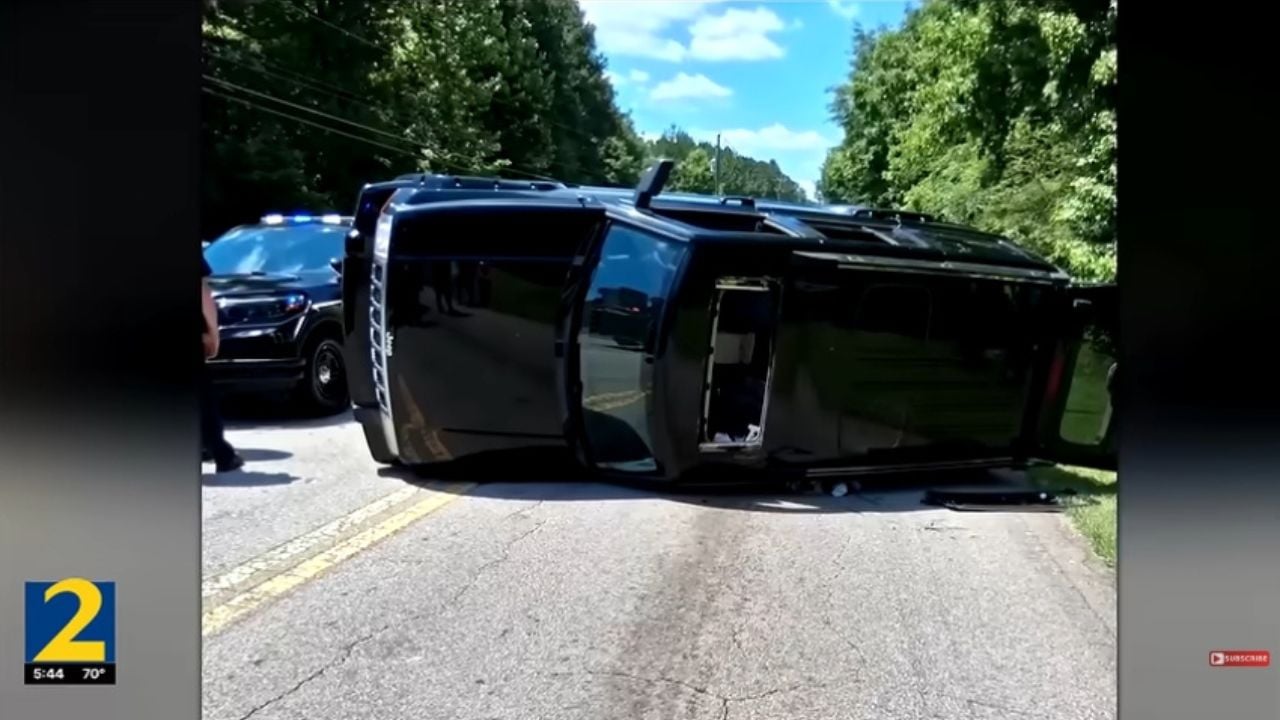

In Austell, Georgia, a father’s decision to avoid a traffic checkpoint sent his SUV flipping onto its side with four children unrestrained inside. The incident, captured on dashcam, naturally stroke a furious debate over police tactics and parental responsibility.
Carlos Rubio now faces charges including child endangerment and aggravated assault on an officer. This is even as his wife questions why a PIT maneuver was the first option against a vehicle hiding its youngest passengers behind tinted windows.
The case lays bare the violent collision between a man’s fear of the law and the law’s determination to enforce it. The footage shows the Jeep approaching a clearly advertised safety checkpoint, the kind the Supreme Court has upheld as constitutional under Georgia law.
Rubio chose to turn away, a maneuver that, under Georgia statute, grants officers reasonable suspicion to initiate a stop. What followed was a three-minute pursuit where the driver passed the police department entrance and activated his hazard lights, yet never yielded. The chase ended when the PIT maneuver spun the Jeep, leading to a rollover that trapped the children inside the wreckage.
A Father’s Flight or a Desperate Gamble
For Rubio’s family, the narrative is one of terror, not defiance. His wife, Denise Camacho, insists he believed the roadblock was a closure for an accident and that past negative encounters with police drove his fear of stopping immediately.

She claims he was heading to the police station to surrender safely, prioritizing a controlled surrender over a roadside confrontation. Yet the reality of his actions contradicts a plan for safety: he fled, drove erratically, and failed to secure his children.
The police point to the man’s record. Rubio had an active warrant for violating probation, a detail that paints his flight as an attempt to avoid capture. The officers on the scene were blind to the cargo.
The heavily tinted windows that hid the children from view meant the police were acting without the knowledge that their tactic would risk the lives of four minors. The department argues that the true threat to the children was the father himself, whose reckless flight forced their hand.
Police policy in Cobb County allows pursuit under certain risk conditions. Officers stated that the presence of a warrant and failure to stop influenced the officers’ actions. The use of PIT ended the movement of the vehicle in a short span of road distance.
Still, the rollover raised questions about the timing of the maneuver. Review of body camera and dash footage will consequently be part of internal evaluation. Officers stated that child passengers were not known at the moment of contact.
The Checkpoint Controversy and Police Defense
Comment sections have erupted, mirroring a split in public opinion. Many viewers see a simple case of cause and effect, with comments like “@UberBri” asserting, “Can’t blame the police if someone doesn’t follow the law.”
Others question the legality of the stop itself. The debate hinges on the nature of checkpoints; while declared constitutional, users like “@MoralisAndCoMechanics” argue they constitute an “unconstitutional traffic road block,” and “@mikepsly73” claims drivers have a right to avoid them.
Austell Police Captain Tim Allen defended the actions, stating, “The only person that knew there were children in that car… was the driver”. The department maintains that a stop at the checkpoint would have resulted in a simple call to the mother to bring car seats, avoiding the entire catastrophe.
They stress that the pursuit was justified by Rubio’s escalating risk to the public, a risk the police were duty-bound to end. Rubio faces charges that include child endangerment and assault on law enforcement. The warrant tied to probation violation remains part of the case record.
His family said Rubio believed the turn related to a road closure or checkpoint notice. His wife stated he intended to travel to a police station later. Their story, however, differs from the police account of what happened before the stop.
The children received medical care after the crash. Reports from family sources describe fear linked to vehicles and sirens after release from treatment. No trial outcome or new court resolution has been reported in current coverage.
The PIT Maneuver Under the Microscope
The central question remains: was the PIT maneuver an appropriate response to a driver trying to avoid a checkpoint? Police policy allows the tactic when officers can “articulate risk to the public”.
In this case, they cited his reckless driving and speed. However, the maneuver has a history of legal scrutiny. Courts have classified it as deadly force when it creates a “substantial risk of causing death or serious bodily injury,” particularly with children inside.
The internal review, which includes reports, body camera footage, and witness statements, is now the battleground for accountability. The family grapples with the trauma of children now terrified of sirens, while critics demand to know why a high-risk takedown was prioritized over continued surveillance.
As the review unfolds, the case stands as a stark example of how one man’s poor judgment and a police pursuit can lead to an outcome where the youngest and most vulnerable pay the heaviest price.