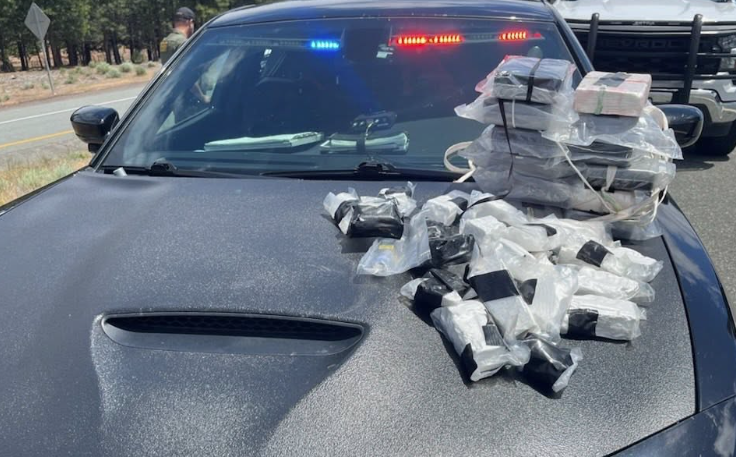
A routine mechanical violation stop on northbound Interstate 5 near Weed, California, turned into one of Siskiyou County’s most significant drug interdiction seizures in recent memory. On May 29, 2026, just before noon, a Siskiyou County Sheriff’s deputy pulled over a 2022 Mazda CX-5 for a mechanical violation — a stop that, on the surface, looked like any other traffic enforcement encounter. What followed was a textbook example of how thorough law enforcement procedure can unravel a much larger operation hiding in plain sight.
The driver, 32-year-old Salvador Roy Najera, Jr., was found to be unlicensed and, according to the sheriff’s office, displaying what deputies described as multiple criminal indicators. That combination – no license, observable behavioral cues – gave the deputy sufficient grounds to conduct an inventory search of the vehicle.
During that search, something about the car’s interior geometry didn’t add up. The deputy observed signs of an aftermarket false compartment, the kind of modification that does not come from the factory floor of any Mazda plant.
At that point, the Siskiyou County Sheriff’s Office called in backup from the Mount Shasta Police Department, which arrived with a narcotics detection K-9. The dog did its job without hesitation, alerting positively to the presence of narcotics in the vehicle.
With that confirmation in hand, deputies breached the compartment. Inside, they found 18 kilograms of cocaine, valued at $1.9 million. Najera was placed under arrest and booked into the Siskiyou County Jail, where he is currently being held on $100,000 bail.
The charges he now faces paint a fairly complete picture of what deputies believe was going on: possession of a controlled substance, smuggling a controlled substance into a correctional facility, transportation of a controlled substance, possession of a controlled substance for sale, and use of a false compartment to conceal a controlled substance. The investigation remains ongoing.
The CX-5 Was Not the Only Thing That Didn’t Add Up
The Mazda CX-5 is a compact family crossover. It is not a vehicle most people associate with anything other than grocery runs and school pickups. That, of course, is precisely the point. False compartments installed in everyday, unremarkable vehicles are a long-established tactic in drug trafficking operations.
Smugglers often modify vehicle body panels to create hidden spaces for storing drugs, and in larger vehicles, traffickers may build false floors or ceilings, often by removing original floorboards or ceiling panels and replacing them with hidden panels. In smaller vehicles, the work is more compact, but the goal is the same: make a car look like every other car on the road.
Under California law, the use of a false compartment to conceal a controlled substance is its own separate charge under Health and Safety Code 11366.8 HS, and it can be prosecuted as either a misdemeanor or a felony depending on the circumstances. Combined with transportation and possession-for-sale counts, a conviction on all charges in this case would carry serious consequences well beyond simple possession.
Interstate 5 Is No Stranger to This Kind of Traffic
This case did not happen in a vacuum. Greater use of Interstate 5 as a drug trafficking corridor has resulted in increased drug availability across nearly every county in Northern California, and law enforcement agencies along the route have responded accordingly.
Interstate 5 is routinely targeted by federal and state task force operations stopping vehicles suspected of carrying drugs northbound. Siskiyou County sits squarely in the middle of that corridor, making it a natural pressure point for interdiction efforts.
This was not even the first significant cocaine seizure along this stretch of I-5 in 2026. In April, a California Highway Patrol officer in the Yreka area conducted an enforcement stop on a vehicle traveling northbound on Interstate 5 and, upon contacting the driver, observed multiple signs of criminal activity.
A search turned up 20 kilos of suspected cocaine in a hidden compartment behind the rear passenger seats. Two major cocaine seizures on the same highway corridor within roughly six weeks suggests the route is actively being used, and actively being watched.
What a Mechanical Violation Actually Gets You
It is worth noting what started all of this: a mechanical violation. Not a high-speed chase, not a tip from an informant, not a multi-agency surveillance operation. A deputy spotted something wrong with the vehicle and made a stop. From there, the deputy’s training and attention to detail did the rest.
This is a dynamic car enthusiasts should recognize. Anyone who has spent time at a track day or worked on their own vehicles knows how much information a car’s exterior and interior can communicate to a trained eye. Deputies are looking for different things than a mechanic would, but the principle holds.
Behavioral cues, interior irregularities, and aftermarket modifications that do not quite match the vehicle’s original spec are all things that can stand out to someone who knows what factory-spec looks like. In this case, those observations translated directly into one of the larger cocaine seizures the county has recorded.
A $1.9 Million Seizure and a Reminder That Big Busts Start Small
Law enforcement tends to get credit for the headline number, and $1.9 million is a number that earns headlines. But the actual work behind this seizure was methodical and procedural, not dramatic. A deputy observed a mechanical issue, conducted a lawful stop, noticed something off during an inventory search, called for a K-9, and followed the evidence. Each step followed logically from the last.
Drug trafficking charges in California are based on transportation – moving drugs across state or national borders, often in large quantities – and are typically prosecuted as felonies, with fines ranging from $20,000 to $500,000 depending on the type and quantity of drug involved. Najera faces all of that and more.
The investigation is ongoing, which suggests authorities believe there may be more to the story than one driver and one modified crossover on a California freeway.