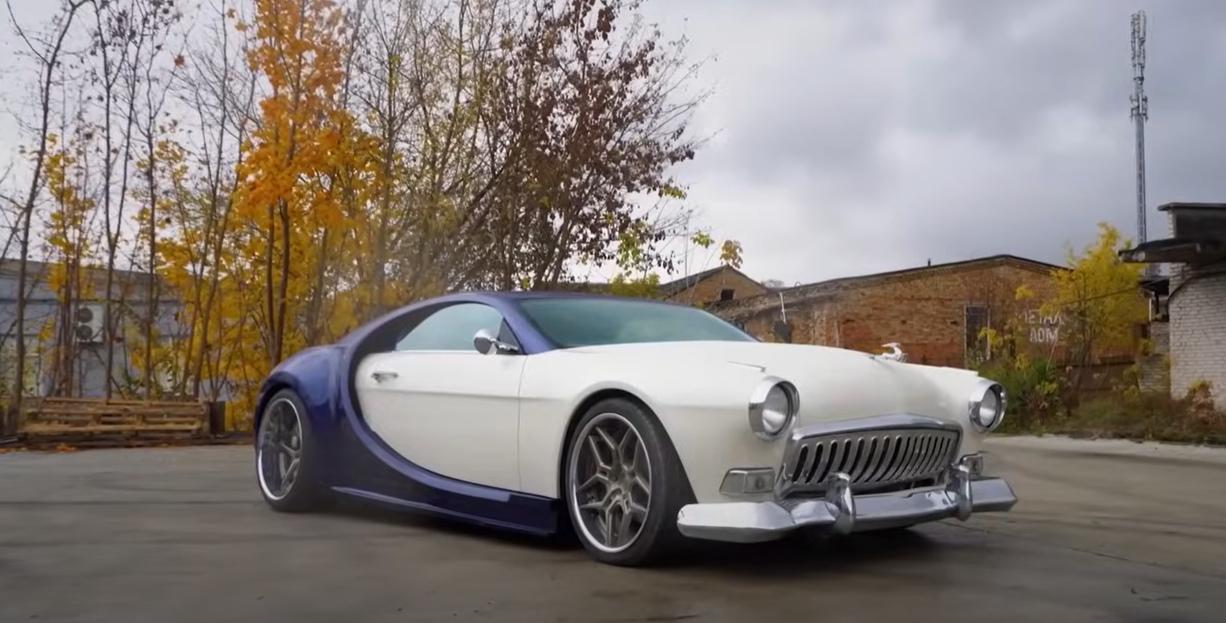
Imagine taking two beat-up cars, one a Soviet-era relic, the other a wrecked BMW, and reshaping them into a street rod that channels the look of a million-dollar hypercar. Sounds impossible, right?
Not for the team at Axes: Garage. In a jaw-dropping feat of engineering, they merged a GAZ-21 Volga with a BMW 6-Series to create a Bugatti-inspired custom build. The result? A one-of-a-kind machine that blends vintage charm with modern performance.
How It Started
Every great custom build starts with an idea, and sometimes, that idea is as simple as a picture. For the team at Axes: Garage, the spark came from a quirky render they stumbled across online: a Volga mashed up with a Bugatti Veyron. At first, it was just a thought experiment. What if you could take a Soviet relic and cross it with one of the most expensive cars on earth?
That idea became a challenge. Could they actually build a working car in that style? They didn’t have unlimited money or corporate sponsors, just a workshop, determination, and a deep love for cars.
The first donor car was a $100 Ford Probe, bought in pieces. It seemed like a clever budget start, but it quickly became obvious the Probe wouldn’t cut it. The project needed a stronger backbone. That’s when the team bought a battered GAZ-21 Volga for $400 and, later, a wrecked BMW 6-Series E63 for $3,500. With the Volga’s iconic face and the BMW’s modern running gear, the foundation for their dream was set.
Stripping It All Down
The early months were all about experimentation. Foam models were milled, molds were shaped, and body panels were hand-laid in fiberglass. Every curve of the future car had to be sculpted by hand before it could be turned into something solid.
By mid-2021, the team had already sunk thousands into labor and workshop rent. Within a year, the bills had climbed steeply. The builders weren’t deterred. This is about proving what was possible with enough grit and imagination.
Building a Bugatti-Inspired Body
One of the biggest hurdles was marrying the Bugatti-inspired shape with the Volga’s old-school lines. Two roofline designs were considered: one with the Volga’s roof (which gave it a quirky Porsche-like vibe) and one that mimicked the Bugatti Chiron’s flowing arch. They chose the latter, locking in the sleek, futuristic silhouette.
The rear bumper was molded separately and integrated later. The spoiler was even trickier. Instead of a static design, the builders insisted on creating a fully functional rear wing — just like on a real Chiron. Using linear actuators and countless hours of trial and error, they engineered a system that could lift the spoiler under load. In fact, it was strong enough to hold the weight of a person (as shown in their build videos).
Even small details were treated with seriousness. The car received a working hatch with proper rubber seals and drainage channels, just like an OEM factory build.
Lighting the Way: Custom Taillights and Chrome
Replicating Bugatti-style rear lights was one of the most demanding subprojects. First, master models were carved out of wood. From there, silicone molds were cast and refined until clear, hollow housings could be created. A central marker light, faithful to the Bugatti, was fabricated as well.
According to Axes: Garage’s expense breakdown, the entire taillight process cost about $340 in materials, but weeks of labor were sunk into perfecting them.
Then came the chrome. Original trim was sourced second-hand for a modest $400, but restoration and rechroming cost about $3,500. As the builders later admitted, it might have been cheaper to buy restored parts outright, but the experience was priceless.
Engineering the Underpinnings
Once the BMW donor was ready, the real mechanical work began. The BMW’s drivetrain gave the car modern handling and reliability, but the builders weren’t content to leave it untouched.
- Cooling system: They re-engineered the BMW’s system (documented in their build videos) to fit the Bugatti-style packaging, moving radiators and fabricating new housings.
- Suspension: A full custom air suspension was ordered and installed at a cost of roughly $3,000 (per their expense notes).
- Wheels and tires: No off-the-shelf wheels fit correctly, so a set of forged Power Wheels was custom-ordered for about $4,000, plus $1,000 for tires.
- Frame: A cold-rolled safety frame was fabricated to reinforce the hybrid structure.
By the end of this stage, it had the bones of an actual performance machine.
The Cost of Passion
When all was said and done, the “Volgatti” represented over three years of labor, multiple workshop moves, and tens of thousands of dollars in costs.
By Axes: Garage’s own calculation indicates that the project costs approximately $106,995 in total, with an average of $2,300 per month going to labor and workshop rent. Consumables, chrome work, wheels, suspension, and custom glass added tens of thousands more.
Painting, Polishing, and the Final Touches
By 2024, the car was finally ready for paint. Friends in the industry donated supplies and even a paint booth, helping reduce costs. The final paint job was completed at a professional level, followed by full-body polishing.
Every panel gap was adjusted, every intake grill refined, every seal and hinge tested. By the time the chrome trim went back on, the car looked like a supercar from an alternate universe: sleek, futuristic, but still carrying the DNA of its Volga roots.
The Finished Car: A Street Rod, Not a Replica
When the dust settled, the “Volgatti” emerged as something unique. From a distance, it might trick you into thinking it’s a Bugatti Chiron. Up close, though, the details reveal its true identity: a handcrafted Bugatti-inspired street rod built on BMW bones, with Soviet heritage proudly on display.
It’s not a replica, and it’s not pretending to be. Instead, it’s a one-off tribute to creativity, engineering, and sheer stubborn determination.
Why It Matters
Projects like the Volgatti remind us that cars are art, storytelling, and a testament to human ingenuity. In an age of mass production and digital everything, this three-year build stands as proof that the garage tinkerers and dreamers still have a place in the car world.
The next time someone asks why anyone would spend years turning a Volga and a wrecked BMW into a Bugatti-inspired machine, the answer is simple: because they could.